
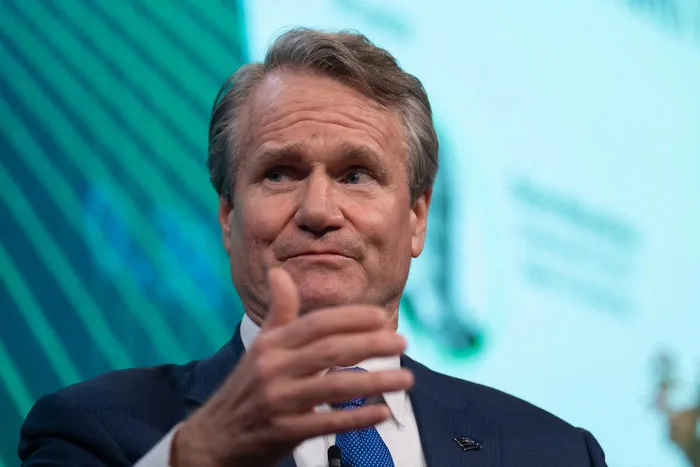
BofA CEO Calls Economy ‘Pretty Solid’ but Warns Consumer Pullback Is Top Risk for 2026

By Tom Ozimek
U.S. economic growth remains on solid footing heading into 2026, but the outlook hinges on whether American consumers continue to spend, Bank of America Chairman and CEO Brian Moynihan said in a recent interview.
“At the end of the day, people are spending. They have good credit quality. They are employed … it’s pretty solid right now,” Moynihan said on “Face the Nation” with Margaret Brennan on Dec. 28, in response to a question about whether a recent dip in consumer sentiment was translating into a spending pullback.
Despite some surveys showing that many Americans remain uneasy about affordability, hard data point to steady spending. Moynihan revealed that Bank of America’s internal transaction data show that consumer spending rose by more than 4 percent year over year during the Thanksgiving-to-early-December period.
“Spending is really solid—reasonably solid—heading into the end of the year, and it’s been kind of going along like that all of December,” Moynihan said, adding that consumers across the entire income spectrum continue to keep their wallets open regardless of the fact that some sentiment surveys show confidence has waned.
Consumer spending powers the economy, accounting for roughly two-thirds of output. Robust spending helped the economy expand at a forecast-beating pace of 4.3 percent in the third quarter, up from 3.8 percent in the prior three-month period.
Moynihan’s remarks suggest growth likely continued at a solid pace through the final quarter of the year—though he cautioned that continued economic expansion depends on consumers staying engaged next year.
“The real question is—will the consumer keep spending in the U.S.?” he said, adding that Bank of America economists now project a 2.4 percent pace of growth for all of 2026, up sharply from a 1.5 percent prediction just four months ago.
“If the consumer becomes less engaged as we move … from ‘25 into ’26 and slows down their spending, that’s going to slow down the economy. So that’s a risk.”
Other risks include geopolitical shocks such as wars and cyber events, Moynihan said. However, he identified consumer strength as the key factor, saying that the primary risk to the economic outlook is whether Americans continue to spend.
Employment and wage trends support the view that consumers are still in good shape, he said.
Unemployment, while rising modestly, remains low by historical standards, and paycheck data show wages growing at roughly a 3 percent pace.
“Four-point-six percent unemployment … is actually a very low unemployment rate, frankly,” he said.
On trade, Moynihan said the uncertainty that rattled businesses earlier this year has begun to ease.
Initial tariff announcements “shocked” small and medium-sized firms grappling with higher borrowing costs and supply chain issues, he said. Since then, however, Bank of America’s outlook has shifted toward de-escalation, with tariffs converging toward a broadly manageable range for most countries.
“It’s starting to de-escalate … broadly in the world, you can see sort of the end point here,” he said, while noting that China remains a separate case due to national security concerns tied to technology and critical minerals.
Small businesses, he said, are now less worried about tariffs and more focused on labor availability, especially amid uncertainty over immigration policy.
Moynihan also addressed concerns about artificial intelligence (AI) and employment, predicting that AI is more likely to boost productivity than trigger mass layoffs.
On housing, Moynihan said elevated mortgage rates and chronic supply shortages are weighing on activity, but he cautioned against viewing lower rates as a cure-all. Building more housing and easing permitting constraints, he said, would do more to improve affordability over time than modest rate cuts.
“The advice I give to anybody is you’re probably not going to see the 10-year [Treasury] rates go down,” he said.
“Our teammates think the Fed funds rate gets the low of three and the tenure rate stays between four and four and a half, which means the mortgage rate won’t be a lot different than this today.
“But if you increase supply, you’ll keep prices flat, and wages will grow through it.”
The Fed funds rate is currently at 3.5–3.75 percent, with markets pricing in two quarter-point reductions in 2026.


More Stories
OpenAI Looking to Hire ‘Head of Preparedness’ to Tackle AI Dangers
By Naveen Athrappully OpenAI is seeking to hire a candidate for the post of “Head of Preparedness” to tackle dangers...
Washington Offers 15-Year Security Guarantee to Ukraine as Part of Peace Plan, Zelenskyy Says
By Guy Birchall Washington has offered a 15-year security guarantee to Kyiv as part of a proposed peace plan, Ukrainian...
Kremlin Says Ukraine Tried to Attack Putin’s Residence, Peace Deal Stance Under Review
By Jack Phillips Ukrainian forces attempted to strike Russian President Vladimir Putin’s residence in the Russian city of Novgorod on...
Top 10 Investment Accounting Software & Other Related Software
Managing complex investment portfolios can be hectic most of the time, as a small mistake can lead to a huge...
Top 10 Richest K-Pop Idols in 2026
Do you also like K-pop or Korean pop? Then this article is for you. Let’s start. In this blog, you...
Over-the-Counter Medicines, Other Items Recalled Over Feces Contamination: FDA
By Jack Phillips The U.S. Food and Drug Administration (FDA) late last week announced that a distributor is recalling its...