
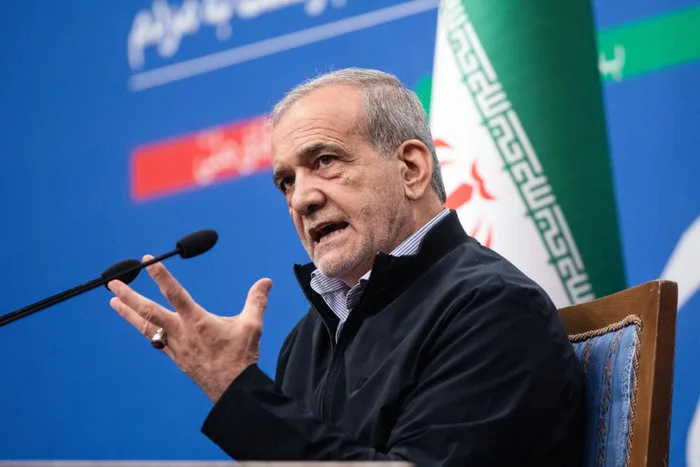
Iranian President Says His Country in ‘Full-Fledged War’ With US, Europe, and Israel

By Jack Phillips
Iranian President Masoud Pezeshkian said Saturday that the Iranian regime is in a full-scale war with the United States, Europe, and Israel—months after his country’s nuclear facilities were bombed during a 12-day-long aerial war.
Pezeshkian said in a Dec. 27 interview released on the website of the country’s leader, Ayatollah Ali Khamenei, that the war is worse than the Iranian conflict with Iraq that began when then-Iraqi dictator Saddam Hussein invaded Iran in 1980 and that lasted throughout the decade.
“In my opinion, we are in a full-fledged war with America, Israel, and Europe; they do not want our country to stand on its feet,” Pezeshkian said. “This war is worse than Iraq’s war against us; if one understands it well, this war is far more complex and difficult than that war.”
Pezeshkian said the West’s war against Iran is “more complicated and more difficult” compared to the 1980–1988 war with Iraq that left more than 1 million casualties on both sides and included reports of chemical weapon and gas attacks.
The remarks were made two days before U.S. President Donald Trump is scheduled to host Israeli Prime Minister Benjamin Netanyahu.
The U.S. and Israeli militaries both launched strikes on Iranian nuclear facilities and other areas during a nearly two-week-long conflict in June. Iran launched a barrage of missiles at Israel and at a U.S. air base in Qatar in response.
The Trump administration and Israeli officials have long said the Iranian regime is seeking to manufacture nuclear weapons and long-range missiles with its nuclear program.
In mid-November, Iranian Foreign Minister Abbas Araghchi said that Tehran is no longer enriching uranium at any site in the country, giving the most direct response yet from the Iranian government regarding its nuclear program following the June bombing of its enrichment sites.
“There is no undeclared nuclear enrichment in Iran. All of our facilities are under the safeguards and monitoring” of the International Atomic Energy Agency (IAEA), Araghchi told The Associated Press last month. “There is no enrichment right now because our facilities—our enrichment facilities—have been attacked.”
The minister then reiterated Iran’s longtime narrative that its nuclear program is for peaceful purposes, which the United States, Israel, and the United Kingdom have all refuted. The United Nations’ nuclear watchdog, the IAEA, has long said that Iran has displayed a lack of transparency around its program and restricted international inspectors from monitoring the country’s facilities.
“We have this right, and we continue to exercise that, and we hope that the international community, including the United States, recognize our rights and understand that this is an inalienable right of Iran. And we would never give up our rights,” Araghchi said.
Iranian nuclear chief, Mohammad Eslami, recently prohibited officials from the IAEA from inspecting the bombed nuclear facilities.
Eslami was quoted by state-run media outlet IRNA on Dec. 24 as saying that the inspections will not happen because the IAEA did not establish any guidelines for conducting them.
The Associated Press contributed to this report.


More Stories
Border Czar: ICE to Assist at Airports Until They Are 100 Percent, TSA Pay Coming This Week
By Tom Gantert White House border czar Tom Homan said Sunday that ICE agents will be used to help out...
Trump Signals Potential Military Action Coming Against Cuba
By Jack Phillips President Donald Trump again suggested that U.S. military action could be coming against Cuba as his administration...
US Monitoring Surge in China’s Detention of Panama-Flagged Vessels
By Aldgra Fredly The U.S. Federal Maritime Commission on March 26 accused China of detaining Panama-flagged vessels in response to...
FBI Director Kash Patel Hacked by Iran-Linked Group
By Jacki Thrapp FBI Director Kash Patel’s personal email inbox was accessed by Iran-based hackers. “The FBI is aware of...
Block CFO Defends Job Cuts Due to AI Adaptation; Silicon Valley Executives Predict Increased Mass Layoffs
By Dylan Morgan Block’s Chief Financial Officer and Chief Operating Officer Amrita Ahuja defended the San Francisco-based payments company’s mass...
Houthis Enter Iran War With Missile Attack on Israel
By Tom Ozimek A spokesman for the Iran-aligned Houthi terrorist organization in Yemen said on March 28 that the group...