
After end of MCAS requirement, Massachusetts seeks new graduation standards

Massachusetts started 2025 scrambling for a replacement to the voter-overturned MCAS graduation standard, and after months of looking for new standards, a first look at a replacement began to take shape as the year came to a close.
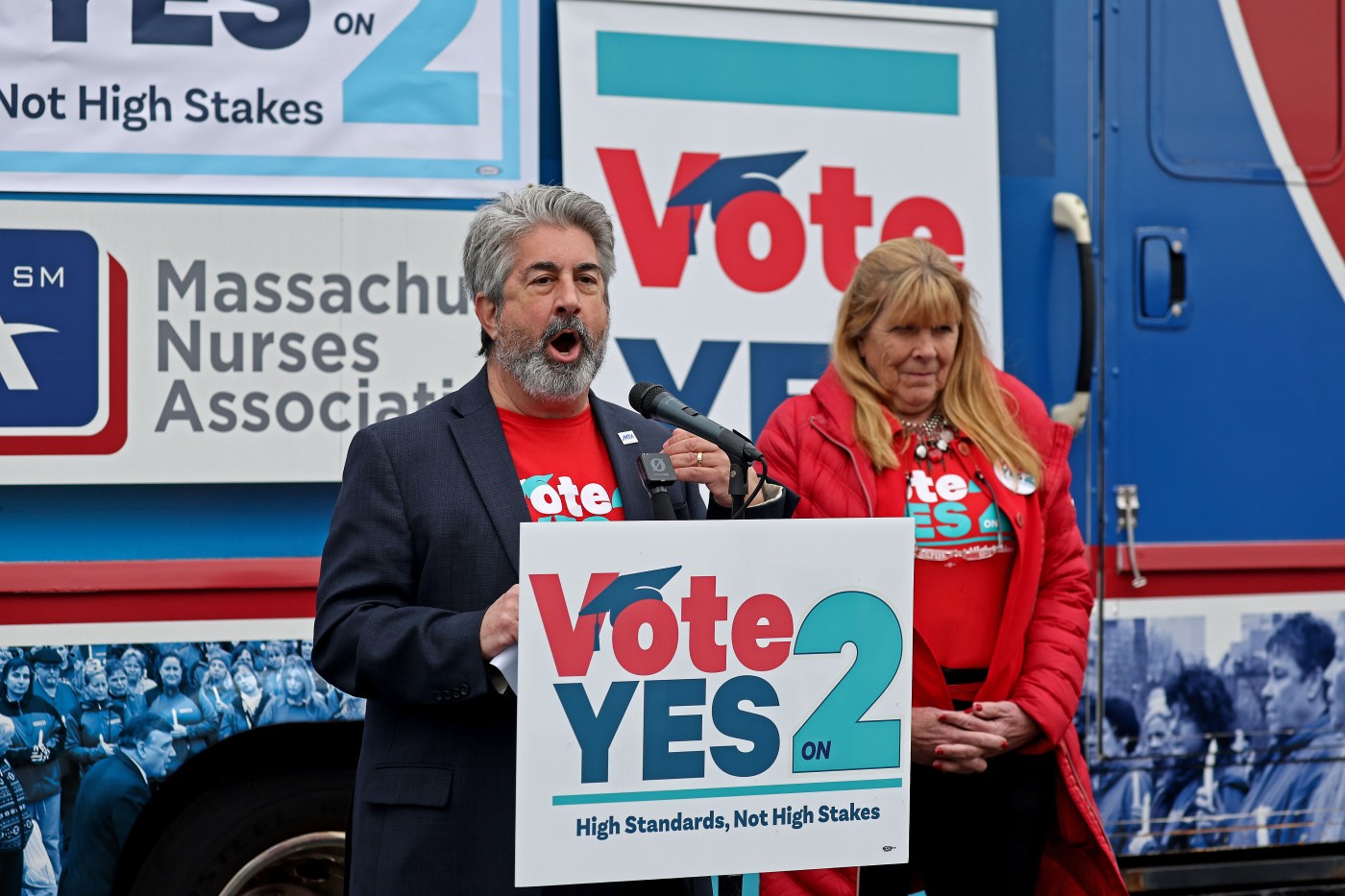
Voters threw out the long-contested MCAS graduation requirement — a staple of the state’s public schools since 2003 — in the November 2024 general election, passing the teachers union-backed Question 2 with nearly 60% of the vote.
Students would continue to take the test as a diagnostic tool, but graduation standards were to be set by local school districts based on the “completion of coursework,” the ballot question stated.
By the next day, the state education department released its first guidance on new the graduation standard — referred to as a competency determination (CD) — for districts, saying students who had not passed the MCAS would be eligible to graduate based on the the local districts’ coursework standards as of 2025.
DESE stated on Nov. 7 that more detailed guidance on certification would be “forthcoming,” setting to work in regular meetings on new interim standards for the fast approaching graduation season.
In her State of the State speech in January, Gov. Maura Healey looked to a more permanent solution, announcing a K-12 Statewide Graduation Requirement Council made up of teachers, colleges, employers and more to find a replacement for MCAS.
“We need a high statewide standard,” said Healey, who opposed Question 2 during the campaign. “Students, families, and employers need to know what a diploma represents, and without that baseline, you know what happens? It’s always going to be the most vulnerable students who don’t get what they need.”
MTA leaders supported the council approach at the time, noting the need for a “public process for shaping a shared vision for educating and supporting our students.”
In February, the state education board took a long-awaited step forward on temporary graduation requirements in the meantime, laying out a new proposal related to coursework completion.
The interim standard would require students “show mastery” — like completing a final or capstone project — in English, Math and Science and complete certain courses-requirements in the three subjects starting with the class of 2026. The class of 2027 on would be required to compete a course and show mastery in U.S. History.
The board voted to advance the proposal and begin public comment, with one controversial caveat including an option to use the MCAS test.
The option allowed students in special circumstances, like homeschooling or transferring from abroad, to use the MCAS as a substitute for the course-work requirements. One board member also pushed to have the public consider an option to use the test as an interim alternative for those who don’t meet the coursework standard, noting “you’re sitting there taking the 10th grade MCAS anyway.”
Board member Matt Hills said the MCAS path might not be necessary in a few years, but it “certainly behooves us to have some backup plan for the circumstances we haven’t been able to capture yet and think of yet.”
On May 20, the Board of Elementary and Secondary voted 8-1 to advance the interim regulations, with DESE stating the new policy would “serve as a bridge” to a permanent solution. The interim policy kept the allowance for the limited use of MCAS.
The MTA stated it was “adamantly oppose(d)” to the continued MCAS used, adding it “could allow districts to put more focus on test preparation than on diversified, high-quality teaching.”
In September, the Healey administration released a “vision” for a Massachusetts high school graduate, laying out six bullet points as a roadmap for the goals of the graduation standards.
As stated in the “vision,” state high school graduates are academically prepared, critical problem-solvers, self-aware navigators, intentional collaborators, effective communicators, and responsible decision-makers.
Days after the administration’s release, the 2025 MCAS results came out, the first results without the added pressure of the graduation requirement.
The overall mixed results showed a continued lag behind pre-pandemic performance and sobering dips for 10th graders in math and English, with only 51% meeting or exceeding expectations in English and 45% in Math.
In October, the first glimpses of the Statewide K-12 Graduation Council work on new permanent graduation standards emerged as an unfinished draft.
The preliminary draft sparked renewed debate by including a new testing component, this time in the form of “end-of-course assessments” (EOCs) tied to classes.
On Dec. 1, the final version released by the Statewide Graduation Requirement Council kept the controversial provision among a comprehensive overview of the proposed permanent requirements — a “first step” towards a permanent framework, state officials said.
“No other state will have implemented such a comprehensive approach to setting such high standards in education, and it does this without relying on high stakes testing,” the Healey-Driscoll administration said with the release. “No single test will represent a barrier to graduation for any student, and the 10th Grade MCAS exam would be phased out as part of this new framework.”
Along with the end-of-course testing, the over 100-page interim framework includes curriculum requirement based on the current MassCore standard; a capstone or portfolio requirement defined by the state but administered locally; and future-focused requirements related to career and academic plans, financial literacy, and FAFSA.
The testing requirement would be connected to specific courses and “designed, administered, and scored by the state, promoting a uniform standard across Massachusetts,” the framework said. They would be used for courses like Algebra I, English Language Arts, Science and Social Studies.
The initial report stated it is “not the intention for any student to be denied a diploma because of EOC assessments,” noting the need to examine the “weight and role” of the assessments.
The MTA and others have staunchly opposed the inclusion of a testing requirement for graduation.
“Including state-developed and graded end-of-course exams in a set of new proposals for high school graduation requirements poisons a once-in-a-generation opportunity for stakeholders to come together and remake the high school experience for our students,” MTA President Max Page and Vice President Deb McCarthy said.
The report states EOCs have “gained attention as an alternative to exit exams” and are now used by seven other states.
Related Articles
Oklahoma college instructor is fired after giving failing grade to essay on gender
Student loan borrowers in default may see wages garnished in 2026
Boys at her school shared AI-generated, nude images of her. After a fight, she was the one expelled
Rural schools hit by Trump’s grant cuts have few options for making up for the lost money
Boston School Committee votes to close 3 schools in 2027
While the statewide council contributed to the draft and will seek public input in the coming month, Education Secretary Patrick Tutwiler and DESE Commissioner Pedro Martinez will “refine” the report and issue the final graduation requirement framework.
“Our aim is to develop a graduation framework that honors the diversity of our students and schools, supports innovation, upholds Massachusetts’ legacy as a national leader in education, and keeps all postsecondary doors open for our graduates,” Tutwiler and Martinez wrote in the December report.
The final report is expected to be released in June 2026.


More Stories
Fuentes de AP: Rams apuntalan su secundaria con canje por el esquinero estelar Trent McDuffie
Por GREG BEACHAM LOS ÁNGELES (AP) — Los Chiefs de Kansas City y los Rams acordaron un canje que enviará...
Man dies after being trapped under snow groomer north of Duluth
St. Louis County authorities on Wednesday identified a man who died after becoming trapped under a snow groomer. On Tuesday,...
Boca se aprovecha de la resaca de Lanús y lo golea 3-0 en La Fortaleza
Por MARCELO R. ANDROETTO BUENOS AIRES (AP) — Con su mejor actuación en mucho tiempo, Boca Juniors goleó el miércoles...
Celtics blown out by red-hot Hornets in potential playoff preview
Depending on how the Eastern Conference standings shake out over the final six weeks of the regular season, the Celtics...
Cómo llevar conversaciones con niños sobre guerras, conflictos y otros eventos traumáticos
Por CHEYANNE MUMPHREY Los niños que viven la guerra más reciente en Oriente Medio o que ven imágenes del conflicto...
Last 2 names of 6 US soldiers who died in Kuwait attack identified by the Pentagon
By HANNAH FINGERHUT, KONSTANTIN TOROPIN and REBECCA BOONE WEST DES MOINES, Iowa (AP) — The last two names of the...