
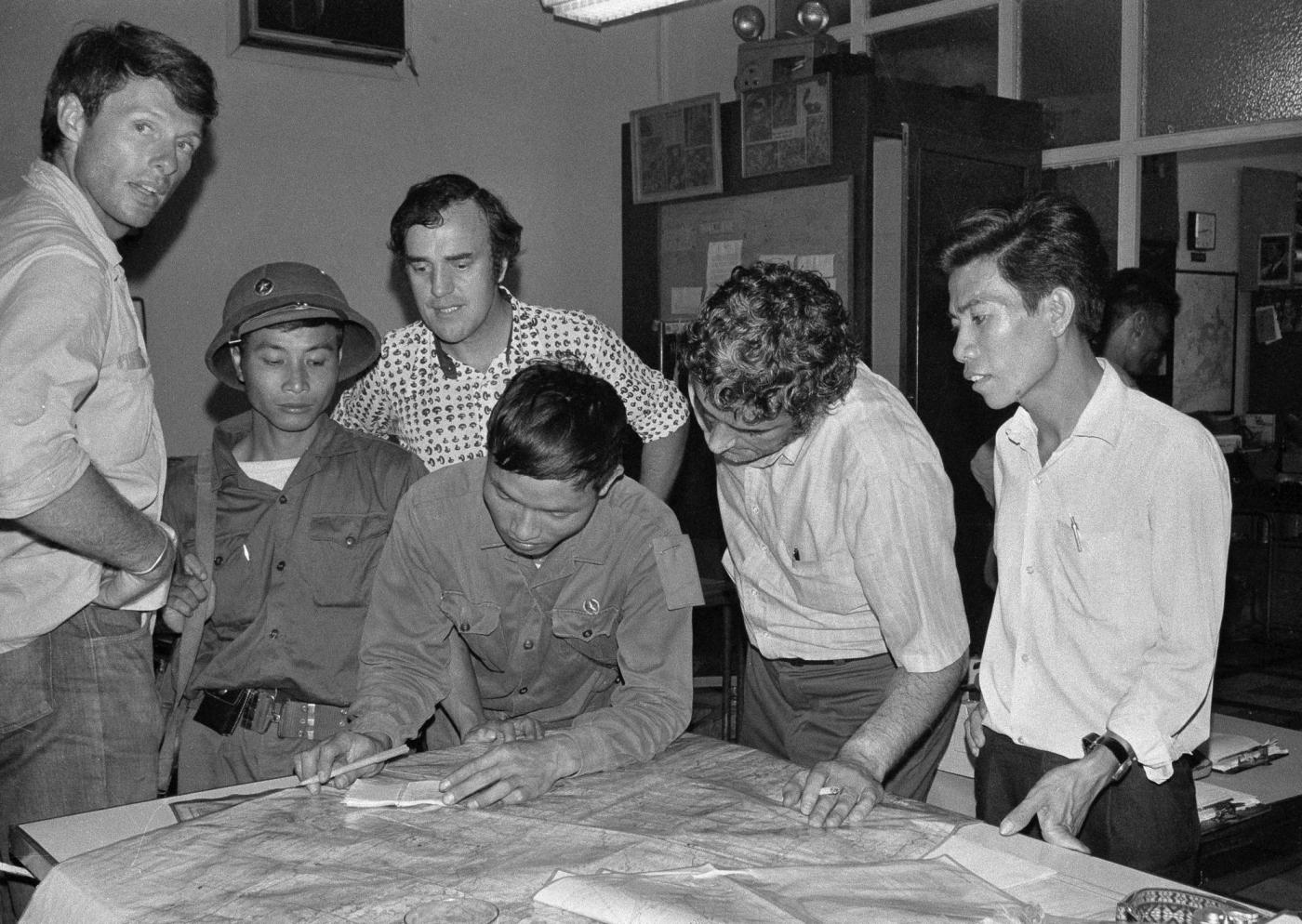
Lucas: Remembering Pulitzer-winning war reporter Peter Arnett

How strange.
I no sooner mentioned Peter Arnett and the Vietnam War in a column about Venezuela, then he died.
The column ran December 11. Arnett died a week later in Newport, California.
The column, in relation to the U.S. military buildup around Venezuela, was about Arnett telling me in Saigon in 1967 that we were losing the war.
He was 91 years old when he died and given the wars he covered, beginning with Vietnam, it is a wonder that he lived that long.
After Vietnam — and fame — he went on to cover other wars like Operation Desert Storm as well as to score exclusive interviews with Iraqi President Saddam Hussein and terrorist Osama bin Laden.
But it is for his coverage of the Vietnam War for the Associated Press that Arnett is most remembered.
Peter Arnett was the best reporter who covered the Vietnam War. He arrived in Vietnam as a young Associated Press reporter in 1962 and covered U.S. combat operations from its beginning in 1965 to its end in 1975.
His stories in those pre-television, pre-cell phone, pre-computer days dominated the news and were read by millions of American newspaper readers.
It was a time when people got their news from newspapers, not from soundbite snippets or cell phones.
It was a controversial war where 58,220 Americans soldiers were killed, and nothing was gained. Some 35,000 of those Americans were killed after Arnett said we were losing the war. Few at the time listened.
The war wrecked much of Vietnam and precipitated a furious anti-war riot that almost wrecked the U.S. as well.
Arnett covered it all, and he knew more about it than any politician in Washington or general in Vietnam.
It was long ago and far away, to be sure.
While people tend to erase the controversial war from their dimming collective memory, the war still haunts us. It was the wrong war, at the wrong time in the wrong place.
It is also an example of what can happen when a president goes off the rails, as President Lyndon Johnson did when he threw the country into a war it had no business fighting.
Arnett was a tough and fearless New Zealander who wrote about the war from the battlefield with a realism that often led to the dismay and anger of President Johnson and the war hawks surrounding him.
It was a time when the Associated Press was a respected, objective and trustworthy international news agency, and not the leftist woke driven operation it is today.
And Arnett was the perfect reporter, gritty to the core, to be covering the war at the time, largely because he was not an American cheering the war on, but an objective New Zealander who had no skin in the game.
When U.S. troops lost a skirmish or a battle, he wrote about it. Fellow reporters loved and respected him. Washington politicians not so much.
One day in March 1967, I was alone in Saigon looking for the fighting. It did not take long to find it. It was everywhere.
On my first armed helicopter ride to a military operation, I thought the lights from the dark jungle below were fireflies. They were not. They were Viet Cong fighters shooting at the helicopter.
One day I met Arnett in Saigon. New to the war, I needed help. I wandered Saigon looking for the press operation of the Military Assistance Command.
I went up to a guy carrying a camera standing outside the building.
“Are you a reporter?” I asked.
“Right, mate, I’m Peter Arnett of the AP,” he said.
“I’m Peter Lucas of the Boston Herald. Didn’t you just win a prize or something?” I asked.
“Yeah, mate, I just won the Pulitzer Prize,” he said.
“Great. I’ve been reading all your stuff.”
We hit it off. He took me under his wing, gave me advice and I didn’t get killed.
Veteran political reporter Peter Lucas can be reached at peter.lucas@bostonherald.com.


More Stories
US court rules against Pentagon in killer AI dispute
The Department of War had ordered contractors to drop Anthropic after it refused to allow military use of its technology...
Which Interior Flooring is Best?
Where do you start when choosing new flooring? When shopping for new flooring a good place to start is to...
Petrol set to top £1.50 a litre as Iran war drives fuel price surge
UK drivers are bracing for a sharp rise in fuel costs, with petrol prices expected to exceed £1.50 per litre...
Dyson hit by £440m sales drop as Trump tariffs bite
Dyson has reported a £440 million drop in annual sales after being hit by US trade tariffs, although the group...
Octopus Investments to cut 20% of staff as AI reshapes asset management
Octopus Investments is set to cut around a fifth of its workforce as it accelerates the adoption of artificial intelligence,...
Next to invest £300m in UK logistics as new warehouse set to deliver £2.5bn boost
Next has unveiled a major expansion of its UK logistics network, committing more than £300 million to new warehouse infrastructure...