
Fall River man convicted of selling drugs that killed teen, running online machine gun marketplace

A Fall River man has been convicted in federal court of selling a mixture of drugs that led to the death of a 17-year old as well as selling drugs and machine guns through a messenger app, the feds say.
The Massachusetts U.S. Attorney’s Office says Benjamin Hunt, 27, pleaded guilty to one count of distribution of fentanyl, MDMA, MDA, Ketamine and LSD resulting in death; among a slew of additional drug and gun charges.
Prosecutors say between at least 2022 and 2024, Hunt operated an online marketplace on the Telegram messenger app where he advertised and sold drugs and guns across the country. Hunt hid his identity by operating through multiple Telegram accounts and collecting payment primarily in cryptocurrency.
Police in Massachusetts learned about an overdose death of a 17-year-old in May 2023 in Indiana, later uncovering evidence Hunt had communicated with and sold various drugs to the victim through the Telegram app, accepting payment this time via Cashapp and sending the drugs to the victim through the mail.
Investigators found messages between Hunt and the victim in the hours leading to their death, where they discussed the victim’s consumption of Hunt’s drugs. The cocktail of drugs given to the victim by Hunt included fentanyl, MDMA, MDA, ketamine and LSD— which authorities say were determined to be the but-for cause of the minor’s death, ruled an acute mixed drug intoxication. Hunt admitted the drugs he sold resulted in the minor victim’s death.
“This defendant made a business out of selling poisonous drugs and flooding our communities with illegal guns – and a 17-year-old victim paid for it with his life,” said U.S. Attorney Leah Foley. “By exploiting online platforms to sell lethal drugs and guns, the defendant showed a complete disregard for human life and public safety. This guilty plea makes clear that those who deal in death and violence, whether on the street or through online encrypted apps, will be held fully accountable.”
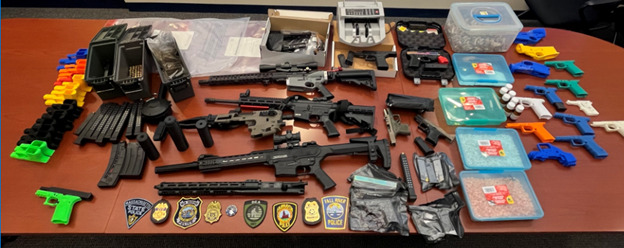
In February, May, and June 2024, authorities say Hunt sold counterfeit oxycodone pills containing fentanyl to an undercover officer, including quantities exceeding 40 grams of fentanyl. During one transaction, he sold a privately made Glock-style firearm, multiple machine gun conversion devices, an extended magazine and 3D printed brass knuckles.
Through the Telegram app, Hunt sold numerous drugs, including fentanyl, cocaine, LSD, MDMA, ketamine and counterfeit pharmaceutical pills made to resemble oxycodone but actually contained fentanyl. He also advertised firearms and firearm components, including ghost guns and machinegun conversion devices, also known as “switches.” Prosecutors say he manufactured some of the conversion devices himself using 3-D printing technology.
“Hunt’s entire livelihood was derived from endangering the public. Hunt’s drug enterprise killed a customer. Hunt manufactured and distributed 3D printed machine gun conversion devices, capable of spraying bullets across neighborhoods,” said Thomas Greco, Special Agent in Charge of ATF Boston.
“This case highlights the collaboration of law enforcement agencies and the United States Attorney’s Office to target and disrupt threats to the safety of our community. Individuals manufacturing and distributing machine gun conversion devices are a priority for the Department of Justice and will remain so,” Greco added.
The U.S. Attorney’s Office says this case is part of the Homeland Security Task Force (HSTF) initiative established by Executive Order 14159, Protecting the American People Against Invasion.
Hunt has been in custody since August 2024 after he was arrested on drug and firearms charges, remaining behind bars as the investigation continued. He was recently hit with additional charges, including drug distribution resulting in the death of a minor, and pleaded guilty on Thursday. Hunt faces between 20 and 25 years in federal prison and up to a $10 million fine.
U.S. District Court Judge Leo T. Sorokin scheduled sentencing for March 19.
(Photo courtesy U.S. Attorney’s Office)


More Stories
Easter and Eid collision sends British lamb prices to a record high
Supermarket shoppers face paying more than £16 per kilo for a leg as overlapping religious festivals, shrinking flocks and buoyant...
Vince calls on Miliband to halt North Sea oil exports as Iran war rattles supply
One of the Labour Party’s most prominent financial backers has called on Ed Miliband to slam the brakes on North...
Reform UK becomes first British political party to launch its own podcast
Reform UK is venturing into podcasting with a weekly show that will offer listeners behind-the-scenes access to Nigel Farage and...
Labour’s tax uncertainty is pushing Britain’s wealthiest towards the exit
The majority of Britain’s ultra-wealthy individuals are actively weighing up whether to leave the country, driven not so much by...
Barclays bets on the high street once more with new branches and the return of the bank manager
Barclays is charting a decisive U-turn on the high street, with plans to open new branches across the country and...
Amazon bets on Whole Foods to salvage its troubled UK grocery ambitions
Amazon is dusting itself off for another tilt at Britain’s fiercely competitive grocery sector, this time by converting its abandoned...