
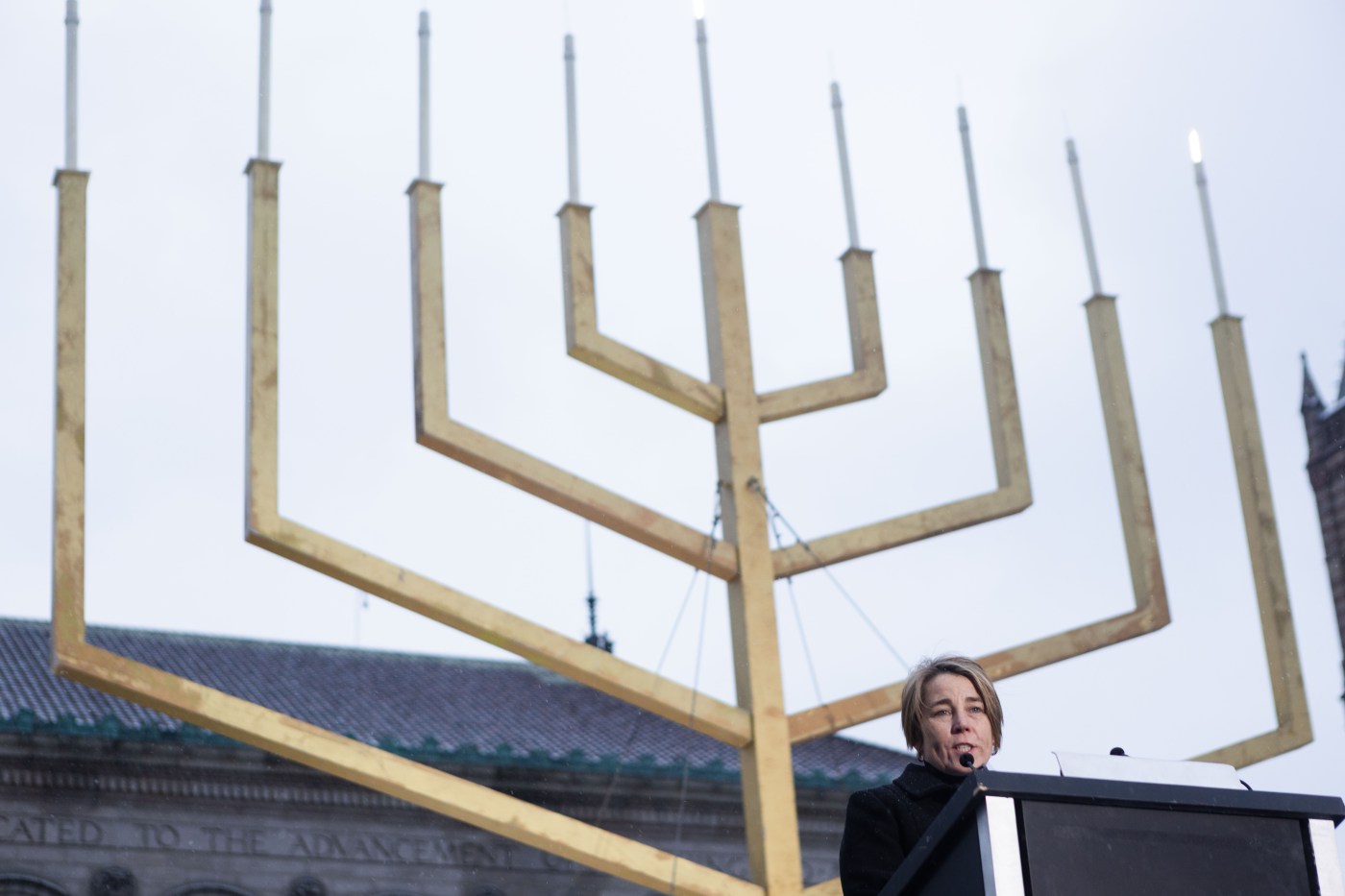
State leaders highlight antisemitism report, urge implementation

Expressing devastation over the antisemitic attack in Australia and newfound urgency to combat Jewish hatred, top state leaders gathered Wednesday to commit to implementing a bevy of recommendations to root out antisemitism in Massachusetts.
The state’s Special Commission on Combating Antisemitism released its report on Dec. 1, offering a blueprint for navigating discrimination in areas like K-12 schools, higher education, law enforcement and public safety, and workplace settings, including health care.
But a press conference Wednesday, coming just days after 15 people were killed at Sydney’s Bondi Beach during a Hanukkah celebration, featured Gov. Maura Healey, Lt. Gov. Kim Driscoll, Treasurer Deb Goldberg, Senate President Karen Spilka and House Speaker Ron Mariano, who pledged to protect the state’s Jewish community and ensure the report’s recommendations come to fruition.
“We will take whatever action is necessary, as I say, to call out antisemitism when we see it and to take all steps to eradicate antisemitism here in the commonwealth, around the country, around the globe,” Healey said in the Senate Reading Room, where she and other elected officials wore blue pins that symbolize combating antisemitism.
“We must do that because we’ve seen what the alternative is,” Healey continued. “We know what happens, we know it from history, we saw it this past weekend — the devastating and violent antisemitic attack in Sydney, Australia.”
The commission, created through the fiscal 2025 budget, was co-chaired by Rep. Simon Cataldo and Sen. John Velis, with other members including Jewish community leaders, municipal officials, educators and law enforcement leaders. The panel held 16 hearings across the state during a period of surging antisemitism, fueled by the Oct. 7, 2023 Hamas attack on Israel.
Mariano thanked Spilka for organizing the event Wednesday “and not letting this report end up on the shelf somewhere.”
“If we don’t understand how important the work that was done by this committee is now after this past week, we’re very foolish. We’re extremely foolish,” Mariano said.
The report describes antisemitism in K-12 schools as a “pervasive and escalating problem, with a large number of reported incidents of hate, bullying, harassment, and discrimination experienced by families and teachers.”
The commission suggests establishing an Advisory Council on Holocaust and Genocide Education to support implementing and tracking the 2021 law requiring middle schools and high schools incorporate genocide education into their curriculum. The report also calls on the Department of Elementary and Secondary Education to provide “appropriate” resources for teaching about ancient and modern Israel, Palestine and related conflicts in the Middle East; establish a statewide bias reporting program that explicitly includes antisemitism; and create a mechanism for reporting “problematic curriculum.”
The commission issued preliminary recommendations for K-12 education ahead of the start of the school year, and Cataldo said the state is “seeing a ton of change already.”
“We’re seeing changes in the language and the timeliness of the communication between the school leader and the school community after an antisemitic incident occurs,” Cataldo told the News Service. “Things like using the words ‘Jewish,’ ‘antisemitism,’ giving resources for how to talk to your students about this in the wake of an incident.”
School districts have also improved their procedures for community members filing complaints, and Jewish student unions are forming in K-12 schools, Cataldo said.
The report says antisemitism also poses a “serious, systemic concern within institutions of higher education across the Commonwealth,” and Jewish students have “raised serious concerns about the lack of clarity in processes for reporting complaints and incidents of bias.”
The commission recommends that colleges and universities have a clear and publicly available protocol for reporting incidents of hate, bias, harassment or discrimination to administrators; ensure their police and security departments receive “appropriate” antisemitism training; implement mandatory anti-bias education for faculty, administrators, students and trustees that incorporates antisemitism; and adopt clear rules for handling campus demonstrations and protests.
“While most Massachusetts colleges and universities have policies governing campus demonstrations, these rules are not always enforced consistently, leading to confusion, safety concerns, and administrative inaction,” the report says. “Protests have, in some cases, disrupted classes, campus operations and classroom instruction, and included speech or conduct perceived by students and faculty as harassing or intimidating.”
Antisemitic incidents are “likely” underreported in Massachusetts, the report says. There’s also a lack of understanding when it comes to which incidents constitute a hate crime, it says, which can then impact the accompanying response from law enforcement.
The commission says the Executive Office of Public Safety and Security should encourage local law enforcement agencies to report all instances of hate crimes to a portal recently created by the Massachusetts State Police Hate Crimes Awareness and Response Team. Law enforcement agencies should also provide training to their personnel, clerk magistrates, victim witness advocates and prosecutors on antisemitism and hate crimes, as well implement youth initiatives and restorative justice programs “to mitigate and combat radicalization,” the report says.
To address antisemitism in professional and health care settings, the report urges the Massachusetts Commission Against Discrimination to issue updated information that clarifies “employment discrimination against Jews is prohibited as discrimination based on religion, ethnicity, shared ancestry, and in some cases, national origin, and is prohibited under state and federal law.” State agencies and private employers should also integrate antisemitism education into anti-discrimination training programs and diversity, equity and inclusion initiatives, the commission recommends.
Across the globe, Jewish communities are questioning whether there is a future for them in countries such as the United States, Canada and Australia, said Jeremy Burton, who served on the commission and is CEO of the Jewish Community Relations Council of Greater Boston.
“This first-in-the-nation antisemitism commission, and the broad and clear support of our elected leaders and the stakeholders who participated in this work, has sent a message loud and clear,” Burton said. “That at least here in Massachusetts, the answer to those questions is a resounding yes – that we belong, that we are welcome, that we have allies, and they have together committed to a strategy for combating antisemitism and have said clearly that this effort will be taken seriously.”
Burton added, “We expect that the recommendations of the commission will be implemented with all necessary urgency.”
Healey said she tapped Driscoll to oversee how the report is implemented within the administration.
“One of the most, I think, troubling trends nationally is that antisemitic incidents and attitudes are more prevalent among young adults, young population — even younger than young adults, in terms of school-age children,” Driscoll said. “We’ve got work to do here and everywhere to understand what is at that and how do we beat that back. And that, frankly, is the real wake-up call.”
Beacon Hill embraced Hanukkah Wednesday, as Jewish music reverberated through the state capitol. Students from Solomon Schechter Day School in Newton performed on the Grand Staircase in the morning, and the annual State House menorah lighting later in the day marked the fourth night of Hanukkah.
— Alison Kuznitz / State House News Service
Alison Kuznitz is a reporter for State House News Service and State Affairs Pro Massachusetts. Reach her at akuznitz@stateaffairs.com.


More Stories
Today in History: December 19, U.S. auto industry gets emergency bailout
Today is Friday, Dec. 19, the 353rd day of 2025. There are 12 days left in the year. Today in...
Bruce Yandle: America chugs along in a ‘K-shaped’ economy
People are talking about America’s “K-shaped economy,” so named because charts show different sectors’ fortunes diverging like the two arms...
Matt K. Lewis: The Democrats are already blowing up their chances in the Senate
Just when you thought Democrats might be on track to claw back the U.S. Senate next year, they decided it...
Callahan: Why the Patriots’ luck will change, an old problem resurfaces and more Week 16 thoughts
Welcome to the Friday Five! Every week during the NFL regular season, I’ll drop five Patriots-related thoughts on Friday to...
Willner and Sullivan: Visa misstep will help predators, scammers
On the day Congress weighed 19 child-safety bills, the State Department told diplomats to deny visas to skilled workers in...
Today in History: December 19, U.S. auto industry gets emergency bailout
Today is Friday, Dec. 19, the 353rd day of 2025. There are 12 days left in the year. Today in...