

Clearing Up The Florida License Plate Frame Law Mess – Here’s The Deal

If you’ve looked at your car’s dealer plate frame a little differently lately, you’re not alone. Florida’s updated license plate law took effect on Oct. 1, 2025, and it immediately kicked off a statewide guessing game for drivers and even some officers. The big question has been simple: is a plate frame that covers even a tiny bit of the tag now enough to get you stopped, or worse, charged?
At the center of it is Florida Statute 320.262, which targets “license plate obscuring devices” and raises the stakes compared to the old slap on the wrist. The language focuses on anything that covers, obscures, or interferes with the legibility and detectability of a plate’s primary details, especially the license plate number and the validation sticker in the top right corner. The big practical change is the penalty: what many people treated like a minor traffic issue can now be a second-degree misdemeanor, which can carry up to 60 days in jail and up to a $500 fine. The law also goes further than most drivers realize, making it a second-degree misdemeanor to purchase or possess an obscuring device, a first-degree misdemeanor to manufacture or sell one, and a third-degree felony if one is used to help commit a crime or avoid arrest.
The confusion comes from how differently “obscure” has been interpreted in the real world. Some departments have taken a zero-tolerance stance, warning that if a frame hides any portion of the plate, it can lead to a stop and a citation. Others have publicly said that if the letters and numbers and the registration decal are visible and legible, you’re fine. That split has played out on the street, with citations showing up shortly after the law went live, including tickets for decorative frames that only partially cover the plate.
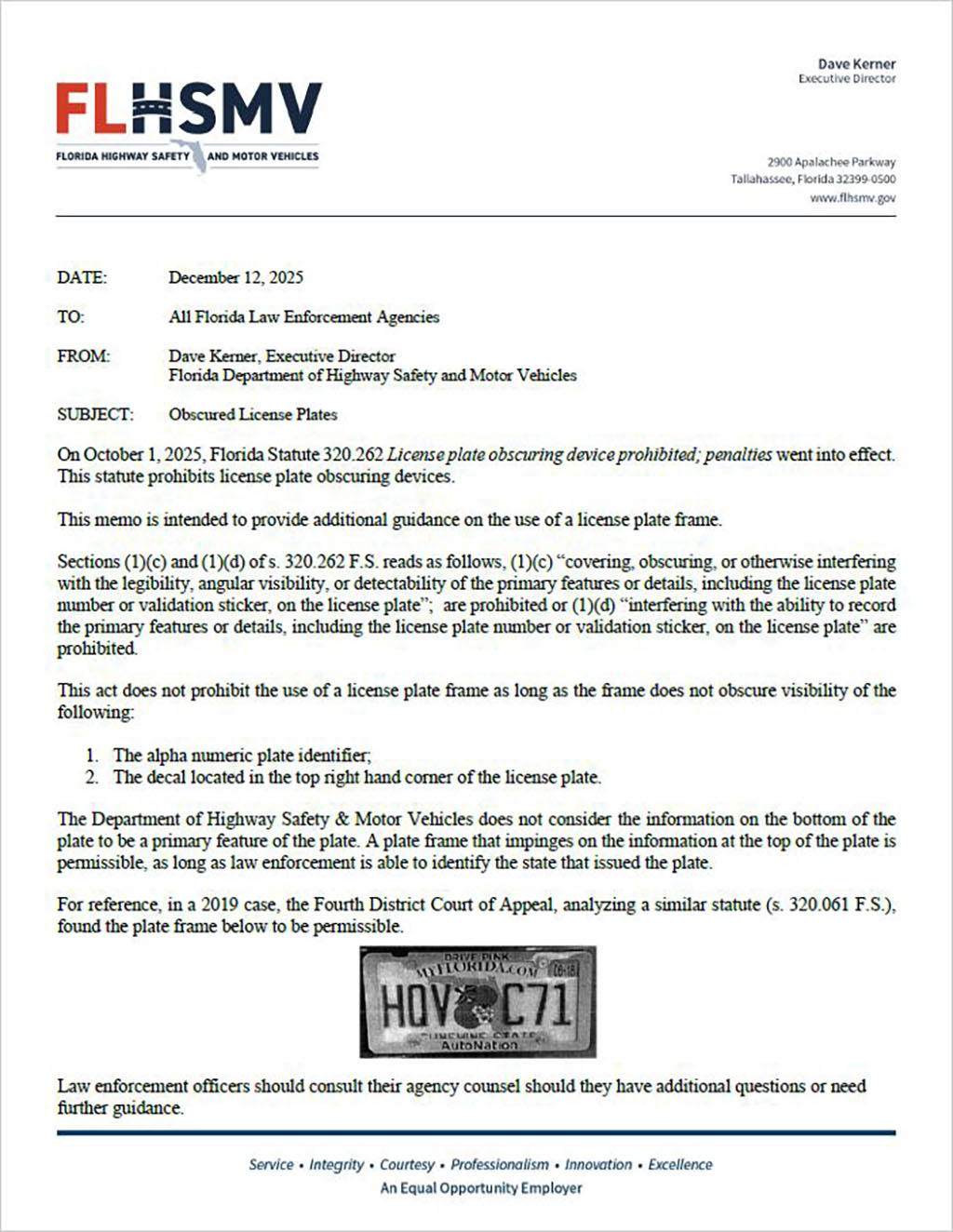
To settle things down, the Florida Department of Highway Safety and Motor Vehicles issued a clarification memo on Dec. 12, 2025, and it’s the closest thing to a statewide answer drivers have been begging for. The memo confirms that license plate frames are allowed, but only if they do not obscure (1) the alphanumeric plate identifier and (2) the decal in the top right-hand corner. It also spells out that the text at the bottom of the plate, like a county name or the state website, is not considered a “primary feature,” so a frame covering that lower area may still be legal. It even notes that a frame that slightly impinges on information at the top can be permissible as long as an officer can still identify the state that issued the plate, and it points to a 2019 appellate case where a frame was allowed because it didn’t interfere with identifying information.
Even with the memo, a lot of drivers are choosing the safest move: skip frames altogether. Defense attorneys have also pointed out that related language about not altering the original appearance of a plate can feel vague in practice, which is never a comfortable place to be when criminal penalties are on the table. The best advice is straightforward: don’t argue on the roadside, and if you believe you were cited unfairly, that fight happens in court with legal help, not during a traffic stop.
For Florida drivers who just want to avoid the hassle, here’s the easy checklist. Make sure the plate numbers and letters are fully visible, and make sure the top-right registration decal is completely unobstructed. Avoid tinted or clear covers, reflective films, sprays, flips, or anything meant to defeat toll cameras or plate readers, because that’s exactly what this law is aimed at. If you insist on running a frame, choose one that leaves a wide, clean opening around the characters and the decal, and double-check it from a few angles in daylight and at night. In the current climate, the simplest “mod” might be removing that frame entirely.

More Stories
China retail November 2025: Fang Cheng Bao, Lynk & Co hit all-time highs, market off -16.8% on high year ago basis
This content is for members only. Visit the site and log in/register to read.
China imports November 2025: Market down -20%, BMW 7 Series (+88.9%) and 2 Series (+53.8%) shoot up
This content is for members only. Visit the site and log in/register to read.
How Certified Pre-Owned Cars Deliver Confidence and Reliability
Buying a vehicle is a big decision, and for many people, it is just as important to feel sure about...
Why Today’s Cars are More Expensive to Repair After Minor Collisions
A decade ago, low-speed fender benders usually meant you had to get a new bumper cover, some paint, and stay...
What to Look for When Choosing a Trucking Fuel Card
Choosing the right trucking fuel card is a crucial decision for any fleet operator. The right card can significantly impact...
The Top 5 Car Phone Mounts to Close Out 2025
A good phone mount is one of those small upgrades that quietly makes every drive better. It keeps your navigation...