
As Battle Group Off Venezuela Awaits Orders, a New Commander Takes the Helm

By John Haughey
DORAL, Fla.—The largest United States naval force to prowl the Caribbean in decades is steaming off Venezuela’s coast, President Donald Trump says the nation is engaged in a “non-international armed conflict” against narcoterrorists, and there’s debate on the airwaves, across social media, and in Congress whether this is a war, what it all means, and where it’s going.
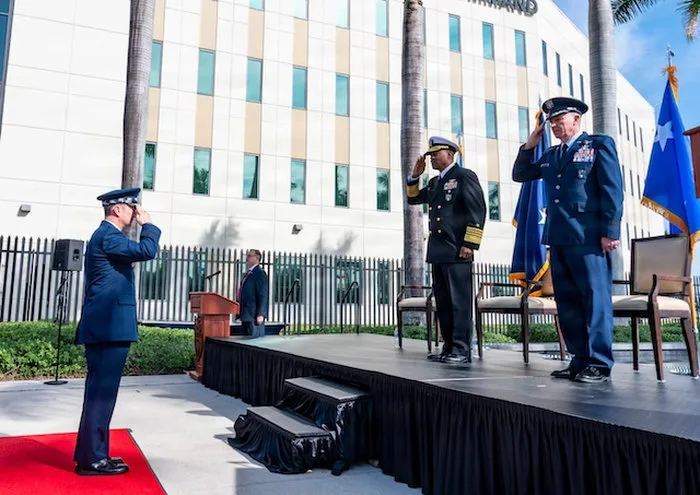
But at the Department of War’s Southern Command outside Miami on Dec. 12, there was only reverent praise for the retiring Navy admiral leading those forces and assurances that the air force lieutenant general succeeding him is ideally suited to assume the helm.
Adm. Alvin “Bull” Holsey relinquished his duties as commander of U.S. Southern Command to Lt. Gen. Evan Pettus in a ceremony marked by humor but no hubris in a transition of leadership between combat veterans who hinted at, but never addressed, events unfolding 1,500 miles to the south.
Pettus, an air force officer for more than 30 years and F-15 pilot with extensive combat experience, takes command of the 14.5-million square mile command, which spans 31 Central and South American nations and, pending adoption of the proposed $901 billion fiscal year 2026 defense budget, Mexico.
One of 11 Pentagon commands spanning the globe, Southern Command was considered a lower priority for a century, with the nation’s strategic and economic interests centered on Europe and Asia.
But in his second presidential term, Trump has determined the United States will shift its focus south, issuing a Jan. 20 executive order that states Mexican and South American drug cartels smuggling fentanyl, cocaine, and other narcotics are waging “a campaign of violence and terror throughout the Western Hemisphere that has not only destabilized countries with significant importance for our national interests but also flooded the United States with deadly drugs, violent criminals, and vicious gangs.”
Trump has also accused Venezuela President Nicolás Maduro of trafficking narcotics. In August, the administration offered a $50 million bounty for information leading to his arrest. Maduro was indicted in the United States on drug charges, including narcoterrorism, in 2020.
The U.S. State Department on Nov. 24 designated Venezuela’s Cartel de los Soles—which it claims is led by Maduro—a terrorist organization.
Last month, Trump issued a new national security strategy to “reassert and enforce the Monroe Doctrine to restore American preeminence in the Western Hemisphere,” framing it as the “Trump Corollary” to President James Monroe’s 1823 policy that declared the Western Hemisphere a distinct U.S. sphere of influence.
The “Trump Corollary” is the first Monroe Doctrine update since 1904 when President Theodore Roosevelt declared the U.S. would intervene as an “international police power” in Latin America to prevent European agitation in the “Roosevelt Corollary.”
According to the Trump administration, the president can authorize the Pentagon to engage in “non-international armed conflict” with terrorists and, since Maduro doesn’t represent Venezuela’s legitimate government, such action isn’t war with a nation state requiring Congressional endorsement. Democrats, and some Republicans, disagree.
Since September, Southern Command forces led by Holsey have been destroying speedboats allegedly smuggling drugs in the Caribbean and eastern Pacific with Hellfire missiles and drones, killing at least 80 in more than 20 strikes.
On Dec. 10, U.S. forces seized a tanker off Venezuela that the administration maintains was smuggling oil on behalf of Iran’s Revolutionary Guard. More seizures are planned, Trump says, hinting air—and, perhaps, ground—attacks inside Venezuela are on the table.
Waiting for orders are at least 12,000 sailors and Marines in an Operation Southern Spear task force led by USS Gerald Ford, the world’s largest aircraft carrier, and USS Iwo Jima, an amphibious assault ship—the biggest Navy battle group to ply the Caribbean since 1965 and the U.S. military’s most significant action in the region since invading Panama in 1989.
Navy Adm. Alvin “Bull” Holsey is “piped ashore” for the last time as he retires after 37 years in the sea service during a “relinquishment of command” ceremony at U.S. Southern Command in Doral, Fla., on Dec. 12, 2025. Air Force Staff Sgt. Christoper Bermudez/US Southern Command
His Watch Is Over
But there was little mention of all that from the podium Holsey and Pettus shared with the Pentagon’s Joint Chiefs of Staff Chair Air Force Gen. Dan Caine in what was not a formal change-of-command but a “relinquishment of command” and retirement ceremony for Holsey after 37 years of service.
Pettus is serving as acting commander and has not yet been officially nominated by the Pentagon and confirmed by the Senate to assume the command.
At the Dec. 12 event, Caine praised Holsey as the scion of a family rooted in service to the nation. His father was a Korean War veteran, six uncles served in the military, including three in Vietnam, a son—like him—is a navy helicopter pilot “who is, right now, out there flying BlackHawks off USS Abraham Lincoln in the Pacific, continuing the watch.”
The military’s highest-ranking officer said Holsey demonstrated bravery, repeatedly “landing a helicopter on the pitching deck of a ship,” but no more so than during two instructor tours training helicopter pilots and surviving “without your students killing you.”
Caine said on behalf of all of the active-duty Americans serving in the nation’s armed forces, including the sailors and Marines “in the fleet afloat right now” off Venezuela, it was an honor to leave cold, gray Washington to officiate his retirement ceremony “in this awesome Miami weather.”
Pettus said the three years he worked with Holsey at Southern Command before their November 2024 ascensions to commander and deputy commander was a privilege, calling the admiral’s “professionalism, commitment and capability unimaginable.”
Following in Holsey’s shadow will be daunting, he said, but he’s ready.
“The challenges we face are complex, but working together, and with our partners, we can and will make a lasting impact,” Pettus said. “I’m looking forward to the adventure. God bless you all, and God bless the United States of America.”
“Those we lead don’t follow words, they follow courage,” Holsey said, which makes Pettus the “right person to take the lead” of a command that will be the “whole-of-government … point-of-need to respond to shared threats in our neighborhood.”
He described himself as “a young boy from a small town in Georgia who dreamed of being aviator even though he had never been on airplane,” who came to realize dreams “God had a purpose for.”
Holsey told the joint force assembly—soldiers, airmen, sailors, Marines, federal agents, and military officers from dozens of nations—it “has been a tremendous honor to stand shoulder-to-shoulder with you. You are the finest among us. Your dedicated efforts will shape this region for years to come. Your vision must be an enduring, secure, free, and prosperous hemisphere.
“I only ask for one thing: your personal best. You have everything you need to succeed—each other.”
And with that, Holsey was “piped ashore” for the last time—his watch over, a sailor no more.
“My mom wanted to be here,” he said, “but I told her, ‘This time, I’ll be home for Christmas.’”

More Stories
Bilt Launches 3 New Credit Cards With 10 Percent Interest Cap for First Year
By Mary Prenon Bilt, one of America’s youngest credit card firms, founded in 2019, is launching a suite of three...
Trump Unveils New Health Care Affordability Plan
By Lawrence Wilson President Donald Trump on Jan. 15 released his administration’s new health care affordability plan, which aims to...
US, Denmark, Greenland to Form Working Group to Find Agreement on Island’s Future
By Ryan Morgam and Emel Akan WASHINGTON—Following a White House meeting on Jan. 14, the foreign ministers of Denmark and...
SEO for Manufacturing Companies: Strategies to Generate High-Quality Leads
SEO has become the biggest part of life in this competitive world. The efficient use of SEO can be done...
The USA “Needs Greenland for the Purpose of National Security”: Trump Remains Adamant
On 14 January, US President Donald Trump declared that “anything less than having Greenland in the hands of the United...
Trump Threatens to Invoke Insurrection Act to End Anti-ICE Protests in Minnesota
By Sam Dorman President Donald Trump has threatened to use the Insurrection Act in Minnesota following an attack on an...