
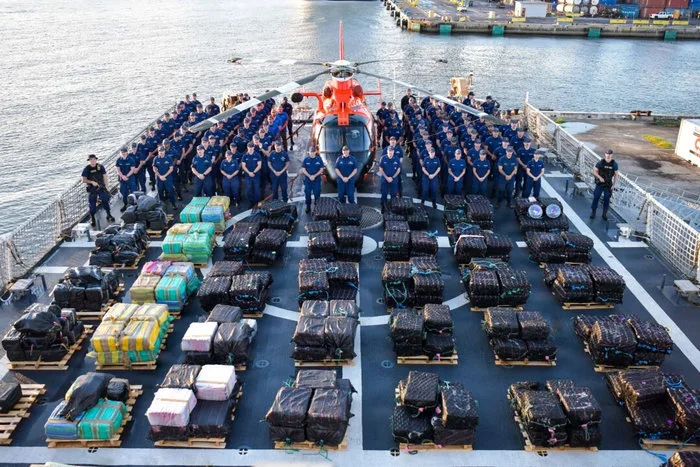
US Coast Guard Operation Seizes 150,000 Pounds of Cocaine

By Naveen Athrappully
More than 150,000 pounds of cocaine have been seized in the Eastern Pacific Ocean since the launch of Operation Pacific Viper, the U.S. Coast Guard (USCG) said in a Dec. 9 statement.
Operation Pacific Viper, launched in early August, directs U.S. forces to the Eastern Pacific Region to counter criminal groups and cartels, essentially cutting off drug and human smuggling activities before they reach U.S. shores.
According to the Coast Guard, a dose of 1.2 grams of cocaine is enough to kill a person, with the seized quantity equating to more than 57 million potentially lethal doses.
Department of Homeland Security Secretary Kristi Noem said: “Operation Pacific Viper has proven to be a crucial weapon in the fight against foreign drug traffickers and cartels in Latin America and has sent a clear message that we will disrupt, dismantle, and destroy their deadly business exploits wherever we find them.
“In cutting off the flow of these deadly drugs, the Coast Guard is saving countless American lives and delivering on President Trump’s promise to Make America Safe Again and reestablish our maritime dominance.”
The Eastern Pacific Ocean continues to see significant drug shipments from South and Central America.
Under Operation Pacific Viper, the Coast Guard has deployed additional assets, such as tactical teams and aircraft, to interdict and seize the shipment of drugs. According to the USCG, 80 percent of all seizures of narcotic shipments bound for the United States take place at sea.
A major drug seizure under the operations took place on Dec. 2, when Coast Guard Cutter Munro seized more than 20,000 pounds of cocaine in a single interdiction. This was the “largest at-sea interdiction” conducted by the Coast Guard since March 2007.
In November, the crew of the Coast Guard Cutter James carried out multiple seizures over several days, taking custody of 19,819 pounds of cocaine.
The drug interdictions have resulted in denying more than $1.1 billion in revenue for criminal organizations.
“By disrupting the flow of cocaine and other bulk illicit drugs, the Coast Guard is cutting off revenue that fuels the ability for narco-terrorists to produce and traffic illegal fentanyl, threatening American communities,” the USCG stated.
The Trump administration has also engaged in deadly military sea strikes against drug traffickers.
One of the recent strikes was conducted on Dec. 4 against an alleged drug trafficking boat in the Eastern Pacific after War Secretary Pete Hegseth ordered a “lethal kinetic strike” on the vessel, the U.S. Southern Command (SOUTHCOM) said in a Dec. 4 post on X.
“Intelligence confirmed that the vessel was carrying illicit narcotics and transiting along a known narco-trafficking route in the Eastern Pacific. Four male narco-terrorists aboard the vessel were killed,” SOUTHCOM stated.
There has been criticism over the strikes. On Dec. 4, Congress held classified briefings discussing an attack in September in the South Caribbean that killed two individuals.
Rep. Jim Himes (D-Conn.) told reporters that a video he saw during the briefing he attended was “one of the most troubling things” he had seen while in public service.
“You have two individuals in clear distress without any means of locomotion, with a destroyed vessel, [that] were killed by the United States,” he said.
Speaking at the Reagan National Defense Forum in Simi Valley, California, on Dec. 6, Hegseth justified the strikes against drug trafficking vessels.
“If you’re working for a designated terrorist organization and you bring drugs to this country in a boat, we will find you, and we will sink you. Let there be no doubt about it,” he said.
“President Trump can and will take decisive military action as he sees fit to defend our nation’s interests. Let no country on Earth doubt that for a moment.”
More than 80 suspected traffickers have been killed in the strikes so far.


More Stories
The Amazing Digital Circus: Release Date of The Last Episode is Out
If you also like to watch animated series and shows, Good News ahead! In this blog, you will get to...
Who is Taylor Paul? Age, Husband, Children, and Recent Controversy
Taylor Paul is a TikTok star and reality show personality. If you like to watch reality shows, then you must...
No Evidence Medical Cannabis Alleviates Anxiety, Depression, or PTSD: Study
By Zachary Stieber There is no evidence medical cannabis works against anxiety, depression, or post-traumatic stress disorder, according to a...
National Medical School Accreditor Scrapping DEI Requirements
By Aaron Gifford The nation’s largest medical school accreditor is phasing out its guidance on diversity, equity, and inclusion (DEI),...
Burgum Says Trump Energy Policies Make US Less Vulnerable to Upheaval, the World Safer
By John Haughey HOUSTON—President Donald Trump’s policies boosting American energy production are proving prescient with ships and pipelines carrying oil,...
NASA Unveils Plan for First Nuclear-Powered Interplanetary Spacecraft
By T. J. Muscaro The first-ever nuclear-powered spacecraft built for interplanetary travel will set off on a mission to Mars...