
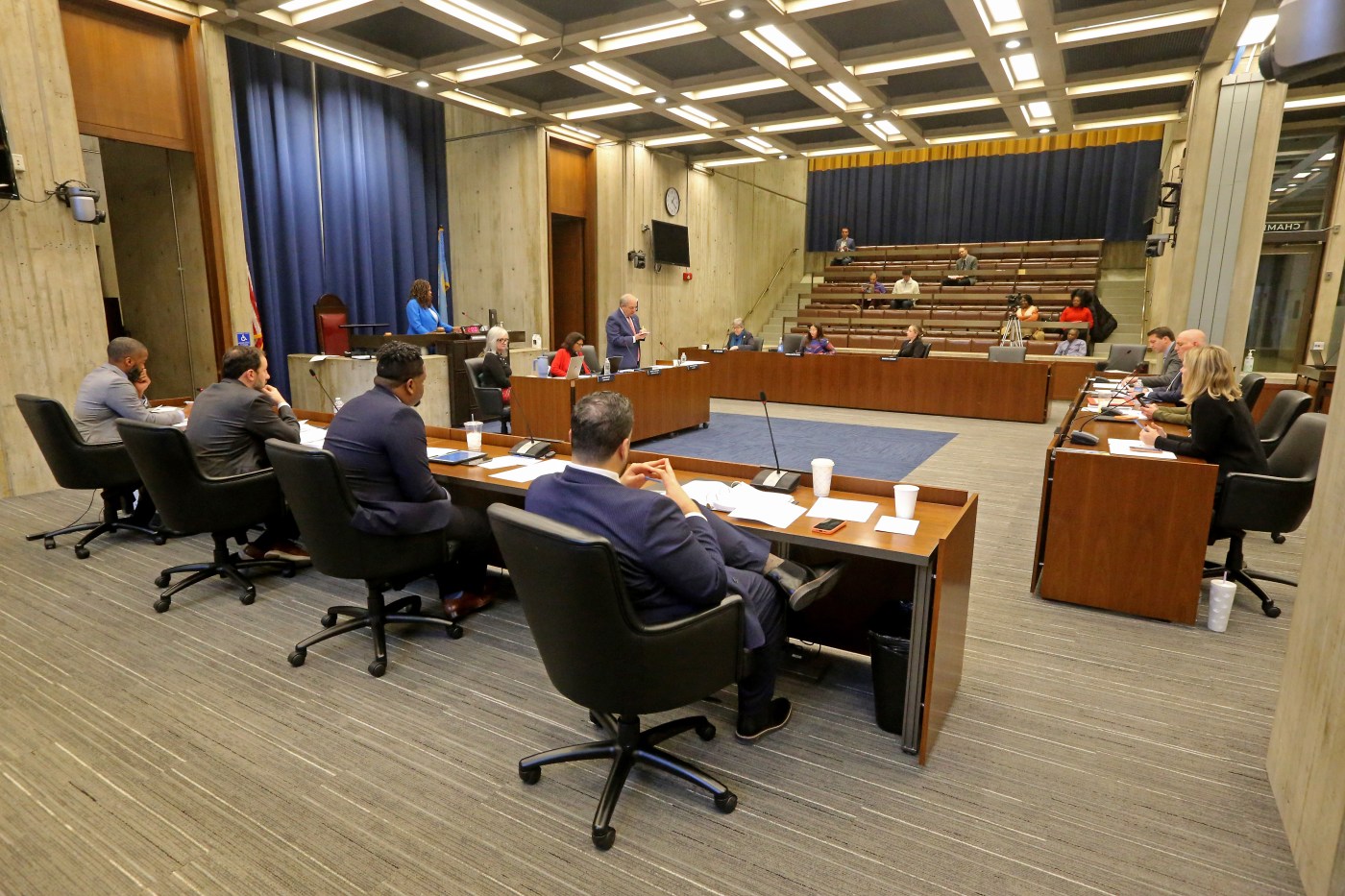
Boston City Council votes to set tax rates, homeowners to see 13% tax increase

The Boston City Council voted unanimously to set tax rates that will bring a projected 13% tax increase for the average single-family homeowner next year.
The Council voted, 12-0, Wednesday to set the residential tax rate at $12.40 per thousand dollars of assessed value and the commercial tax rate at $26.96 per thousand dollars of assessed value at its final meeting of the year. Those rates are based on setting the maximum shift of 175% of the city’s tax burden from the residential to commercial sector.
Boston Mayor Michelle Wu has said the new tax rates will result in a 13%, or $780 increase, in property taxes for the average single-family homeowner next year. The Council also voted to set the maximum residential exemption of 35%, which city financial officials projected will save qualified homeowners up to $4,354.74 on their tax bills.
“These actions will provide the maximum amount of relief for homeowners under our current state laws,” said Council Vice President Brian Worrell, who chairs the Ways and Means Committee.
Still, the vote will have homeowners bracing for a second straight year of double-digit tax increases, and eight straight years of hikes over 5%. Residential taxes grew by 10.4% this year.
“I’m grateful to the City Council for their work to unanimously pass the annual tax classification rates for next year,” Wu said in a statement. “As residential property owners are set to pay their highest share in property taxes in over 40 years, our legislation awaits state approval that would stabilize taxes, protect residents and help businesses continue to benefit from strong city services.”
Worrell joined other councilors in stressing the routine nature of the day’s vote to set tax rates, but acknowledged the battle that’s again brewing between the mayor and state Senate over Wu’s tax shift legislation. The bill would allow the city to shift the city’s tax burden from the residential to commercial sector beyond the 175% limit allowed under state law.
The mayor’s office says homeowners would see a $480, rather than $780, increase in their tax bills that go out Jan. 1, should Wu’s legislation be passed by the state Senate, where it died late last year and has stalled again this year. The bill would allow the city to shift taxes at a 180% rate next year.
Wu said commercial values are projected to drop this fiscal year by 6% alongside a 2% rise in residential values, which, by way of a city budgetary structure that derives roughly three-quarters of its revenue from property taxes, is pushing more of the city’s tax burden from the commercial to residential sector.
The mayor has said her legislation is meant to stabilize that post-pandemic shift, and that commercial property owners would still see a lower tax bill should it be approved, though not by as much. Wu said the average Class A office taxpayer will see a 4.4%, or $210,000 decrease, in their property tax bills next year.
Councilor Sharon Durkan said the day’s vote was “an important step” that would save homeowners $3 per $1,000 of assessed value, but noted that, “Obviously, there’s a lot else that’s going on here.”
“I have shared, and it’s been in the media, how upset I’ve been with the Senate, because I think if you represent Boston, you need to make sure that they have an affordable place to live,” Durkan said. “For young families and low-income seniors in my district, the lack of action from the Senate — it has a ripple effect.”
Councilor Ed Flynn said the city should be looking to practice fiscal restraint and that the Senate is not to blame for the city’s current predicament. He advocated for cutting the $4.8 billion city budget, which grew by 8% last year and 4.4% this fiscal year, and implementing a hiring freeze.
Flynn blocked a vote on a resolution put forward by Councilors Worrell, Benjamin Weber and Ruthzee Louijeune, the body’s president, that called for the Council to support the mayor’s bill.
“Raising property taxes significantly on homeowners and businesses is not the answer,” Flynn said. “It’s time to demonstrate fiscal discipline, accountability, transparency, and positive leadership. … If we really want to help residents, we should lower the temperature in city government. Let’s not call out the state Senate. They are our partners.”
Councilor Erin Murphy similarly called for “better stewardship of city spending.”
“If we are serious about protecting already-burdened homeowners, we cannot simply count on commercial property owners to shoulder more of the tax burden when they too are struggling,” Murphy said. “It is time to prioritize fiscal restraint and responsible budgeting.”
The mayor has directed all city departments to propose budgets for the next fiscal year that are 2% below this fiscal year, but the city budget is still expected to grow again next year, Chief Financial Officer Ashley Groffenberger said this week.
Wu has been pushing her tax shift legislation for nearly two years, and saw her renewed push for its immediate approval last week met with a chilly reception from the state Senate.
State Sen. Nick Collins, a South Boston Democrat, who blocked a vote on the mayor’s legislation repeatedly last year, has said it would jeopardize the economy. Wu had singled out Collins last week for killing the bill.
Related Articles
Boston city councilor demands White Stadium cost update from mayor amid budget crunch
Boston Mayor Wu’s tax battle intensifies ahead of City Council vote to set residential tax hike at 13%
‘Unacceptable’: Boston homeowners to see 13% tax hike next year, state certification confirms
Editorial: City Hall can’t afford to miss another security lesson
Consultant worked for Boston City Council candidate and union backing her, violating campaign finance law
The bill was ultimately killed by Senate President Karen Spilka late last year due to a lack of support, after Department of Revenue-certified numbers of city assessing data showed residential tax increases were lower than projected by the city.
Spilka issued a statement Monday defending Collins and state Sen. William Brownsberger, who led last year’s opposition to the mayor’s bill, while calling out city officials for not engaging with the Senate on tax relief proposals put forward by the two Boston senators.
Collins on Monday said “the Senate is advancing legislation that would give the mayor the authority to issue rebates and drive down taxes for homeowners. These bills would provide real relief for residential taxpayers while protecting small business owners and not putting our economy at risk.”
Councilor Weber said the two Senate-led measures would “essentially restrict further our ability to decide whether to raise revenue in our city” and require the city to cut “vital services for our residents.”


More Stories
Fuel price surge could force one in ten drivers to cut hospital visits, survey warns
Rising fuel prices could force some drivers to reduce essential journeys, including hospital visits, as the escalating oil price crisis...
F1 set to cancel Bahrain and Saudi Arabian Grands Prix amid Middle East conflict
Formula 1 is expected to cancel the Bahrain and Saudi Arabian Grands Prix as the escalating conflict in the Middle...
UK and Ireland strengthen economic partnership as £937m investment set to create 850 jobs
The UK and Ireland have strengthened their economic partnership as leaders gathered in Cork for the second UK-Ireland Summit, where...
UK economy stalls in January as hospitality slowdown drags growth to zero
The UK economy stalled at the start of the year as households cut back on discretionary spending, with restaurants and...
US-Israeli war on Iran wipes billions off Gulf energy revenues – FT
The Middle East escalation has cut off a number of American allies from the vital Strait of Hormuz Oil producers...
Maersk halts operations at Oman port after drone strike widens Iran conflict disruption
Global shipping giant Maersk has suspended operations at the Port of Salalah in Oman after a drone attack struck oil...