
Trump Announces $12 Billion Farm Aid Program

By Jacob Burg
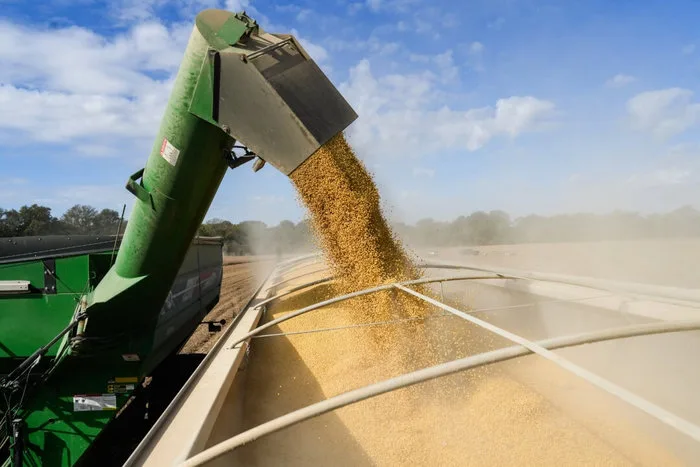
President Donald Trump on Dec. 8 unveiled a $12 billion economic assistance package for farmers.
The Trump administration has been embroiled in a trade war with China, in which both nations have exchanged tariffs on each other’s exports. It has resulted in some U.S. farmers struggling to sell their crops as Beijing pulled back purchases of products such as American soybeans this year and bought from other markets and nations, including Argentina.
Trump made the announcement at a roundtable at the White House to discuss his economic aid package for American farmers. He was joined by Treasury Secretary Scott Bessent, Agriculture Secretary Brooke Rollins, members of Congress, and farmers from the corn, cotton, sorghum, soybean, rice, cattle, wheat, and potato industries.
During the ceremony, Trump said his administration was taking a “very vital action to protect and defend American farmers and reduce prices for the American consumers.”
“I’m delighted to announce this afternoon that the United States will be taking a small portion of the hundreds of billions of dollars we receive in tariffs … and we’re going to be giving and providing it to the farmers in economic assistance,” the president said.
“They’re the backbone of our country. So we’re going to use that money to provide $12 billion in economic assistance to American farmers.”
Up to $11 billion of the total aid package will go to the U.S. Department of Agriculture’s (USDA’s) Farmer Bridge Assistance (FBA) program, which will offer one-time, targeted bridge payments to row crop farmers recovering from trade actions on American agriculture by foreign governments, preexisting inflation, and various market disruptions, an administration official told The Epoch Times ahead of the roundtable.
The remaining $1 billion will be dedicated to crops not included in the Farmer Bridge Assistance program, and the USDA will make final determinations based on market conditions.
During the roundtable, Meryl Kennedy, the owner of a Louisiana rice agribusiness, said that the industry believes that certain countries, including India, Thailand, and China, have been dumping foreign rice exports into the United States, making it difficult for American rice to reach certain markets, such as Puerto Rico, which is a U.S. territory.
“Puerto Rico used to be one of the largest markets for U.S. rice. We haven’t shipped rice into Puerto Rico in years. So this has been happening for years,” Kennedy said.
Ahead of the ceremony, White House deputy press secretary Anna Kelly said Trump’s aid package was intended to boost farmers and the farm safety net.
“President Trump is helping our agriculture industry by negotiating new trade deals to open new export markets for our farmers and boosting the farm safety net for the first time in a decade,” Kelly said in a statement.
“Today’s announcement reflects the President’s commitment to helping our farmers, who will have the support they need to bridge the gap between Biden’s failures and the President’s successful policies taking effect.”
The aid package is intended to provide certainty to U.S. farmers as they bring this year’s harvest to market and plan for next year’s crops, the official said, providing a financial bridge as an extension of the president’s existing economic policies of trade deals, tax cuts, and deregulation.
Trump had said in late September that he wanted to use revenue from his mass tariffs on U.S. trading partners to provide aid to American farmers struggling from the fallout of the U.S.–China trade war.
At the time, the president did not say whether the aid would be given to farmers in the form of direct checks, but said he would confer with Agriculture Secretary Brooke Rollins about “how to get money to the farmers.”
The farmer’s aid announcement comes two days after Trump signed an executive order creating task forces within the Justice Department and Federal Trade Commission (FTC) to protect competition across the U.S. food supply chain.
“Food supply sectors, including meat processing, seed, fertilizer, and equipment, have similar vulnerabilities to price fixing and other anti-competitive practices,” the president wrote in the order.
“My Administration will act to determine whether anti-competitive behavior, especially by foreign-controlled companies, increases the cost of living for Americans and address any associated national security threat to food supply chains.”
The order directs Attorney General Pam Bondi and FTC Chairman Andrew Ferguson to bring “enforcement actions” and propose “new regulatory approaches” if their respective task forces’ investigations uncover any anti-competitive behavior.
Some economists and Democrats have criticized Trump’s tariffs for leading to higher prices at the grocery store, and the Supreme Court heard arguments last month on the legality of the president invoking the International Emergency Economic Powers Act (IEEPA) to impose tariffs on all U.S. trading partners.
Trump said on Sunday that he had “other methods of charging tariffs” even if the Supreme Court ultimately rules against his use of that 1977 law to impose wide-ranging import levies.

More Stories
State Department Urges Vigilance for Americans Overseas Amid Iran Conflict
By Bill Pan The U.S. Department of State is urging Americans worldwide, particularly those in the Middle East, to exercise...
Trump Admin Seeks Months-Long Pause on Tariff Refunds
By Bill Pan The Trump administration says it needs months of additional time to weigh its steps, as a wave...
Iran Targets US Bases in Middle East in Retaliatory Attacks: What We Know So Far
By T.J. Muscaro Iran’s Revolutionary Guard said it has launched retaliatory attacks against multiple nearby U.S. military bases on Feb....
US, Israel Strike Iran
By Sam Dorman President Donald Trump released a video on Feb. 28 stating that the United States had begun “major...
Subaru Recalls Nearly 70,000 Vehicles for Fuel Leak Risk, Issues ‘Park Outside’ Warning
By Mary Prenon Subaru and Kia America have both issued recalls involving thousands of vehicles with elevated risks for accidents...
Melania Trump Set to Make History by Chairing UN Security Council Meeting
By Evgenia Filimianova U.S. First Lady Melania Trump will make history on March 2 when she presides over a U.N....