
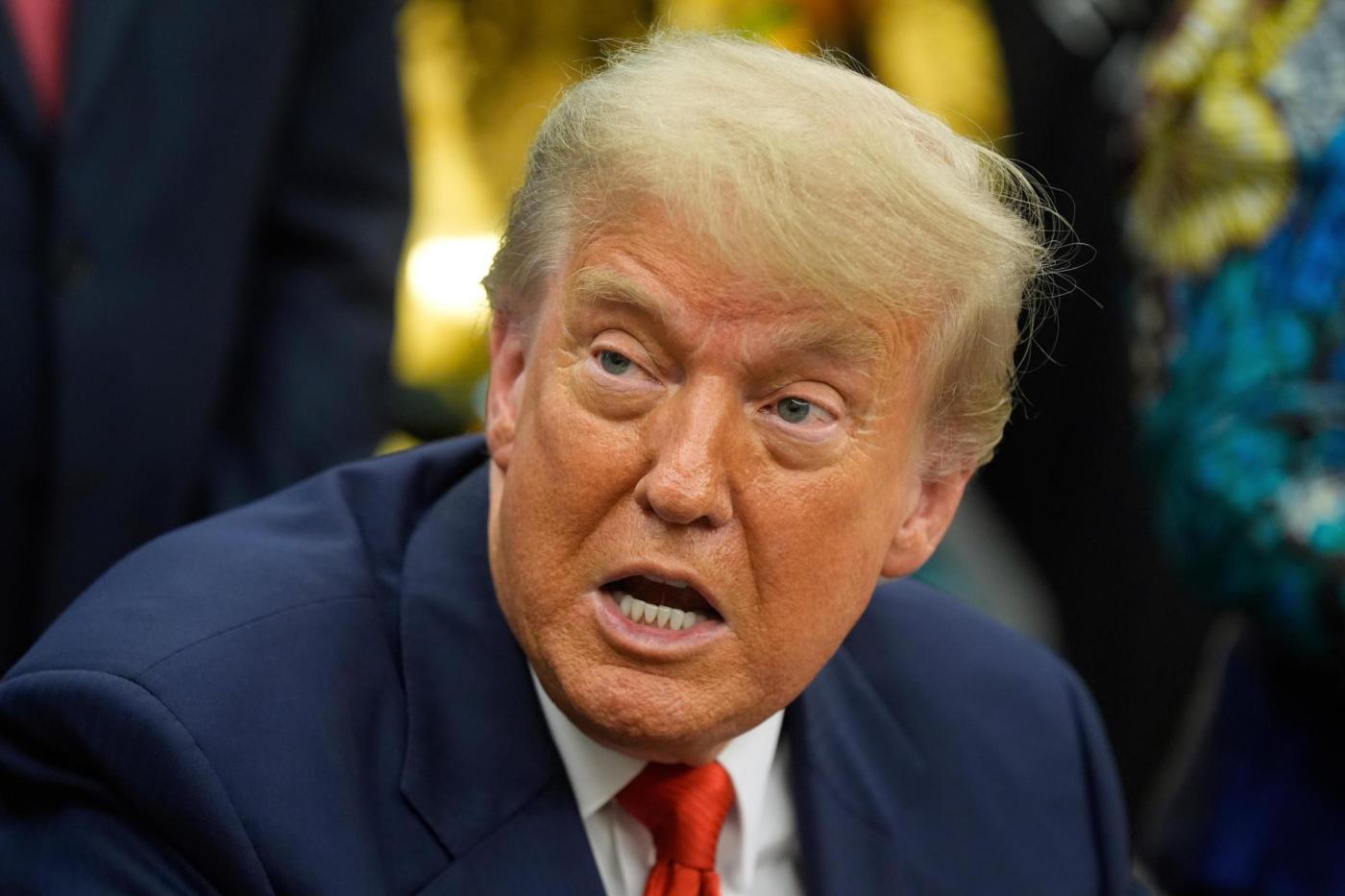
Congress gears up to pass $900 billion defense policy bill

WASHINGTON — The House is expected to take up legislation this week that would authorize about $900 billion for the military, providing an increase over the White House’s annual budget request.
The bicameral version of the bill released Sunday includes $8 billion more than what the Trump administration had requested and what the House allotted in a version of the bill that it passed earlier this year. The additional funding in the legislation marked a modest but rare divergence for Republican lawmakers from President Donald Trump, after a year of largely ceding authority as he made dramatic cuts to the government.
Both chambers are racing to pass the annual defense policy bill before the end of the year and deliver it to the president’s desk.
One overarching goal of the bill, which authorizes spending for the 2026 fiscal year, is to streamline how the Defense Department meets its needs through research, contracting and manufacturing.
The bill would authorize an overhaul of how the department buys weapons. It also seeks to shore up the network of public and private organizations that provide a range of materials, products and services to the military.
Rep. Mike Rogers, R-Ala., the House Armed Services Committee chair, said in a statement that the legislation was focused on “building out critical warfighting capabilities.”
“I’m eager to send this to President Trump’s desk so we can give our military the tools they need to remain the most ready, capable, and lethal force in the world,” he added.
Troops across the military will receive a 3.8% annual pay raise under the bill.
The legislation also seeks to codify more than a dozen of Trump’s executive orders, including those aimed at accelerating U.S. manufacturing of military drones, transforming the country’s air and missile defense system into a “Golden Dome” to intercept foreign attacks, and authorizing the use of active-duty troops to patrol the southern border.
The final bill includes some House Republican provisions about gender in the military that echo the Trump administration’s efforts to end “woke” ideology, including a ban on transgender women participating in women’s athletic programs at U.S. service academies.
The bill, however, does not rename the Defense Department the “Department of War,” as Trump and his defense secretary have called it. Instead, the legislation sticks with the already codified “Department of Defense” and “secretary of defense” throughout the roughly 3,000-page bill.
The legislation would also roll back Biden-era climate policies, including by restricting the Defense Department’s use of electric or hybrid vehicles.
Aid for Ukraine is included in the bill, with a reauthorization of $400 million in security assistance annually through the 2027 fiscal year for the country as it faces a worsening position in its war with Russia.
Negotiators also included in the final text new guardrails on U.S. investments in certain technology in China. The language is a bipartisan attempt to stem the flow of American capital into China’s development of, among other sectors, artificial intelligence and military tech.
The bill would also repeal authorizations for the use of military force from 1991 and 2002. There was strong bipartisan support to eliminate the Iraq and Persian Gulf War-era authorizations that presidents for decades, in both parties, have used to justify overseas military operations.
A permanent repeal of U.S. sanctions on Syria is also included in the latest version of the bill, building on steps Trump has taken. Lawmakers say the repeal is necessary if Syria is going to recover from the civil war that ravaged the country for more than a decade.
Both the House and Senate versions of the bill that passed earlier this year would have approved expanding health insurance coverage for in vitro fertilization for service members and their family members. The provision was removed by Speaker Mike Johnson at the eleventh hour last year, but its sponsors had hoped that Trump’s pledge to improve access to IVF would pressure Republicans to support the proposal this year.
The Defense Department only covers fertility treatment for those who can prove a difficulty in becoming pregnant is because of “a serious or severe illness or injury while on active duty,” leaving those who cannot to pay out of pocket for the expensive procedure.
His office said in a statement that Johnson has “clearly and repeatedly stated he is supportive of access to IVF when sufficient pro-life protections are in place.”
Rep. Sara Jacobs, D-Calif., one of the sponsors of the IVF proposal, said in a statement that Johnson had put his “personal beliefs” over the needs of service members, and that she was disappointed that the president had “failed to do anything” to change the speaker’s position.
This article originally appeared in The New York Times.
Related Articles
Thailand launches airstrikes along border with Cambodia as tensions reignite
Trump wants Venezuela’s leader to go. Here’s who could replace him.
GOP-led states settle lawsuit against federal government over checking citizenship status of voters
In announcing pardon of drug trafficker while threatening Venezuela, Trump displays contradictions
Trump issues White House invitation to families of the two National Guard members who were shot


More Stories
Court records reveal details of ICE agent’s previous dragging incident in Bloomington
MINNEAPOLIS — The federal immigration agent who fatally shot a woman in her car this week was dragged about 100...
5 states sue Trump administration for withholding billions in social safety net funds
By MORIAH BALINGIT WASHINGTON (AP) — Attorneys general in five Democratic-led states filed a lawsuit Thursday against President Donald Trump’s...
High School roundup/scores: Danvers star sees 20-20 in victory
AngieLouise Djoko flirted with a triple-double and finished with an eye-opening 21 points, 20 boards and eight steals as Danvers...
Timberwolves offense explodes in win over Cleveland
The Timberwolves were beaten decisively both times they met Cleveland last season, as Minnesota had no answers for the Cavaliers’...
Bruins burn Flames with home cooking in 4-1 victory
The last time the Bruins were seen on Causeway Street, they were heading into the Christmas humbled after getting walloped...
Minnesota adds 8,900 jobs from Sept.-Nov.; state data release delayed
Minnesota employers added 8,900 jobs between September and November, according a release Thursday from the Department of Employment and Economic...