
Puerto Rican Families in New York’s Public Housing Worry Privatization Will Cause Displacement

New York City’s public housing authority has turned thousands of apartments over to private management. While PACT may currently be the most effective way to fund renovations quickly, many tenants are still not sold on the program, citing eviction threats and higher costs.
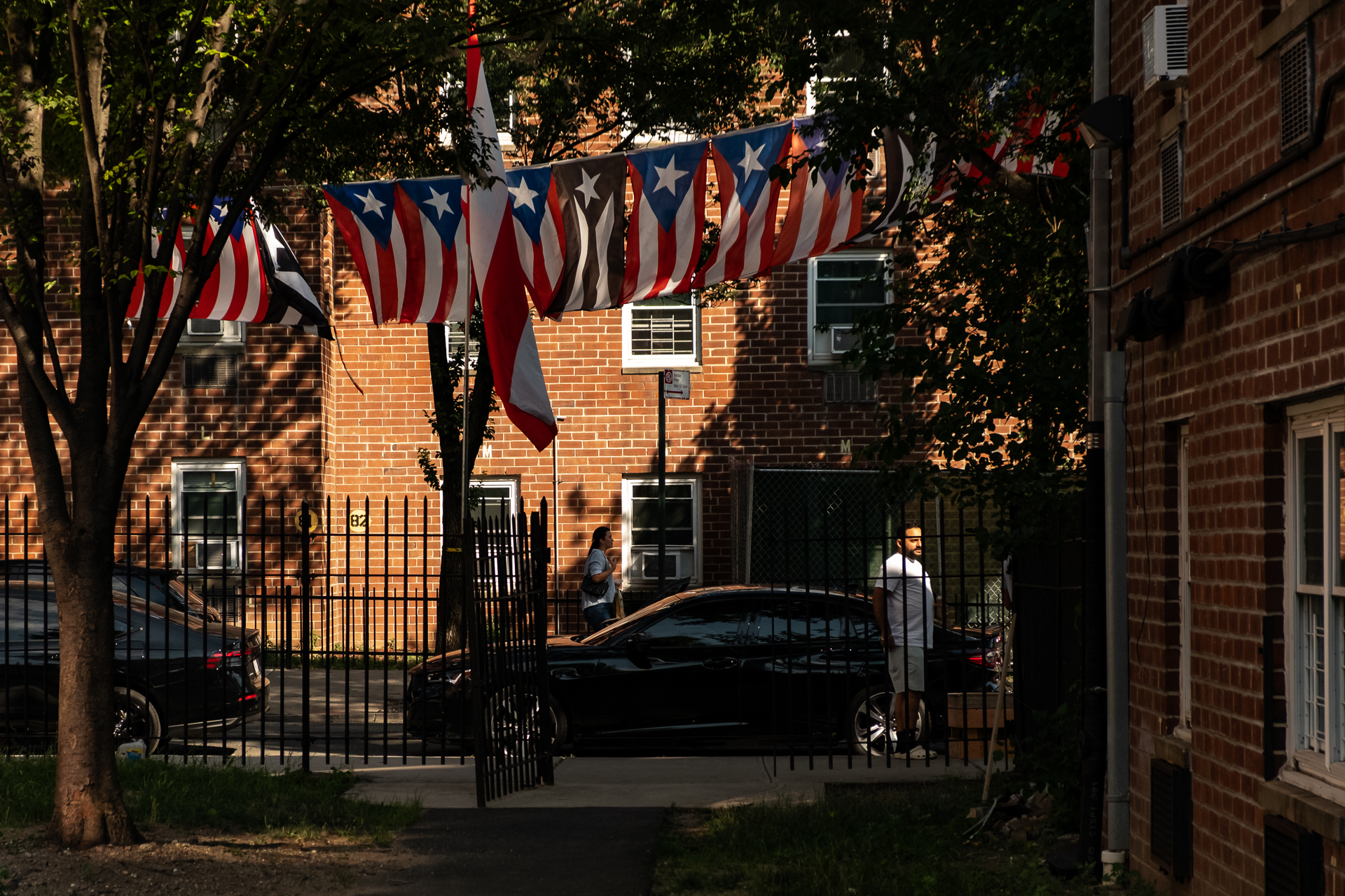
Puerto Rican flags dangle over the entrance to a Hope Gardens courtyard on Linden Street, Brooklyn. (Adi Talwar/City Limits)
This story was originally published by the Centro de Periodismo Investigativo.
Lydia Díaz was living in a dilapidated New York City Housing Authority (NYCHA) apartment in 2021 when she got the news. Her building, part of the Harlem River Houses, would be the latest handed to private developers as part of the Permanent Affordability Commitment Together (PACT) program. The conversion would bring millions of dollars for renovations, but also make her a Section 8 tenant of a new private landlord.
Upset that they were denied a voice in the decision to join PACT and worried they would lose rights in exchange for poor-quality repairs, Díaz and other tenants sued to stop it. But it was too late. The new companies took over, remodeled the buildings, and started managing them as they saw fit, all without the outside oversight that existed under full public control.
Since then, her new landlord, Harlem River Preservation LLC, with its management company C+C, has tried to evict her three times, most recently in August for under $500 in unpaid rent.
“I want to feel like this is my home. I only feel like I settle here. I don’t feel like it’s my home,” said Díaz, who is 68 and has lived in her Harlem apartment, in the northern part of Manhattan, for 16 years. She grew up in southern New Jersey to parents from Puerto Rico and has experienced homelessness in the past.
The new kitchen window in Lydia Díaz’s apartment at the Harlem River
Houses, installed as part of NYCHA’s PACT renovation program, opens
only a few inches. (Adi Talwar/City Limits)
The new kitchen window in Lydia Díaz’s apartment at the Harlem River Houses opens only a few inches. The window was installed as part of NYCHA’s PACT renovation program.
NYCHA has handed more than 39,000 units of public housing to private developers since 2016 as part of the PACT program, which is an implementation of the federal 2012 Rental Assistance Demonstration (RAD) program. While NYCHA, a public-benefit corporation governed by a mayor-appointed board, historically manages its own properties, the program leases chosen developments to private companies if they undertake massive and long-overdue renovations.
Developers fund this work with loans the government can’t access. They then pay them back, and earn some profit, by collecting rents set at standardized rates meant to mirror the market. Tenants pay 30 percent of their income towards this rent and a Section 8 voucher covers the difference.
But since renovations have been completed at many PACT developments, eviction threats against tenants have surged and eviction rates are about five times higher than NYCHA’s regular buildings, although actual evictions remain low.
For communities like Puerto Ricans, whose population in New York City decreased by 20 percent between 2017 and 2022 and who largely rely on public housing as a last holdout in gentrifying neighborhoods, this reality makes PACT feel like the latest ploy to drive them out for the benefit of real estate interests.
Fear and frustration circulate, but PACT privatization, which keeps the land under NYCHA ownership, came from desperation. Before Díaz’s new developers took over the Harlem River Houses, the 693 units were estimated to need over $300 million in repairs by 2023. They had earned a 37 out of 100 in their 2019 inspection from the federal Department of Housing and Urban Development (HUD), far below a passing score of 60.
In fact, before PACT began, NYCHA said its overall portfolio required more than $45 billion in repairs by 2037. As the need grew, the amount the housing authority received from its primary funder, the federal government, was reduced.
But through PACT, developers have raised over $13 billion to fund renovations at buildings across the boroughs. These residents enjoy new parks, remodeled apartments, and modern HVAC systems, while nearly 300,000 NYCHA residents continue to sit in buildings one decade more deteriorated, where constant leaks, rodent infestations, and broken locks are the norm.
Developers receive a substantial revenue stream from this partnership, which comes from a combination of rents, subsidies, and tax credits, even though many have long histories of neglecting buildings and evicting tenants.
Councilmember Chris Banks, who chairs the New York City Council’s Committee on Public Housing, said some PACT partners are apathetic to tenants’ wishes and manage with the notion that NYCHA residents don’t deserve housing to the standard of other New Yorkers. He cited Wavecrest Management, which has won contracts across the city with a history of violations from before PACT began.
“You really have to question folks and intentions as to why they would put a slumlord to manage a property,” he said. “It leads me to question whether this is a get-rich scheme or if this is a real, true investment to really uplift the residents of public housing.”
The playground at the Wise Towers on Manhattan’s Upper West Side has been a source of disputes between residents and visitors. (Adi Talwar/City Limits)
Fears of displacement
Interspersed with brownstones and pre-war buildings housing many of the city’s wealthy and white residents, the Upper West Side has long been home to a Puerto Rican population who largely reside in its NYCHA developments and Mitchell-Lama buildings, another type of affordable housing built decades ago.
Their presence was once felt in bodegas, butchers, and restaurants dotting Amsterdam Avenue, but businesses have closed as Puerto Ricans have gradually left the neighborhood. Since 2010, about one quarter of the neighborhood’s Puerto Rican population has left, American Community Survey five-year estimates show.
The Wise Towers, a NYCHA development converted to PACT in 2020 and now managed by Wavecrest Management, still serves as a lasting foothold in the area. But as eviction threats have increased over the last few years, Puerto Rican residents worry they will be the next community pushed out. Tenants point to the playground, which was remodeled so successfully that visitors overwhelmed the once ignored courtyard, as evidence that the privatization was never primarily for their benefit.
Ernesto Carrera, the Wise Towers’ tenant association president who has witnessed the neighborhood change as a resident for over 50 years, has identified the new playground as a perfect microcosm for his problems with PACT: outsiders making decisions about people’s homes without their input and pushing them out in the process.
“We’ve had mothers tell our children that they don’t want their children to play with our children. We can’t have that here. We never had that here, […] but the creation of this new park has brought out a lot of feelings in people,” said Carrera, who successfully pushed for closing the park to the public.
Signs around the children’s playground at the Wise Towers warn that it is a residents-only area. (Adi Talwar/City Limits)
“If it’s private, it’s private. We didn’t make it private,” he added.
Carrera acknowledges the park’s improvements, but says they are “just makeup” on more serious issues within the buildings, like outdated plumbing, broken locks, and infestations. While some apartments now resemble luxury developments, others have barely been updated from their neglected NYCHA state.
Darrell Williams lives in an apartment accessible for people with disabilities on the second floor of one of the Wise Towers. Shoddy paint jobs cover damage from chronic leaks, his electric fob won’t open his front door, and water from his wheelchair-accessible shower streams out into his hallway.
Wavecrest management says these types of issues should be reported to them online or by phone and they will resolve them within 48 hours, unless the repairs are significant or require outside contractors.
“I tell them I have a leakage problem. ‘Oh, here’s a number.’ You call that number, nobody answers,” said Williams, who used to work for NYCHA. “Under NYCHA, they would have did a better job.”
In addition to physical issues, residents say the Wise Towers became less affordable when they converted to private management, particularly in terms of rent.
Residents in both PACT and traditional NYCHA buildings typically pay 30 percent of their gross household income toward rent, meaning if a family earns $50,000 a year, they would pay $1,250 a month. They are also supposed to occupy apartments fit for their family size.
But many people had not been reassessed for income or family changes in years. Parents whose adult children now earned incomes had to start reporting them. Parents whose adult children left were moved to smaller apartments. Higher-income residents, who sometimes paid flat rates at NYCHA, were forced to start paying 30 percent of their income instead.
“We have to fix the buildings, but we also have to fix processes and the like. And some of it involves working with the residents so that they understand the expectations that actually always existed,” said Jonathan Gouveia, chief real estate officer and executive vice president for NYCHA.
Part of this process is issuing pre-eviction notices to tenants behind on rent. Over 10 percent of PACT residents received this outreach in the first half of 2025, according to NYCHA’s PACT Progress and Compliance Oversight monitor.
Gouveia says pre-eviction notices are a tool to offer support to residents behind on rent rather than evict them. This could come in the form of helping them report income changes or enroll in social services. They are also a way of protecting PACT partners from the arrear crisis at NYCHA, where 34 percent of tenants didn’t pay rent in October.
However, data shows that, so far this year, about half of pre-eviction notices became eviction filings, the first legal step toward an eviction. NYCHA says developers often pursue filings so tenants can qualify for New York City’s “one-shot deal,” which grants financial assistance to individuals dealing with acute emergencies like eviction.
While only three households of the 399-unit Wise Towers have been evicted this year, memories of past displacement and broken government promises leave residents fearful that others are in line.
“Long term, we ain’t gonna be here,” said Domingo Román, who grew up in the buildings and now comes to visit friends and family. “We’re gonna have to move all the way up to the Bronx, because that’s what they’re trying to do—get all the Puerto Ricans and Blacks out of here and moved up to the Bronx.”
Some Wise Towers residents previously lived in nearby brownstones that were seized and demolished for the development’s construction as part of “urban renewal” programs spearheaded by Robert Moses, former New York City planning commissioner, according to Councilmember Gale Brewer.
The destruction of brownstones to construct the Wise Towers mirrored the 1947 development of the Amsterdam Houses, the neighborhood’s first NYCHA development, which was built on top of a once-thriving Puerto Rican neighborhood called San Juan Hill.
“These are residents that I’ve known since 1978, so they mean everything to me,” said Brewer, who has represented the neighborhood since 2002, eight years of which as Manhattan borough president. “I would like to assume, I hope I’m correct, that the eviction rate at Wise Towers would be very, very low. I will have a fit if somebody’s [evicted without cause].”
PACT developers have little to gain short-term from evicting tenants, though. When vacancies arise, they get filled from NYCHA’s Section 8 waitlist in a process PACT partners don’t have control over. And developers receive a standard rent regardless of how much the tenant pays, since the Section 8 voucher pays the difference.
Wavecrest Management stated that they have no intention of increasing eviction rates.
“I’m very proud of the PACT program. I think it has changed many lives. I think when you’re dealing with that many households at any one time, one person may not be happy,” said Susan Camerata, one of the three Cameratas who make up Wavecrest’s executive board.
Harlem River II apartment building, located on Frederick Douglass Boulevard in Manhattan. (Adi Talwar/City Limits)
Repairs over tenants’ wishes
The Harlem River Houses were completed in 1937 as the first development NYCHA constructed after its founding three years earlier. The buildings stand as a monument to the political vision of NYCHA’s pioneer, Mayor Fiorello La Guardia, who thought city government should be responsible for providing New Yorkers with the infrastructure they need to thrive, such as housing, schools, and hospitals. The vision was enabled by funding from President Franklin D. Roosevelt’s New Deal program.
Not only was the development to be functional, but it was also intended to be a dignified place to raise a family, specifically a Black family. La Guardia officials touted this vision for the complex as they laid its first bricks in 1936, journalists reported. Besides apartments, the Harlem River Houses also featured cobblestone-lined paths encircling playgrounds, sculptures from a range of artists, and an amphitheater overlooking the river.
NYCHA’s Harlem River Houses in June. (Adi Talwar/City Limits)
The campus, which now includes another nearby building constructed later, was restored to its former beauty over the last four years by the Harlem River Preservation with the use of $275 million.
“It looks like you’re in a movie scene. It’s surreal,” said JeRome Dunbar, director of community relations at the Harlem River Preservation. “Especially for it being affordable housing, low-income housing, you can’t beat it. I would live here.”
But the historically authentic façades of these landmarked buildings obscure apartments with mold-dotted walls that feel squeezed in by a layer of drywall added during renovations. In one apartment, a lightly humming HVAC system emits the ripe odor of a decaying rat. And throughout the buildings, faux wood floors peel at the edges of where they were hastily laid down, revealing a layer underneath coated with dust that residents say they constantly need to sweep.
Visible mold conditions inside Celena Soto’s apartment at the Harlem River Houses. Soto is one of several residents who have reported ongoing maintenance problems. (Adi Talwar/City Limits)
“They didn’t even bother to flatten out the walls and level the walls or even file the walls down before they painted. They just painted over the cracks,” said April Washington, whose family has lived in the development since 1955.
Washington has refused to abide by the terms of the lease that grant the Harlem River Preservation access to her apartment, which means her apartment has not been renovated. In response, they filed a holdover case against her in February.
Developers created forums for residents to provide feedback to the design choices before the renovations began, but with the upgrades standardized across the development, some residents were bound to have choices imposed on them.
NYCHA received criticisms for overlooking residents’ viewpoints in their first PACT conversions, and say they have strived to include them more actively since. In doing so, they recently offered residents of the Jacob Riis Houses a chance to vote on if they wanted to join PACT, which tenants rejected. NYCHA says these votes won’t necessarily happen going forward.
Typically, residents only vote when there is a third option to convert to the Public Housing Preservation Trust, which switches tenants to Section 8 but keeps their buildings under government management. In the seven votes hosted with these three options, Randall Avenue-Balcom Avenue became the first to choose PACT in April.
”They’re saying whether you like it or not, this is what’s best for you,” said Lydia Díaz, speaking of the gray wood laminate cabinets installed in her apartment, as well as the overall changes with PACT.
Residents say they became skeptical about moving their apartments under the control of the private sector after hearing stories from other conversions. In part, they fear they will lose transparency and outside oversight over their homes.
“NYCHA has come a long way when it comes to transparency, but I think the PACT program is still notoriously not transparent,” said Iziah Thompson, senior policy analyst at the Community Service Society of New York (CSS).* “[NYCHA] knows these issues exist. Some of these buildings are super old, and sometimes the scope of work for the projects doesn’t cover everything.”
Among other transparency gaps, PACT developments don’t receive inspection scores from HUD or the same oversight from a federal monitor imposed on NYCHA in 2018.
PACT as gentrification
Robert Camacho is the chair of Brooklyn Community Board 4, where he represents the residents of the rapidly gentrifying neighborhood of Bushwick. Throughout his 64 years there, the Puerto Rican community has slowly been pushed out by surging rents.
At the Hope Gardens’ massive local NYCHA campus, though, those born on the island still make up 32 percent of residents, while the majority of the rest come from either the Dominican Republic or Brooklyn.
The development was switched to PACT in 2019 and, after a disastrous few years under Pinnacle City Living management, is now controlled by Wavecrest. Pinnacle has since earned contracts at other PACT sites.
As Camacho walks around the development, between hugs with grateful tenants and rants on local issues from bike lanes to dog owners, he details how PACT developers have ignored local voices and instilled fear in tenants with constant eviction threats. To him, the privatization is a continuation of the harmful policies that have displaced Puerto Rican families from the neighborhood.
“[Elected officials] are too busy telling us what we want and what we need, instead of listening to us and what we need and what we want,” said Camacho. “I don’t live in NYCHA, but the people that are there are my family. You know why? Because if they go to my store and they’re paying and they’re hurt, then we’re hurt.”
Between the Hope Gardens’ three-story buildings on Wilson Avenue, playgrounds, barbecues, and picnic tables were removed, where now sit adult gym equipment and empty grass shaded by a new 13-floor building—a separate project between NYCHA and other developers.
Blanca Gardana, with her husband, Heriberto Echevarría (standing), and her brother-in-law, Julio Echevarría, in a courtyard at Hope Gardens. (Adi Talwar/City Limits)
Long-time Puerto Rican neighbors Blanca Gardana and Blanca Izquierdo say they are relieved their children reached adulthood before the conversions, as developers stripped the community of spaces where children used to congregate.
“The kids don’t have enough space to play, for entertainment,” said Izquierdo, who moved to New York from Aguadilla as a child and has lived in Hope Gardens for 36 years. “Everybody, almost everybody, says that NYCHA was better.”
Wavecrest Management said they would not comment on the courtyard renovation decisions because they were made before they assumed control.
The space has also been used less by residents because when it rains hard, a puddle overtakes the lawn that streams into Gardana’s ground-floor apartment. Wavecrest Management provided tenants with hydrobarriers to stop the water, but NYCHA claims the problem is due to city infrastructure outside its control.
Blanca Izquierdo and her husband pose inside their second-floor apartment at the Hope Gardens housing complex in Brooklyn (Adi Talwar/ City Limits)
Due to the flooding, management decided to relocate the boilers from the basement to the roof. For Izquierdo’s second-floor apartment, this meant seizing one of her closets to put pipes through.
In addition to physical changes that happened without residents’ input, residents say their relationship with the space has changed due to widely issued fines for violating rules people didn’t know existed, like smoking in stairways or forgetting keys.
Some say these fines add financial challenges and a feeling of increased surveillance, as they are partially enforced through new cameras installed across the buildings. While some residents are happy with the crackdown, others say it mirrors broader correlations between increased policing of low-level offenses and gentrification.
Fines are only charged for offenses prohibited across developments and cannot exceed NYCHA’s. PACT partners have just been more adamant about enforcing them. According to Wavecrest, these fines are just used to influence behavior, not collect revenue.
“We don’t enforce it,” said Joseph Figueroa, Wavecrest property manager at Hope Gardens. “We’re going to bill them for it, but it’s not something that we’re taking them to court for and saying they have to pay.”
Flood damage inside Gardana’s apartment. (Adi Talwar/City Limits)
Caught in a bind
Public housing advocates see PACT as the end of an era of city government that provided low-income New Yorkers with necessities like housing without an outside, profit-motivated party involved.
But federal funding makes up 67 percent of NYCHA’s revenue and President Donald Trump’s proposed budget would cut about 43 percent of that, a report from the New York City Independent Budget Office found.
This federal disinvestment has plagued NYCHA since President Richard Nixon suspended subsidies to construct public housing in 1973, laying the groundwork for the 1974 creation of Section 8. With New York City concurrently enduring its own financial crisis in the 1970s, NYCHA fell into disrepair. Corruption thrived in this neglected state, further draining the authority of its limited funds.
Caught in this predicament where NYCHA simply could not fund needed repairs as traditional public housing, they decided to sacrifice some control to access private loans and a voucher that would ensure steadier revenue. While NYCHA residents continue living in deteriorating homes where health, safety, and comfort are mere aspirations, thousands of residents moved to PACT now live in buildings free from lead with new kitchen appliances, bathrooms, and playgrounds.
“We should not be in the business of selling public assets,” said U.S. Representative Nydia Velázquez, whose district includes Hope Gardens. “But if you have a development like this one where you don’t have the money to make the capital improvements, this is going to attract the kind of violence that has been impacting this community.”
PACT tenants could also be vulnerable, Velázquez noted, as Trump proposes imposing a two-year limit on Section 8 vouchers, which could mean they would lose their rent assistance.
While NYCHA hopes to convert 23,000 more units to PACT by 2028, it is also exploring other ways to make progress without federal funding through leveraging the private sector. They are currently seeking proposals from developers for new projects.
Mayor-elect Zohran Mamdani has also committed to doubling city investment in NYCHA to maintain their buildings as public and construct new ones, which could indicate less enthusiasm for PACT than there was under Mayor Eric Adams, who ardently supported the program.
At the same time, Mamdani’s appointments, such as incoming First Deputy Mayor Dean Fuleihan, draw largely from former Mayor Bill de Blasio’s administration, which created PACT. And, at least for the three years of Mamdani’s term that will overlap with Donald Trump’s presidency, the prospects of increased federal funding for NYCHA are slim.
In one comment to The City, Mamdani said he would build out a democratic process that ensures NYCHA residents have a voice in if their buildings convert to PACT.
While PACT may currently be the most effective way to fund renovations quickly, many tenants are still not sold that the program represents the right path. Tenants fundamentally feel less respected by these private management companies, an unpublished survey from the Community Service Society found.
For Puerto Rican residents like Lydia Díaz, constant issues with C+C management and the squeezed-in drywall that surrounds her, just compound the financial pressure she says makes living in New York increasingly difficult.
“I will be homeless,” Díaz said. “Section 8 is people coming into your home, fixing your apartment, saying we need assistance with our rent so they can make money off of us, and saying they did a great job by converting our apartments.”
*CSS is among City Limits’ funders.
This story was made possible by a grant from CPI’s Instituto de Formación Periodística.
The post Puerto Rican Families in New York’s Public Housing Worry Privatization Will Cause Displacement appeared first on City Limits.


More Stories
Middle East war triggering global energy ‘shock’ – IMF
Disruptions to oil and gas supplies will leave lasting “scars” on the world economy, managing director Kristalina Georgieva has said...
What is fueling unrest across the EU?
The bloc is facing an energy crisis due to the Strait of Hormuz disruption, with soaring diesel prices triggering protests...
OECD urges reeves to overhaul ‘inefficient’ UK tax system
Rachel Reeves has been told by one of the world’s most influential economic bodies that Britain’s tax system is holding...
Easter lifts footfall but retailers brace for April cost squeeze
Britain’s high streets enjoyed a welcome lift last month as an early Easter drew shoppers back through the doors, but...
Google takes on Opentable with AI that books your dinner in seconds
Google has fired the opening shot in a battle for Britain’s restaurant booking market, rolling out an artificial intelligence tool...
Retail backers of SEIT face wiping out half their money as green trust raises the white flag
Thousands of small investors who piled into one of London’s best-known green investment vehicles are staring down the barrel of...