
Opinion: Will NYC’s Pension Funds Once Again Lead the Nation on Climate Change?

“Comptroller Brad Lander has proposed moving some of the city’s enormous pension fund business from dirtier to cleaner money managers,” the authors write. “If he gets the pension fund trustees to enact his late-game proposal, it’ll be a major boost in the global fight against climate change.”
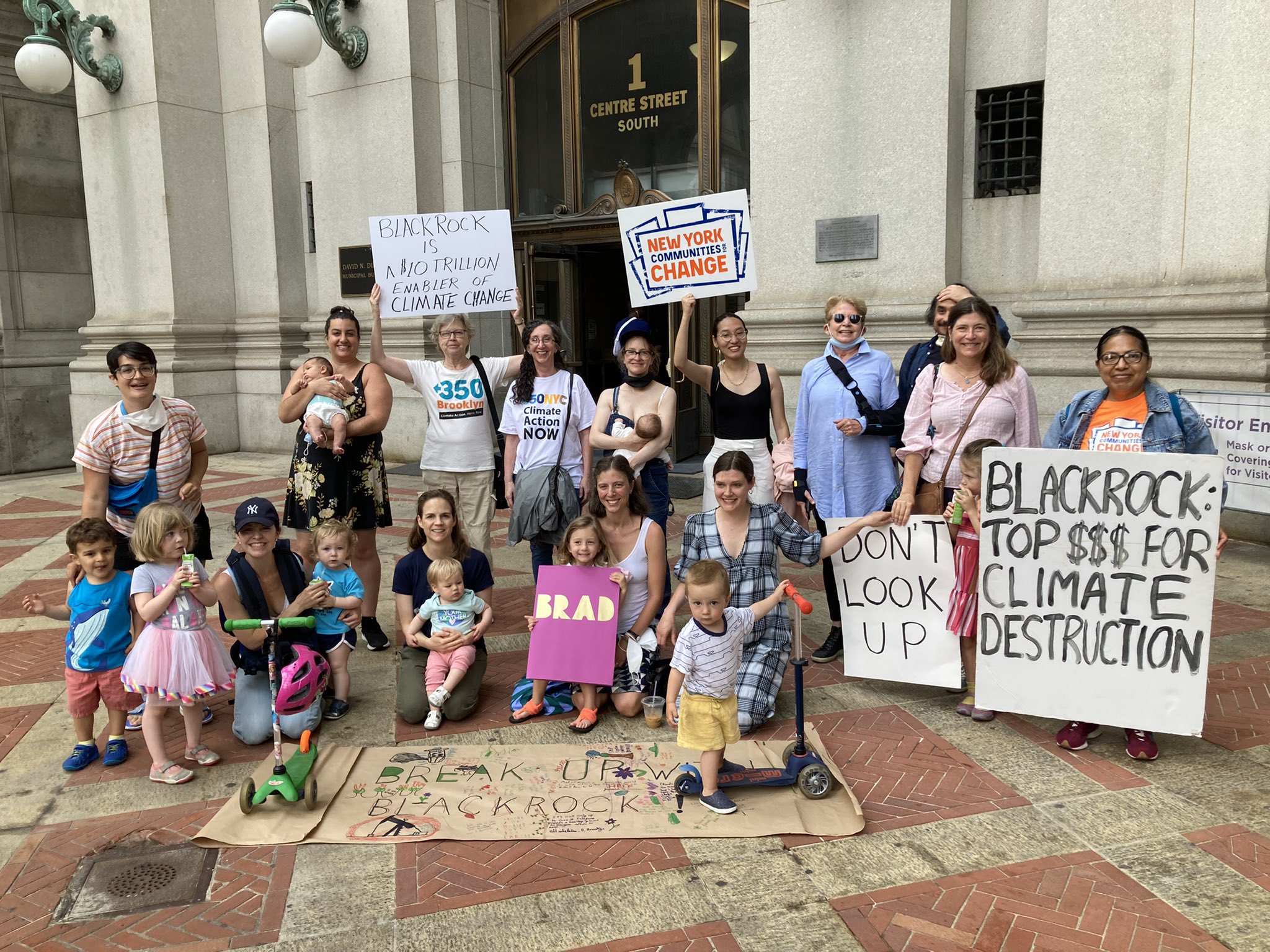
Climate activists rallying outside Lander’s office in 2022, calling for the comptroller to divest the city’s funds from BlackRock. (Courtesy of New York Communities for Change)
Forty seven months into his 48 month term, New York City Comptroller Brad Lander has proposed moving some of the city’s enormous pension fund business from dirtier to cleaner money managers. In particular, Lander proposes sending $42 billion worth of the city’s business with BlackRock, the world’s dirtiest money manager, to other, cleaner firms. If enacted as policy, that’d give Wall Street 42 billion reasons to clean up on climate.
Yet the proposal means nothing if it isn’t enacted. And there’s exactly one pension fund board meeting before Lander is no longer comptroller. Now, at the 11th hour, it’s time for Lander to use his considerable political skills to get it done. If he gets the pension fund trustees to enact his late-game proposal, it’ll be a major boost in the global fight against climate change.
The stakes are high: if global pollution levels don’t decline much faster than they are currently, about 30 percent of the city will flood chronically as sea levels rise and rainstorms intensify in the coming decades. It’s imperative for the city to reduce pollution to save itself—and absurd for it to finance its own destruction by investing in oil and gas. Moreover, since it is a low-growth industry entering the beginning of its sunset, oil and gas companies have lagged the broader markets now for many years.
Under previous Comptroller Scott Stringer, the largest of the city’s five pension funds committed to and then implemented divestment from oil, coal and gas. By the time Comptroller Lander took office, the city had dumped three of four billion dollars in stocks and bonds it had held from the likes of Exxon. Lander then finished out the city’s fossil fuel divestment program.
Meanwhile, as the city has divested from oil and gas, the red states and Trump have pushed the biggest Wall Street firms to keep pouring money into fossil fuels. As a result, instead of beginning to clean up, BlackRock—the city’s top money manager—has rolled back the very modest steps it took on climate. For example, BlackRock has returned to the worst shareholder voting record on climate action of all large money managers.
Since BlackRock invests over $12 trillion (trillion!) and owns about 10 percent of every big, publicly traded firm, its power is immense. Yet its business practices run contrary to the city’s net zero pollution goals. Why is the city sending tens of billions of dollars in business to a company whose services can be replaced by other, cleaner managers?
The city should align its money managers with its goals to achieve net zero pollution. Indeed, as a universal owner, the city can only achieve its goals if its money managers are aligned with it. Thanks to its size, the city’s leverage is also large: it currently sends about $50 billion in business to BlackRock alone.
Now, Lander’s proposal for action comes very late, but is strong. He proposes to shift $42 billion worth of business from BlackRock based on the manager’s failure to act as a responsible shareholder advocate. Lander points out that BlackRock is knuckling under to Trump by failing to vote the shares it controls in U.S. companies where it holds more than 5 percent of stock.
By failing to effectively use its voting authority, BlackRock is abdicating its oversight duty, including on climate. If shareholders aren’t vigilant over the companies they own, their interests, including New York City’s pension funds, are damaged.
Thus, Lander’s demand that BlackRock either exercise its fiduciary responsibilities or lose the city’s business makes perfect sense. The problem is that by waiting until the virtual end of his career as comptroller, Lander has left precious little time to convince his fellow trustees to act.
Regardless of his process to reach his conclusions, the core logic of Lander’s proposal is sound: the city’s pension funds should enact it. After the city has acted to part ways with BlackRock, it can proceed to more comprehensive climate risk metrics to cover all of its managers, under incoming Comptroller Mark Levine.
Such action could and should assess climate risk more broadly, rating all of the city’s managers in part on their capabilities to manage such risks. The city should give managers positive consideration in its business decisions for better policies—and negative consideration for future contracts if they have weaker policies.
Right now, though, Lander should make the rubber hit the road at the upcoming New York City Employees’ Retirement System (NYCERS) pension fund board meeting. If Lander gets it done, he’ll establish a legacy to match previous Comptroller Stringer, who set divestment into place. Conversely, if Lander fails to enact his proposal, he’ll have ended his four years with precious little in the way of results of his own.
As the adage goes: better late than never.
Jose Gonzalez and Pete Sikora are climate campaigners for New York Communities for Change. Dorian Fulvio serves on the steering committee of 350NYC.
The post Opinion: Will NYC’s Pension Funds Once Again Lead the Nation on Climate Change? appeared first on City Limits.


More Stories
Today in History: January 2, ‘Yorkshire Ripper’ captured in England
Today is Friday, Jan. 2, the second day of 2026. There are 363 days left in the year. Today in...
Other voices: Lower housing prices, not loan standards
Philosopher George Santayana once famously observed, “Those who cannot remember the past are condemned to repeat it.” Unfortunately, our nation’s...
Waiting for a mentor: Natalie
Kids ‘n Kinship provides friendships and positive role models to children and youth ages 5-16 who are in need of...
Callahan: The Patriots’ Stefon Diggs and Christian Barmore stance and other Week 18 thoughts
Welcome to the Friday Five! Ready, set, football. 1. The Patriots’ strong stance Coming down from the tumultuous news cycle...
Today in History: January 2, ‘Yorkshire Ripper’ captured in England
Today is Friday, Jan. 2, the second day of 2026. There are 363 days left in the year. Today in...
Battenfeld: Michelle Wu ignores Kraft-Trump bromance to broker stadium deal
The progressive face of the Democratic Party, Boston Mayor Michelle Wu, just handed a big victory to the kind of...