
Boston Holocaust Museum installs historic early 20th-century railcar exhibit

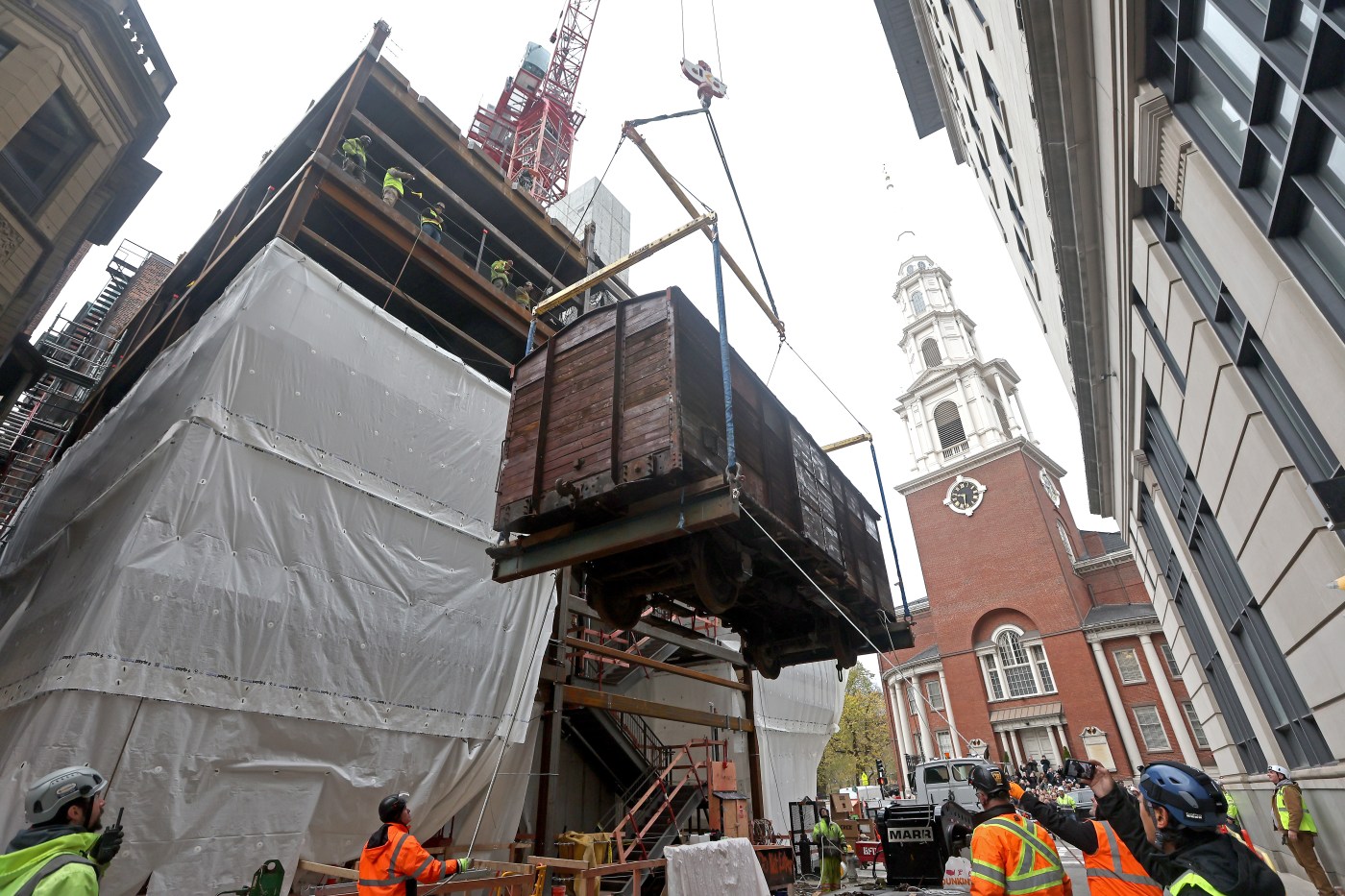
Traffic stopped on Tremont Street in downtown Boston early Tuesday morning as a 12-ton historic railcar was lifted over a hundred feet into the city’s future Holocaust Museum, an artifact donated by the family of a survivor and personal reminder of the tragic chapter for Bostonians to look up at.
“We don’t look at this rail car as just an artifact,” said Jody Kipnis, co-founder and CEO of Holocaust Museum Boston. “We look at it as a witness to history. It carried human beings who were stripped of their dignity and sent towards ghettos, labor camps and extermination camps. … We’re placing the rail car into the fourth story glass bay window, right across from the Freedom Trail, so that no one walks by without being reminded of the cost of indifference.”
The restored early 20th-century railcar was lifted in a 173-foot-tall tower crane to be installed in the fourth-floor of the museum just after 9 a.m. Tuesday morning, watched by museum officials, government officials, members of the Jewish community and more.
The installation is a major step in the construction of Boston’s newest museum, set to open late 2026. The museum will be the only one in New England solely dedicated to Holocaust education.
Construction will continue around the massive historic railcar, measuring 30 feet long, 12 feet high, and 8.75 feet wide, officials said. The exhibit will be visible from the street, set up in a protruding bay window, and visitors will be able to walk through the railcar.
“From outside the museum, passersby will see people enter the railcar, but not exit – a visible reminder of the millions of Jews who were transported to their deaths in railcars just like this one,” the museum detailed.
Kipnis said the installation will be one of many interactive parts of the museum.
“We’re inviting the visitor to really examine the past, but then connect it to things that are happening in present day,” said Kipnis. “Not telling the visitor how to do those connections, but helping them throughout the their journey through the museum.”
The CEO said her hope is “people leave committed to standing up against hatred, bigotry and anti-semitism within their schools, communities and workplaces.”
The railcar was donated by Arizona-native Sonia Breslow, whose father was one of fewer than 100 survivors of the 900,000 murdered at Treblinka, the organization said. The artifact is a “powerful and personal testament to history,” as Breslow’s father was transported to the extermination camp in a railcar of the same type. After surviving the camp, Breslow’s father immigrated to Boston.
The railcar exhibited was discovered in a Macedonia junkyard, the museum detailed, before being brought to the U.S., stored in Arizona and brought to Massachusetts to be preserved by a conservator.
Breslow said Tuesday seeing the railcar lifted into its new home “took my breath away.”
“My father survived a transport to Treblinka in a car just like this,” Breslow said. “Most who were taken there did not survive. For this rail car to be in Massachusetts, a place where he rebuilt his life is deeply personal and ensures that his story and the stories of millions will never be forgotten.”
The crowd applauds as the Holocaust Museum Boston raises a 12-ton early 20th century European rail car to its new home in the future museum. (Staff Photo By Stuart Cahill/Boston Herald)


More Stories
Royal Mail faces scrutiny as 219 million letters arrive late despite rising stamp prices
Royal Mail is facing renewed scrutiny over the reliability of Britain’s postal service after figures revealed that around 219 million...
Government-funded mobile mast upgrades reach 50 milestone in Wales
Fifty government-funded mobile mast upgrades have now been activated across Wales as part of the UK’s Shared Rural Network (SRN)...
Small businesses sceptical over tariff refunds after Supreme Court strikes down Trump’s tariffs
Small business owners across the United States have expressed scepticism that they will ever see refunds following the landmark ruling...
OpenAI delays ‘adult mode’ for ChatGPT to focus on higher priorities
OpenAI has confirmed it is postponing the launch of an “adult mode” for ChatGPT, saying the company will instead prioritise...
China prioritizes Russian gas amid Middle East conflict – media
Beijing’s latest development strategy envisions accelerated work on a major gas pipeline project with Moscow China has signaled a major...
The Business Behind the Bet: How UK Online Gambling Became a Sixteen Billion Pound Industry
The UK Gambling Commission’s annual report for the financial year ending March 2025 recorded a total gross gambling yield of...