
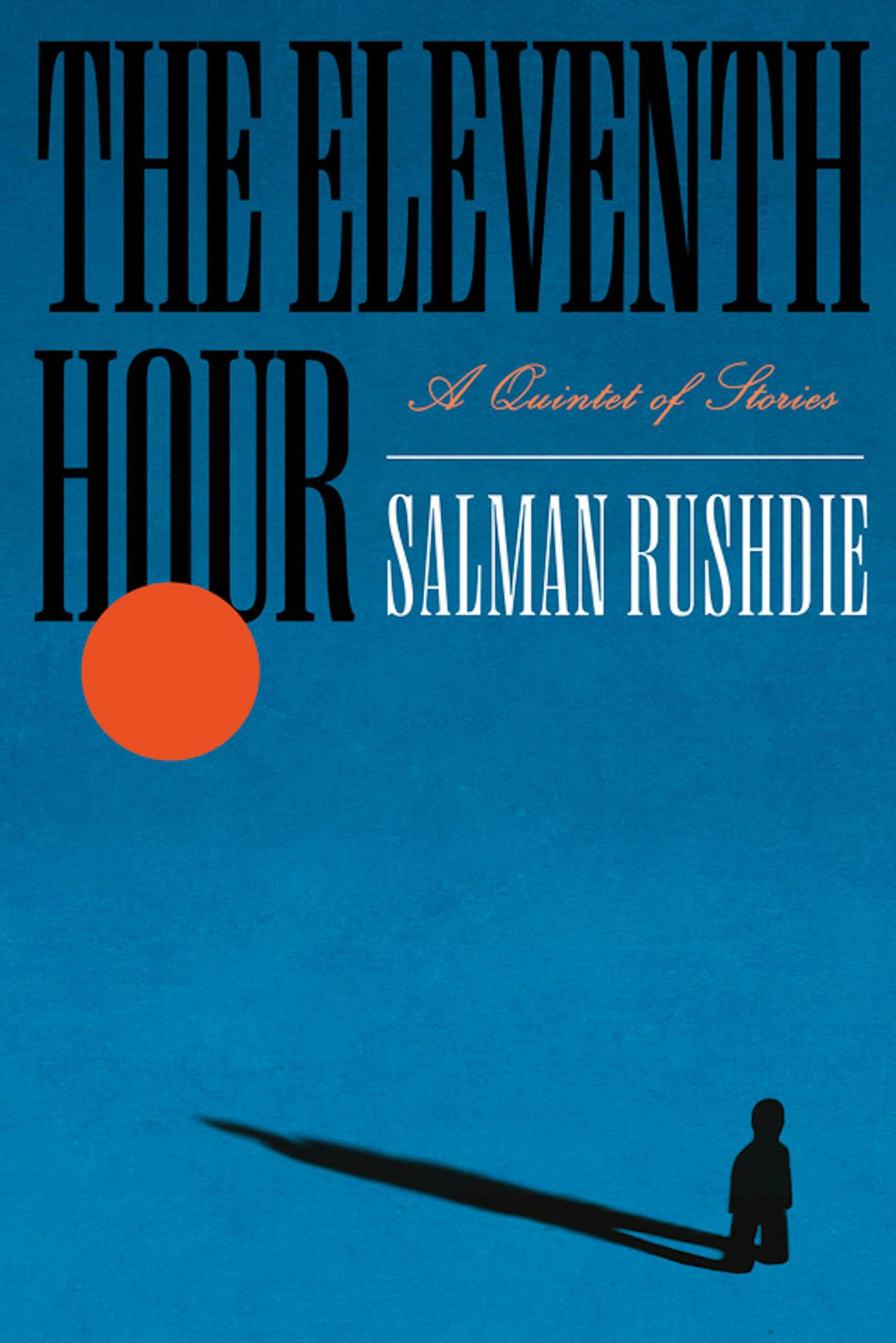
Rushdie still at top of his game with ‘Eleventh Hour’

Call him a master wordsmith, formal innovator, Booker prize winner, Nobel laureate-in-waiting, a sorcerer. Call him Sir Salman Rushdie.
He slips into a story as gracefully as Laurence Olivier vanished into a Shakespearean role. Rushdie’s towering talent is evident throughout “The Eleventh Hour,” a quintet of tales that are his follow-up to “Knife,” a searing memoir of his near-fatal 2022 stabbing. Here, his fiction blends the real with the fable-like. No Anglophone writer does it better.
Set amid a city on India’s southeast coast, “In the South” features Senior and Junior, two elderly men who share a last name and adjoining balconies and who contemplate philosophy and religion. “Oklahoma” is a text embedded within a text, brimming with mesmerizing mystery, befuddled characters and an afterword that offers as much clarity as the Sphinx’s riddle.
“The Musician of Kahani” unfolds in a city not unlike Mumbai: An unhappily married couple of mathematicians marvel at their daughter, who fixates on an old piano. “Its presence was a kind of prophecy. One day the little girl lifted the piano’s lid, struggled up onto the stool, and simply began to play. Her astounded parents came into the room and stood and watched as people do before whose eyes a miracle is taking place.”
The prose here is Rushdie at his supple best, restrained yet daring. He nods to non-western traditions: a college provost enters a room “as regally as he always did, floating forward as if conveyed on a small airborne rug, the invisible bejeweled crown glittering as usual on his shining head, the imaginary orb and scepter of kingship in his hands.”
In the wake of the author’s recent attack (he lost an eye), his characters brood on mortality; a few are ghosts, such as a dead 61-year-old academic who wakes up one morning, still sentient: “Things he would never do. He would never visit the Pyramids or Greece or his mother’s grave. Things he would never do again: sex would be at the top of the list for many people, but in his case it hadn’t been a subject for a long time, so it didn’t count. He should put ‘eat Chinese food’ up there instead.” There’s a twist in this piece, “Late,” that underscores Rushdie’s wizardry on the page.
While diverse in technique, each story in “The Eleventh Hour” springs from a common argument: Language, whether spoken or read or imagined, transforms us all.
In the collection’s concluding piece “The Old Man in the Piazza,” Rushdie writes: “Words simply burst out of people and would not be held back. People felt great globs of vocabulary rising up in their throats and pushing against their teeth, like children released from single-sex boarding schools at the end of a long, dour semester.”
Witty if somber, “The Eleventh Hour” showcases the agility of one of our greatest writers in the aftermath of his brush with death.
Tribune News Service
‘THE ELEVENTH HOUR: A QUINTET OF STORIES’
By Salman Rushdie
Random House, $29
Grade: A


More Stories
Bristol’s new arena sets sights on hosting the Brit Awards
Bristol is about to join the big league of British live entertainment, with the city’s forthcoming Aviva Arena setting its...
Businesses shoulder £200 billion National Insurance bill as payroll tax receipts surge 40% since pandemic
The scale of the tax burden heaped on British businesses since the pandemic has been laid bare by new HMRC...
GB News makes its pitch for a slice of public broadcasting funds
GB News has made a bold bid for access to the public purse, arguing that government broadcasting grants should be...
Budget tax breaks worth £100m come into force for founders and start-ups
Fresh incentives designed to turbocharge Britain’s start-up and scale-up economy have officially taken effect, with the government forecasting that the...
Easter and Eid collision sends British lamb prices to a record high
Supermarket shoppers face paying more than £16 per kilo for a leg as overlapping religious festivals, shrinking flocks and buoyant...
Vince calls on Miliband to halt North Sea oil exports as Iran war rattles supply
One of the Labour Party’s most prominent financial backers has called on Ed Miliband to slam the brakes on North...