
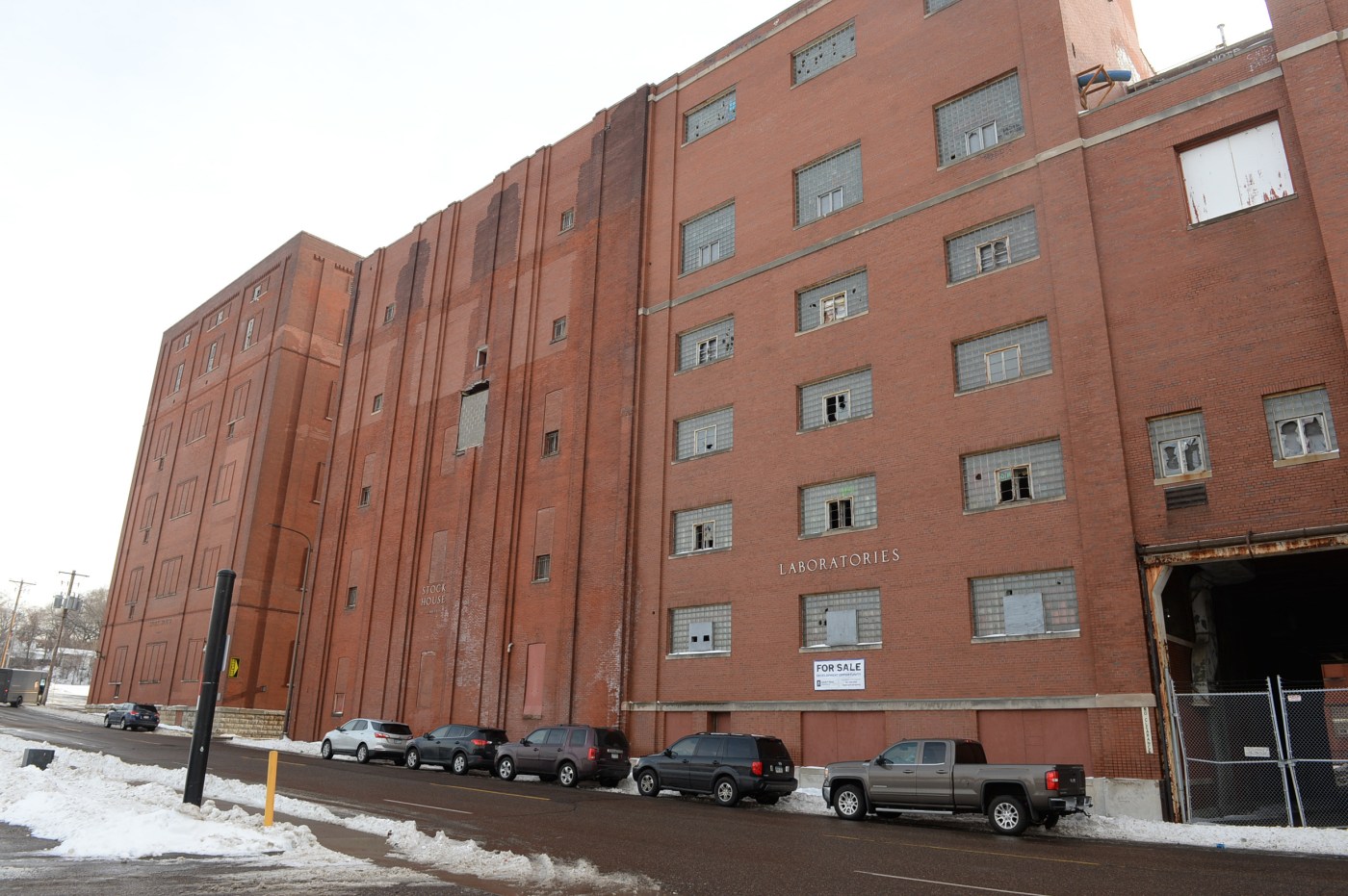
St. Paul: Hamm’s Brewery site designated ‘local heritage preservation district’

The Theodore Hamm Brewing Co. once employed a handful of workers on St. Paul’s East Side, circa the 1860s. With a new dormitory installed for laborers and Hamm, a German immigrant and former saloon owner, at the helm, that handful grew to 75 employees by the late 1880s, and then, under his son’s and grandson’s leadership, into the hundreds, ultimately peaking at 1,300 workers in the 1940s and ’50s.
Hamm’s signature marketing jingle — “From the Land of Sky Blue Waters” — would go on to make Hamm’s beer, and the Hamm’s bear mascot, a nationally recognized brand.
The story of the Hamm’s Brewery, once one of the city’s largest employers, and its one-story to six-story red brick buildings has been less romantic in the modern era, with different portions of the massive brewery campus partitioned for the creation of Phalen Boulevard, converted into eclectic uses such as a used car lot, thrift clothing shop and trapeze school, or acquired by the city after changes in property ownership.
The last major beer maker and land owner, Stroh Brewery, left the site in 1997.
‘More than a collection of old buildings’
On Nov. 5, the day after much of the city went to the polls to elect a new mayor, the St. Paul City Council voted to adopt a local historic designation for the 23-acre “Theodore Hamm Brewing Company Heritage Preservation District,” which spans some 30 buildings owned by at least eight separate entities along Minnehaha Avenue between Payne Avenue and Arcade Street.
The district opens up the possibility of state and federal historic tax credits, among other grants, a key part of developer JB Vang’s plans to install more than 100 units of affordable housing on site.
“This landmark is more than a collection of old buildings,” said council member Cheniqua Johnson, addressing the council before the 7-0 vote. “It’s a symbol of resilience. … Even during Prohibition, when other breweries closed, Hamm’s found a way to survive producing soft drinks and other goods. That adaptability speaks volumes to how that site has constantly adapted to the times. What excites me the most about the site is that it continues to evolve.”
The local historic nomination, previously vetted by the city’s Heritage Preservation Commission and the St. Paul Planning Commission, as well as the State Historic Preservation Office, follows 20 years of off-and-on debate. It also follows an ongoing dispute between the city and JB Vang on the one hand and, on the other, St. Paul Brewing Co. owner Rob Clapp, who had previously objected to real estate development plans that would fill in part of a shared parking lot with new housing.
The district was nominated to the National Register of Historic Places in 2005, but was never added to the registry due to objections from multiple property owners. It received a “Determination of Eligibility” letter from the National Park Service instead, effectively queueing it up for a national historic designation if the objections were to ever subside. They have not.
Local, not national, designation
“The district was determined eligible … as one of the most important breweries to operate in the state of Minnesota and … for its association with three of the state’s more influential businessmen — Theodore Hamm, William Hamm (son), and William Hamm Jr. (grandson),” reads a city staff report, referencing the 2005 designation. The “period of significance” was identified at the time as 1865 to 1952.
On Jan. 27, the Heritage Preservation Commission supported an updated nomination to the National Register, which was also backed by the State Historic Preservation Review Board in February. The National Register recommended that the “period of significance” be updated as well, to 1865 to 1965, to reflect the year that the brewery was sold to new owners. As a result, eight structures, including a carpenter shop, silo and warehouse, were added to the map of buildings that could contribute to a potential historic district.
With a national designation stymied by Clapp’s objections, among others, developer JB Vang opted for a local historic designation instead.
The city has more than 75 individually designated historic properties and nine locally designated historic districts, which require permit review by the city’s Heritage Preservation Commission before any significant changes. The local districts do not trigger state or federal review for permit changes.
State, federal historic tax credits
Still, having the city designate the brewery a local historic site could unlock state and federal historic tax credits, a key part of the developer’s efforts to add 110 loft-style affordable housing rentals and an indoor marketplace on property currently owned by the city’s Housing and Redevelopment Authority. J. Kou Vang, the developer’s president and CEO, raised written concerns that without historic tax credits, his redevelopment plans could be dead in the water.
In April, JB Vang Properties nominated the district for designation as a St. Paul Heritage Preservation site, and a public hearing was held before the city’s Heritage Preservation Commission on May 19. The developer remains hopeful it can secure financing next year and possibly begin construction in mid-2027.
“We know that renovating and restoring historic buildings like these, which have been vacant and in decline since 1997, is much more expensive than new construction, and tax credits are a tool intended to bridge this gap,” reads an Oct. 22 letter from JB Vang vice president of development Ashley Bisner to the city council. “Creating a local historic district will unlock the necessary historic tax credits and ensure the history here is preserved.”
Related Articles
U.S. Customs and Border Protection plans $11M facility at St. Paul airport
St. Paul City Council orders demolition of former CVS at Snelling-University
140-year-old rug cleaner/retailer to leave Minneapolis for St. Paul
St. Paul Port Authority celebrates end of East Side TIF district
St. Paul: Hearing officer recommends demolition of vacant Midway CVS
The vote on the historic designation was supported by the Payne-Phalen Community Council, the Dayton’s Bluff Community Council, Historic St. Paul and the housing advocacy group Twin Cities YIMBY, who noted its proximity to the Bruce Vento Regional Trail and Swede Hollow Park.
The public record shows no written objections from Clapp over the local historic designation. Clapp and his representatives were not available for comment on the matter.
Clapp sued the city in August, objecting to the city council’s decision to rezone the Hamm’s site for new development in a manner that he described as “spot zoning,” which is illegal in Minnesota. Clapp, who also owns Dark Horse Bar & Eatery in Lowertown and Can Can Wonderland in the Midway, acquired property on the Hamm’s site in 2021.

More Stories
Frederick: Congratulations to whichever NFL team hires Brian Flores to be its next head coach
Dallas entered Sunday night sporting the NFL’s top offense by yards per game and passing yards per game and the...
Vikings dañan gravemente las esperanzas de playoffs de Cowboys al vencer a Dallas 34-26
Por SCHUYLER DIXON ARLINGTON, Texas, EE.UU. (AP) — J.J. McCarthy lanzó para dos touchdowns y corrió para otro, C.J. Ham...
Dear Abby: Telling hoarder pal house party a bad idea
Dear Abby: We have a mutual friend who’s very dear to us. He’s a kind-hearted and generous disabled vet who’s...
Toluca consuma el bicampeonato después de vencer 9-8 en penales a Tigres tras empate global de 2-2
TOLUCA, México (AP) — Alexis Vega volvió al campo después de mes y medio de ausencia para marcar el penal...
Grant y Sharpe anotan 35 puntos cada uno y los Blazers vencen 136-131 a los Warriors
PORTLAND, Oregon, EE.UU. (AP) — Jerami Grant y Shaedon Sharpe anotaron 35 puntos cada uno y los Trail Blazers de...
El primer ministro australiano Albanese propone endurecer leyes de armas tras tiroteo en Sydney
Por CHARLOTTE GRAHAM-McLAY, ROD MCGUIRK y KRISTEN GELINEAU SYDNEY (AP) — El primer ministro australiano, Anthony Albanese, propuso el lunes...