
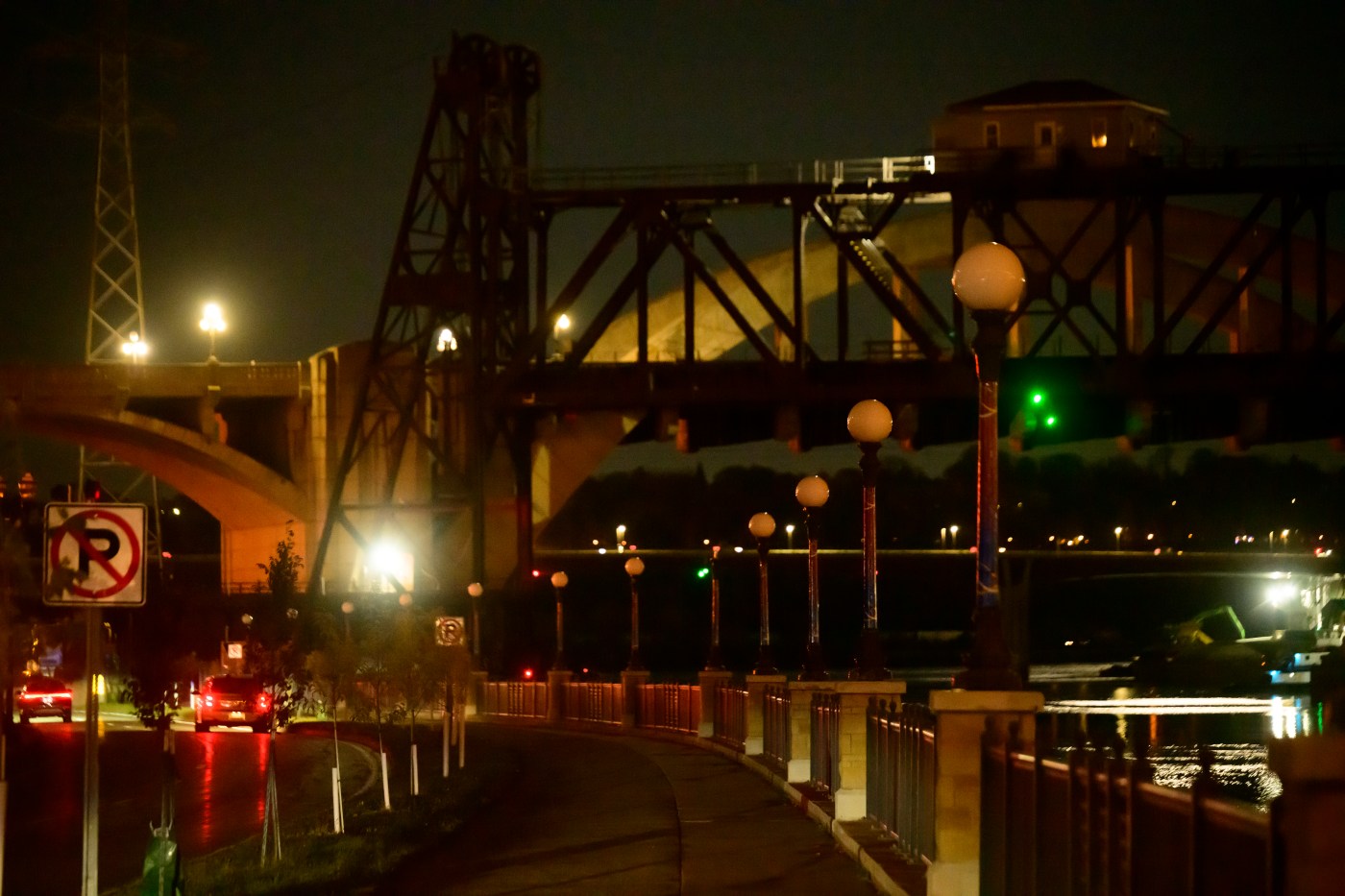
St. Paul: Why do some streetlights remain out on Shepard Road, elsewhere?

If the capital city seems a bit brighter at night, that’s because more streetlights remain lit. In stops and starts, the city of St. Paul has begun to get a handle on the copper wire thefts that for years had been cloaking long swathes of the city in darkness, with at least one prominent exception.
A particular thoroughfare — a principal arterial road into downtown St. Paul — remains the one that got away like a thief in the night, so to speak. Along a four-mile stretch of Shepard Road, drivers have reported upwards of 250 darkened streetlights between Lowertown and Otto Avenue in Highland Park.
“Lights out along Shepard Road are a huge public safety issue,” said city council President Rebecca Noecker, who represents downtown St. Paul and surrounding neighborhoods and has asked community members to come together in a letter-writing campaign to voice their concerns to City Hall.
Her goal is to find dedicated funding for repair and replacement of the darkened lights, which may have contributed to the repeat vandalism of dozens of freshly planted trees along Shepard Road in October, as well as last November.
“We simply can’t protect what we can’t see,” Noecker wrote in an Oct. 28 newsletter to constituents.
Mississippi River flooding forced St. Paul to close more than three miles of Shepard and Warner roads for weeks at a time in both 2023 and 2024, creating easy access for thieves to strip copper wire from the many streetlights stretching from Interstate 35E through downtown to U.S. 61. Only scattered fixtures were untouched in a few high-visibility areas, including in front of the Upper Landing housing development.
Fast forward more than a year or two, and they’re still out.
“Shepard/Warner Road has been repeatedly hit with repetitive wire theft over the last few years,” said Lisa Hiebert, a spokesperson for St. Paul Public Works. “The city has replaced it several times to have it almost immediately re-stolen.”
Some progress citywide — but not on Shepard
A street light along Shepard Road in downtown St. Paul is dark on Wednesday, Nov. 5, 2025, after a string of copper wire thefts. (John Autey / Pioneer Press)
Stretching for eight miles from Highland Park to Battle Creek Regional Park, the four-lane Shepard/Warner Road bears the distinction of hosting scores of streetlights that are a bit different from the city’s norm. Partly as a result of volume, traffic control and design, getting their lights turned back on could cost $750,000 or more, according to St. Paul Public Works Director Sean Kershaw.
And that’s money his department doesn’t have on hand.
To the west of Otto Avenue, Shepard Avenue a city-owned road. To the east of Otto and through downtown St. Paul, Shepard/Warner is technically a county road, but the city is in charge of the streetlights.
In 2024, St. Paul Public Works spent $2 million replacing stolen wire citywide or installing high-access poles. This year, the city has seen some progress, though exact figures are hard to come by because of the city’s transition to a new asset-management system and a cyberattack that crippled reporting for weeks this summer.
There remain other spots still in the dark around the city. Public Works received 1,472 calls for darkened lights from Jan. 1 through Sept. 1 of last year, compared with 969 calls in the same period this year.
“The best year-to-year measure that we have is calls from people in the public reporting copper wire theft,” Kershaw told the city council during a Sept. 17 budget discussion. “Right now, we’re seeing calls down by about 30% year over year. … Our rate of theft had been doubling every year for five years. So, A) they’re not doubling, and B) they’re going down, and C) there’s still too much.”
St. Anthony Park area also hit
Thieves in recent years have returned, time and again, to some of the same spots, yanking wire almost as quickly as it can be replaced. Wire thieves were especially drawn to St. Anthony Park this past summer, according to Public Works, even as the city made progress keeping Como Park lit.
“The city recently replaced a big stretch of wire along the walking path on the south side of the lake that had noticeably been out for quite a while, which has been celebrated with fingers crossed that it stays lit, especially with the days getting shorter,” said Shevek McKee, executive director of the District 10 Como Community Council, in an email.
Near CHS Field, parts of Prince Street remain dark on either side of the Lafayette Bridge, as does Lafayette Street. Around the same time Shepard Road fell victim, the decorative lights died along the Sam Morgan Regional Trail, from behind the Upper Landing development over to Lambert’s Landing.
Some of those are back on, but “Shepard Road is totally dark at night,” Kershaw acknowledged. “It’s isolated. It’s incredibly easy to steal copper there. … The cars are going by quickly.”
“Solving that has a mechanical problem, it has a theft-prevention problem and it has a capital problem,” he added. “I won’t say that there’s going to be an easy answer there.”
The First Bank sign shines above an unlit street light, after a string of copper wire thefts, along Shepard Road in downtown St. Paul on Wednesday, Nov. 5, 2025. (John Autey / Pioneer Press)
The Shepard Road lights, he explained, sit on a base with two access panels instead of a one-panel base like most of the city’s streetlights, making them doubly complicated to protect.
“That stretch is also really long,” Kershaw said. “Even if we had the perfect way to protect the base, it’s a long stretch, so it’s really expensive. … We have to put traffic control in place … and we don’t have money to do that right now.”
Kershaw said he was not optimistic about short-term solutions, though “we’re in the process right now of evaluating options.”
All of those options carry pros and cons. Reinstalling copper wire in the existing lights, with added shielding to try to deter theft, could be prohibitively expensive because of the length of the corridor. That approach still would not guarantee against theft, Hiebert noted.
Installing wood poles with temporary lighting would also be costly, but it could be even more theft resistant. Highway-style lights would likely be the most effective, but they too would be costly, and they lack the same lantern-style aesthetic.
“Nothing is a quick fix, and nothing is foolproof or theft-proof,” Hiebert said.
Law changes
Hiebert said if a resident sees someone fussing with a streetlight panel and there’s not a city vehicle parked at the site, that’s a good time to call 911 right away.
“With the help of our residents, the police have been able to catch, arrest and prosecute some of these thieves,” she said. “The more eyes we have watching our tens of thousands of streetlights, the better we can all protect them and keep our streets lit this winter.”
In addition to public tips, police enforcement and active efforts to replace stolen wire, the city has been able to rely on two major policy changes aimed at deterring theft. As of Jan. 1, the state has required a license to sell copper, a disincentive for anyone looking to yank wire off a streetlight and run to a scrapyard. The $250 license must be renewed annually. Residents and businesses may still recycle copper with scrap metal companies free of charge.
As of Aug. 1, destruction of or damage to streetlights is now classified as damage to public infrastructure, which is a felony. It’s a bit too soon to tell whether that legal change will have a long-term impact, but it could help, Kershaw said. Also helping matters: copper prices have dropped somewhat.
Public Works has mapped 2,000 locations where the public reported dead streetlights to the department from January through December 2023, a period when the department’s repairs exceeded $777,000, compared with $99,000 in 2019. That spending increased to $2 million last year.
That map, as well as answers to more than a dozen frequently asked questions related to copper wire theft, is online at tinyurl.com/StreetLightFAQ.
How many streetlights?
Among those questions: How many streetlights does the city have, anyway?
The answer is more than 42,000, including 5,000 lights maintained by St. Paul Parks and Recreation in parks and park facilities. There are 16 design styles, with the most common in the city being lantern lights.
Another frequently asked question: What strategies has the city experimented with to prevent copper wire theft?
The short answer is welding, epoxying and banding access panels; using security bolts and screws to close and secure access panels; keeping streetlights on, or “daylighting,” to keep the wires electrified during the day; using smaller gauge wire, which would be less valuable for theft and resale; and labeling wire “City of Saint Paul” to identify ownership for authorities and recyclers.
They’ve also tried silent alarms and considered changing streetlight fixtures to aluminum wiring, which comes with higher costs and other complications. Maintaining the city’s streetlight system would get more expensive if the city were to make the switch, and changing the wire type likely would require the use of a heavier wire compared to the thinner gauge copper wire used now, according to Public Works.
Related Articles
St. Paul mayor’s race: What voters say about Kaohly Her’s victory
Joe Soucheray: Seems Mayor-to-be Kaohly Her brings regard for detail and private success. Pinch me!
Minnesota officials say SNAP benefits will be funded for November
Former Irish on Grand employee buys building, opens new St. Paul store
Letters: All the agreements Hitler signed were meaningless. Same with Putin’s.
“Aluminum wire still has resale value, and is not likely to decrease the current rate of wire theft,” according to the city’s website.
High-access poles have generally deterred theft at streetlights, Hiebert said, but the city has seen an increase in adjacent facilities as thieves move to other copper sources nearby.
Solar lights, catch basin vandal
Public Works staff are still studying creative measures to install and protect copper wire, according to Hiebert, but they’re time-intensive. The department continues to explore options for new capital funding and new designs as a part of its capital construction program, she said.
Among newer approaches, Public Works has been testing solar lights in the reconstruction of Pleasant Avenue, in connection with an effort to explore the best solar lighting options for northern cities through the Minnesota Local Road Research Board.
The stakes are far from academic. In December 2023, a pedestrian was killed after being struck by a driver at a Ramsey County construction site at Maryland Avenue and Park Street, where a new streetlight had yet to be turned on because of wire theft.
It’s not just streetlight wires that have been stolen or tampered with.
Metal vandals have targeted everything from EV-charging stations to utility vaults, private businesses, and heating and air conditioning systems.
More than one case has been resolved with an unusual outcome. With the help of security cameras and St. Paul police, authorities recently caught up with an alleged vandal who had been removing catch basin grates from city streets. The “thief” turned out to be someone with obvious mental health needs who had been moving the grates, apparently to buff them.
“We caught the catch basin vandal,” Kershaw said, noting his department had appealed to the public for tips. “The person was in mental crisis and was trying to clean the basins.”


More Stories
Mexico threatens to ditch US gas
The country has signaled a shift toward domestic fracking as global energy prices soar due to the war in the...
US energy giants report fallout from Middle East war
Exxon and Chevron have both disclosed production declines which resulted from the Iran conflict US energy giants ExxonMobil and Chevron...
Vinted breaks the billion-euro barrier as thrifty shoppers embrace second-hand fashion
The relentless squeeze on household budgets is reshaping how consumers buy clothes, and few businesses are reaping the rewards quite...
Oil price surges towards $100 as Middle East ceasefire begins to unravel
The brief sigh of relief across global markets lasted barely a day. Brent crude climbed sharply back towards $100 a...
Harrods Estates shuts up shop after 130 years as tax raids on wealthy overseas buyers take their toll
The iconic property arm of the Knightsbridge department store has closed its last remaining office after a perfect storm of...
John Lewis chairman’s pay climbs 21% to £1.2m as 3,300 roles disappear across the partnership
There is never an easy way to announce a hefty pay rise at the top while headcount is falling on...