
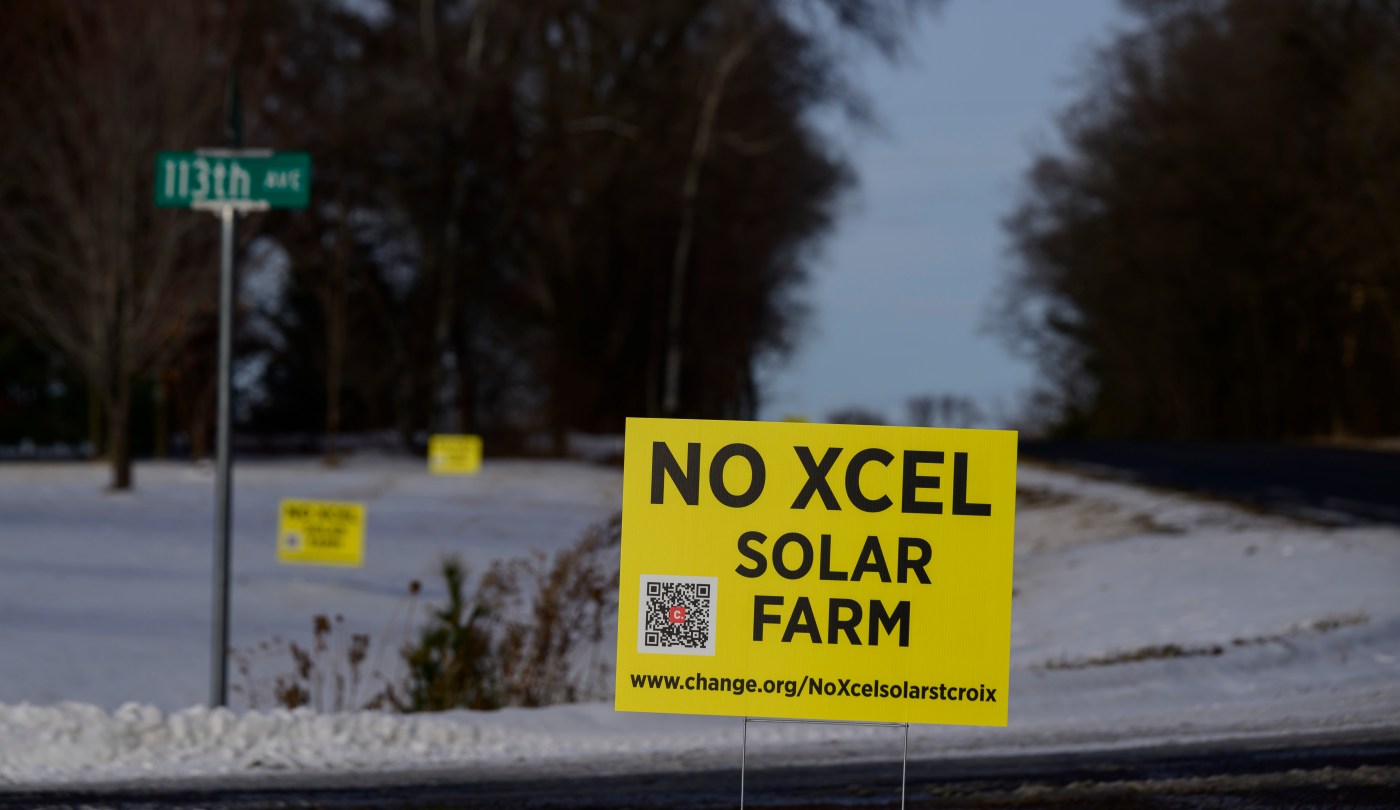
Xcel pares Wisconsin solar farm project, adds battery backup

Xcel Energy has curtailed plans to build a large-scale solar farm spread across thousands of acres in western Wisconsin, cancelling the second phase of the plan, while moving ahead with the first phase and instead adding battery energy storage to the proposed project.
The Ten Mile Creek Solar project calls for 300 megawatts to be generated on solar panels spread across 2,980 acres of leased land in St. Croix County. The project also includes building and routing a new transmission line to the existing grid connections at Xcel’s Allen S. King Power Plant in Oak Park Heights.
The coal-fired King plant is set to be decommissioned in 2028, but Xcel plans to continue to use existing connections at the site.
Originally, Xcel’s Ten Mile Creek Solar proposal included up to 650 megawatts of solar panel production on 5,000 acres spread across some 40,000 acres in St. Croix County.
Federal support of solar tech sunsets
The market atmosphere for renewables has changed greatly since Xcel announced this project, meant to pick up the slack of the King plant eventually being taken offline. Federally, President Donald Trump has called wind and solar generation the “scam of the century,” at a time when, according to the World Economic Forum, other industrialized nations are investing into renewables at historic rates, moving away from pollution linked to oil and natural gas.
Trump’s One Big Beautiful Bill Act also stripped away much of the incentives for wind and solar projects previously passed under the Biden Administration. Future costs of the components for the panels themselves are also uncertain, as Trump has taken aim at China, responsible for more than 80 percent of the manufacturing share for solar panel components, in his trade war.
Leaders of the two countries met last month as new tariffs were scheduled to go into effect on Nov. 1. Trump had previously threatened a 100 percent tariff on Chinese imports but, after the talks, said he was lowering the rate on Chinese imports to 47 percent from 57 percent.
Asked if the federal government’s reluctance to support renewable energy sources factored into the plan to pare the Ten Mile Creek proposal, an Xcel Energy official declined to blame federal support specifically, saying that his company reviews all external factors in the marketplace that go into a long-range project like this.
Specifically, the cost and technology of battery systems has greatly improved since project planning began in 2019, Regional Vice President for Wisconsin and Michigan Brian Elwood said. That allowed Xcel to change the scope of the project, he said.
According to maps provided by Xcel Energy, the battery energy storage facility and a substation will sit northeast of the corner of 170th Street and County Road E, a few miles north of Hammond, Wisconsin.
While phase two is being vacated for the time being, Xcel representatives said they have secured leasing agreements for the full 5,000 acres, and will maintain those options as needed.
Xcel Energy will now work to complete its application with the Public Service Commission of Wisconsin to move the project ahead. That application is expected to be filed by the end of 2025, which kicks off a 12- to 18-month review process by the Public Service Commission. If eventually approved, the first phase of the Ten Mile Creek Solar Project could begin in late 2027, with a goal of starting service by late 2029.
County Board intervenes
U.S. Rep. Tom Tiffany is met with a packed town hall Jan. 27 at New Richmond Middle School auditorium as residents come out to levy their opposition to a solar farm project proposed in St. Croix County by Xcel Energy, joined on stage by Trine Spindler with Farmland First Marathon County. (Elliot Mann / Special to the Pioneer Press)
The project has brought the ire of local residents during the past year, as landowners in the area have voiced concerns about possible impacts to property taxes, wildlife and agricultural land, among other issues.
In September, the St. Croix County Board of Supervisors voted to officially intervene in the Public Service Commission proceedings, and are now working in conjunction with Xcel Energy on a joint development agreement. Last January, residents filled the board chambers to voice concerns about the project.
Related Articles
As world leaders enter climate talks, people in poverty have the most at stake
Bill would allow roads, vehicles in Boundary Waters for border enforcement
Climate-fighting efforts show slight gain but still fall far short, UN says
On eve of UN climate talks in Brazil, a call for less talking and more doing
Hamline University, Manitou Fund send St. Paul teachers into the woods to write lesson plans
St Croix County Board of Supervisors chair Bob Long said intervening allows the county to have representation at the table with the Public Service Commission. And the joint development agreement allows the county to put protections in place for residents who live near the project as construction unfolds. If items like protective berms or road repairs are proposed, they need to be followed through with, he said.
Other items in discussion include a geological survey, as well as management plans concerning erosion, stormwater runoff and vegetation.
Long, speaking as a member but not as a representative of the entire board, said he remains cautiously optimistic that they will find an agreement that allows for residential protections as the solar project continues.
“It is a very complex issue,” Long said. “Unfortunately, it’s been a very emotional issue for many people, understandably, and it becomes a challenge to be pragmatic about the process.”
Townships look for guardrails
The project plans have divided the community, including in Erin Prairie Township where the three person township board held a special meeting Oct. 30 to discuss potential ordinances that could be passed regarding solar installations like Ten Mile Creek. One member abstained as they have already agreed to a land deal with Xcel.
“In 24 years I’ve never had this kind of controversial splitting of the township,” said John Van Dyk, chair of the township board. “It really bothers me because we were always recognized as a nice place to live.”
Wisconsin statute prevents cities, counties and townships from restricting the installation of solar or wind energy systems unless the move serves to preserve or protect public health or safety. In lieu of an outright ban, some cities and townships have gone the way of creating ordinances trying to regulate setbacks, enforce visual screening, or ground buffers.
The Village of Baldwin, for instance, is finalizing a solar ordinance with setbacks, design standards and screening requirements in mind. The Village of Woodville, east of Baldwin, adopted its own similar ordinance in November 2024.
Municipalities do not have much else in terms of tools to curb these installations, said Mark Vahlsing, Baldwin village administrator.
“For us, it is a pretty finite ability to regulate these things,” Vahlsing said.
Erin Prairie Township resident Steve Wlodyga has been working on his Township’s ordinances. He has several concerns, notably about how a rural fire department would handle a lithium battery fire at a storage site, how construction would impact township infrastructure and about potential impacts to groundwater.
The Wisconsin Geological and Natural History Survey identified that much of St. Croix County contains shallow carbonate bedrock near the surface, which, according to the survey, leaves the area particularly vulnerable to groundwater contamination. Due to this geologic phenomenon also known as karst, sinkholes are an issue in St. Croix County. When the land collapses in this way, it creates a direct line from the ground surface to the water table.
“We will continue to fight so that our concerns are met,” Wlodyga said.
Xcel Energy has said the company requires testing to determine if there is a potential for leaching from solar panels into the soil and groundwater. The panels themselves are non-toxic, according to Xcel Energy, and project plans include management of erosion, stormwater runoff and vegetation.
Unique to this project, Xcel Energy has also engaged a geological consultant to conduct an investigation of the project area’s geology and to develop a comprehensive karst management plan, including a response protocol if karst geologic features are encountered.
“Xcel Energy understands and respects the community’s concerns about groundwater protection, and seeks to develop a project in the most environmentally responsible manner possible,” Xcel Energy spokesperson Christine Ouellette said.
New battery site, new concerns
Dan Weatherly stands along the edge of a cornfield next to his rural Hammond Township, Wis., home on Jan. 16, 2025. Weatherly and his neighbors are alarmed over the prospect of an Xcel Energy solar farm being built a mere 50 feet from homes and surrounding their development. (John Autey / Pioneer Press)
Hammond Township resident Dan Weatherly lives next door to one of the proposed solar sites, and also near where the new battery storage facility has been proposed. He organized opposition to the project through an online petition that has since gathered more than 5,000 verified signatures.
The pared down project still gives him great concern, especially the addition of the battery backup site, calling it a new fire risk.
Related Articles
Wisconsin becomes the 36th state to limit cellphones in schools
Wisconsin man killed in two-car crash on I-94 in Afton
Best Burgers 2025: 9 cult-favorite burgers off the beaten path
Best Burgers 2025: 11 ‘destination’ burgers worth the drive
Readers and writers: Don’t miss these two novels, including a Minnesotan’s debut
“No one that I have talked to is against solar energy. It is more about, ‘What is the proper location of it?’” Weatherly said. “We should be (installing this) over parking lots, on rooftops, along Interstates. The question is, ‘Why would they want to endanger families?’”
Weatherly would like Xcel Energy to pursue sites farther away from residential homes, if possible. As proposed, Weatherly said, setbacks of 150 feet from dwellings and 100 feet from property lines don’t leave him much in terms of peace of mind.
“I’d like (Xcel) to work with the county and the citizens to find alternate locations — and they already have some of them under leases — to get (the project) away from houses,” Weatherly said. “That would go a long way to address my concerns.”


More Stories
Government launches new programme to help more women and girls enter the UK tech sector
The UK government has announced a new package of initiatives designed to boost female participation in the technology sector, including...
Porsche profits crash after costly EV strategy U-turn
The automaker’s operating profits plunged nearly 93% after scrapping an all-electric vehicle program German luxury carmaker Porsche AG has reported...
US borrowed $1 trillion in five months
Over $430 billion has been spent to service the debt, which is approaching $39 trillion, the Congressional Budget Office states...
Green hydrogen plant to be built in Milford Haven with government backing
A new green hydrogen production facility is set to be built in Milford Haven, Wales, marking a significant development for...
Revolut launches UK bank after regulatory approval
Digital banking giant Revolut has officially launched its UK bank after receiving regulatory approval from the Prudential Regulation Authority (PRA),...
Oil price climbs above $90 after ship attack in Strait of Hormuz
Global oil prices have climbed back above $90 a barrel after a cargo vessel was struck by a projectile in...