

Ex-Boston Police officer and child rapist Patrick Rose’s victims get partial win in Massachusetts federal appeals court

The victims of former Boston Police officer and child rapist Patrick Rose have notched a partial win in federal appeals court, as their lawsuit has new life.
Two victims of Rose sued him, BPD, the city of Boston, the police union, the state Department of Children and Families and dozens of other people who allegedly allowed the sexual abuse to continue to happen.
After the federal district court judge tossed the case, a federal appeals court is now sending the case back to district court for further proceedings.
Rose, who was the president of the Boston Police Patrolmen’s Association from 2014 to 2018, pleaded guilty in 2022 to more than 20 counts of child rape and sexual assault that occurred over a 27-year period. He was sentenced to 10-13 years in prison.
The two victims — John and Jane Doe — are now adults. Following Rose’s guilty plea, the victims sued Rose, Boston Police, and numerous other defendants who played a role in the investigation and response to their sexual abuse allegations in the 1990s.
The two young children lived with Rose, who was married to their mother. Rose sexually abused John Doe from 1990 through 1997, when John was between 8 and 14 years old — and Rose sexually abused Jane Doe from 1990 through 1999, when Jane was between 5 and 14 years old.
Rose also sexually abused four other children who were family members from at least 1990 through 2020.
The two victims in the suit claimed that the defendants “deprived them of their Fourteenth Amendment right to bodily integrity by affirmatively enhancing the danger to John and Jane from Rose’s abuse,” the U.S. Court of Appeals for the First Circuit wrote in its recent ruling.
But the district court judge had dismissed the case — ruling that the defendants could not be held responsible under what is known as the state-created danger doctrine.
The judge ruled that the victims had not “sufficiently alleged that the defendants’ actions had enhanced Rose’s abuse and caused them harm,” the court wrote.
However, the appeals court recently tossed the district court’s decision on the victims’ Fourteenth Amendment claims.
“We conclude that the Does plausibly alleged that at least some of the defendants’ actions enhanced the danger to them, meeting the first requirement of the state-created danger test,” the appeals court wrote.
As a result, the lawsuit is heading back to district court for the Fourteenth Amendment claims against the BPD, DCF, and the city.
Back in 1995, DCF had received a report that Rose sexually abused John Doe. Later that week, BPD launched an investigation.
Rose was arrested back then for indecent assault and battery on a child under 14, and he was served with a restraining order barring him from contacting John, Jane, another child victim who was a family member and a fourth minor. Rose was then placed on administrative duty by BPD.
Related Articles
Migrant at Massachusetts shelter who allegedly raped his daughter pleads guilty
ICE Boston will try to deport migrant who allegedly raped woman and threatened to report her to ICE
Massachusetts man accused of raping woman, threatening to report her to ICE
Major crimes in Massachusetts fell more than 4% in 2024, but hate crimes grew
Boston police sergeant charged with aggravated rape of 14-year-old
During his arraignment in 1995, the court sentenced Rose to pre-trial probation for one year, and ordered him to attend therapy directed by DCF.
But Rose did not comply with the state court order to attend therapy or with the restraining order, and none of the lawsuit defendants took any action in response.
Instead, DCF withdrew the restraining order against Rose only two months after it was issued, and BPD approved vacating the restraining order.
The state then dismissed the indecent assault and battery criminal complaint against Rose seven months before his pre-trial probation period was scheduled to end. The state claimed that Rose had met the requirements of his pre-trial probation, and that the victims were no longer willing to cooperate with the prosecution.
Then in BPD’s internal investigation against Rose, none of the BPD officers further investigated the allegations. They also did not order or recommend disciplinary measures.
Even though the Internal Affairs Division sustained the sexual abuse complaint against Rose, BPD reinstated Rose to full duty in 1998, without imposing any sanctions. Rose served as a police officer for the next 20 years, until his retirement in 2018.
Then two years later when John Doe was in his late 30s, he again reported to BPD that Rose had sexually abused him and four other victims when they were children. A Massachusetts grand jury returned an indictment against Rose.
John testified during Rose’s 2022 sentencing hearing that Rose’s sexual abuse escalated after November 1995 because the city did nothing in response to John’s report.
In the recent court ruling, the appeals judges wrote, “We disagree with the district court’s analysis under the first prong of the state-created danger test and conclude that the Does plausibly alleged four affirmative acts that could have enhanced the danger they faced from Rose.”
Boston Herald file photo
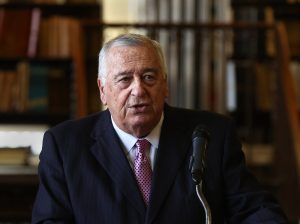
Patrick M. Rose Sr., former president of the Boston Police Patrolmen’s Association, wipes away tears at his sentencing, April 25, 2022. (Pool photo by Pat Greenhouse/Globe Staff, File)

More Stories
Today in History: December 29, Ghislaine Maxwell convicted
Today is Monday, Dec. 29, the 363rd day of 2025. There are two days left in the year. Today in...
Festive filers sleigh their Self Assessment returns as thousands log on over Christmas
Thousands of taxpayers chose to spend part of their Christmas break tackling their tax affairs, with more than 4,600 people...
‘Made in Britain’ body challenges Reform UK over alleged unauthorised logo use
The manufacturing trade body Made in Britain has raised concerns over the alleged unauthorised use of a logo closely resembling...
City set to pour billions into defence as Russia threat reshapes investment priorities
The City of London is preparing to channel significantly more capital into defence as rising geopolitical tensions, and the growing...
Lucas: Healey needs to meet with Trump
Gov. Maura Healey is better at flying illegal immigrants into Massachusetts than flying them out. One only has to recall...
Hairdressers join pub landlords in banning Labour MPs over business rates backlash
Hairdressers and barbers are joining pub landlords in banning Labour MPs from their premises, as anger intensifies across the high...