
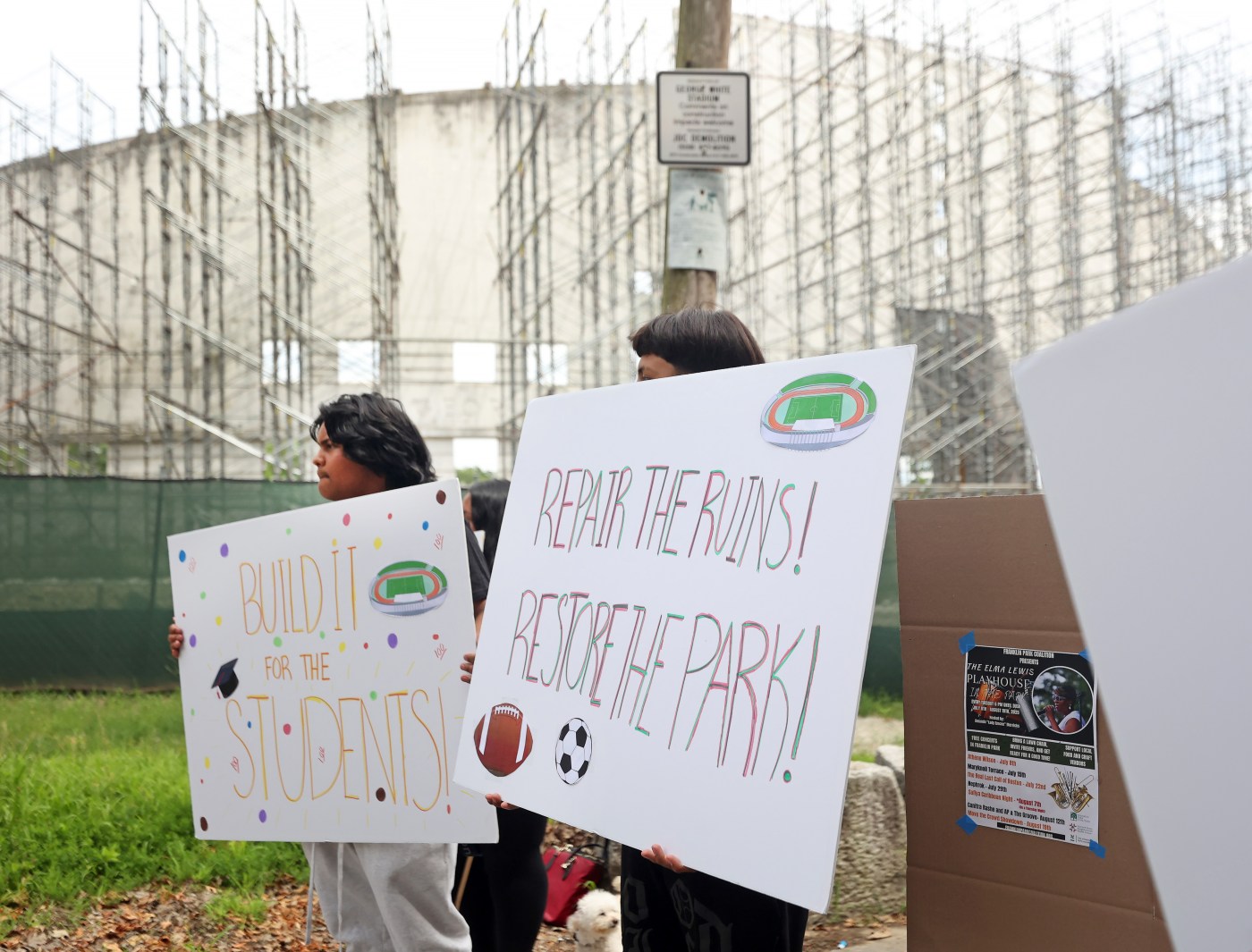
Boston’s White Stadium renovation sparks neighborhood clash: ‘I am funded by nobody’

Tension continues to escalate over Boston’s $200 million public-private plan to rehab Franklin Park’s White Stadium for a pro soccer team, with project proponents labeling opponents as a “well-funded” vocal minority.
The Franklin Park Coalition is trying to “change the narrative” around the project, prompted by frustration with how the endeavor is sparking “negative attention.”
“We believe that it’s a really small group that is against the project,” coalition member Christine Poff said during a gathering at the stadium on Wednesday. “A very loud group, a very wealthy and well-funded organization.”
Poff’s criticism is connected to the Emerald Necklace Conservancy, a private nonprofit that protects Franklin Park, which has led efforts to halt the project from proceeding with unsuccessful lawsuits and a recent appeal.
“The opposition is funded by an organization that has a $3 million budget and 20 full-time staff,” Poff claimed while speaking to neighbors and reporters. “The Franklin Park Coalition has a $200,000 budget a year and one or two very part-time staff.”
“We’re a little bit of a David vs. Goliath here,” she added. “We’re the ones who have been in the park for 45 years. We’re the ones who use the park all of the time.”
Nancy Lessin, a neighbor who has lived on nearby Park Lane for decades, took exception to the claim.
“I am a part of the opposition,” she told Poff, “but I am funded by nobody.”
Lessin, who has four grandchildren, said she wants what is best for Boston Public Schools, taking aim at how the city has not been transparent at all throughout the process, particularly around the project’s environmental impacts.
“There are many, many issues,” Lessin said, “and I don’t want to be characterized as somebody who doesn’t want something for the Boston Public Schools. I do, and I have a vested interest in that, and my neighbors do as well.”
Poff responded, “I want to thank you for your comments. It’s really important, and it’s what we want to hear and work on for people who have real deep concerns. … We absolutely would like to … be the liaison to help get answers.”
The plan will eventually see the National Women’s Soccer League expansion team, Boston Legacy FC, share use of White Stadium with Boston Public Schools student-athletes, beginning in March 2027.
Delays have pushed Boston Legacy’s 2026 inaugural season home games from White Stadium to Gillette Stadium, owned by Robert Kraft, the father of mayoral candidate and critic, Josh Kraft.
Neighborhood concerns around escalating costs and a for-profit use of public parkland prompted the Emerald Necklace Conservancy and a group of roughly 20 residents, dubbed the Franklin Park Defenders, to file unsuccessful lawsuits.
The courts ruled in favor of the city in April, but the plaintiffs, who prefer a high-school-only stadium rehab, have since appealed.
Neighbor Martha Karchere told the Herald at Wednesday’s event that she supports Mayor Michelle Wu’s reelection campaign. Pairing with a private group to renovate the stadium is the wrong move, she said, adding it would lead to a “playground for the wealthy.”
“The Emerald Necklace Conservancy has always been very supportive,” Karchere said. “To characterize them as not interested in Franklin Park is absolutely inappropriate.”
Last month, Wu said that while she expects the city’s costs for its half of the professional women’s soccer stadium renovation project to exceed its previous $91 million estimate due to federal tariffs, design and construction changes, it is “unlikely” that taxpayer costs will reach $172 million.
The latter estimate is a figure that Josh Kraft revealed as the cost to taxpayers, but Wu countered that the number represents a “worst-case scenario.”
Boston Legacy, which is under a lease agreement with the city and is on the hook for more than $100 million, said it remains committed to “taking on over half the total cost” of the project and long-term maintenance.
Kaylin Diaz, a rising junior at Margarita Muniz Academy, lives five minutes away from the stadium. She recalled how it never felt like the facility received proper care when she’d visit with her family.
Diaz said she’s seen how the renovation is portrayed on social media.
“I kept seeing videos that make it sound like negative or harmful,” she said. “I’ve shared them and asked, ‘Can somebody explain what the problem is?’ But I have not heard a good reason besides the cost.”
“I do know that this was always going to be expensive,” she added, “but it is something that we, students, deserve.”
Proponents and opponents agree on at least one aspect of the project: The stadium’s transportation plan needs to be improved.
A traffic engineer commissioned by opponents has concluded the city’s game-day transportation plan is a “disaster” that will worsen traffic and parking.
Franklin Park Coalition member Jacob Bor agrees, adding that the plan must take into account the entire park, not just the stadium.
“Public transportation access to this vital city resource is woefully inadequate,” he said. “The bus stops are poorly defined … How would you know how to get to the park?”


More Stories
OECD urges reeves to overhaul ‘inefficient’ UK tax system
Rachel Reeves has been told by one of the world’s most influential economic bodies that Britain’s tax system is holding...
Easter lifts footfall but retailers brace for April cost squeeze
Britain’s high streets enjoyed a welcome lift last month as an early Easter drew shoppers back through the doors, but...
Google takes on Opentable with AI that books your dinner in seconds
Google has fired the opening shot in a battle for Britain’s restaurant booking market, rolling out an artificial intelligence tool...
Retail backers of SEIT face wiping out half their money as green trust raises the white flag
Thousands of small investors who piled into one of London’s best-known green investment vehicles are staring down the barrel of...
White House warns staff over Iran war bets – media
The warning comes as markets have spiked on several occasions before big announcements by President Trump The White House has...
JLR battery plant lands £380m as government unveils £700m EV package
Jaguar Land Rover’s under-construction gigafactory in Somerset has been handed a £380 million taxpayer grant as part of a £700...