
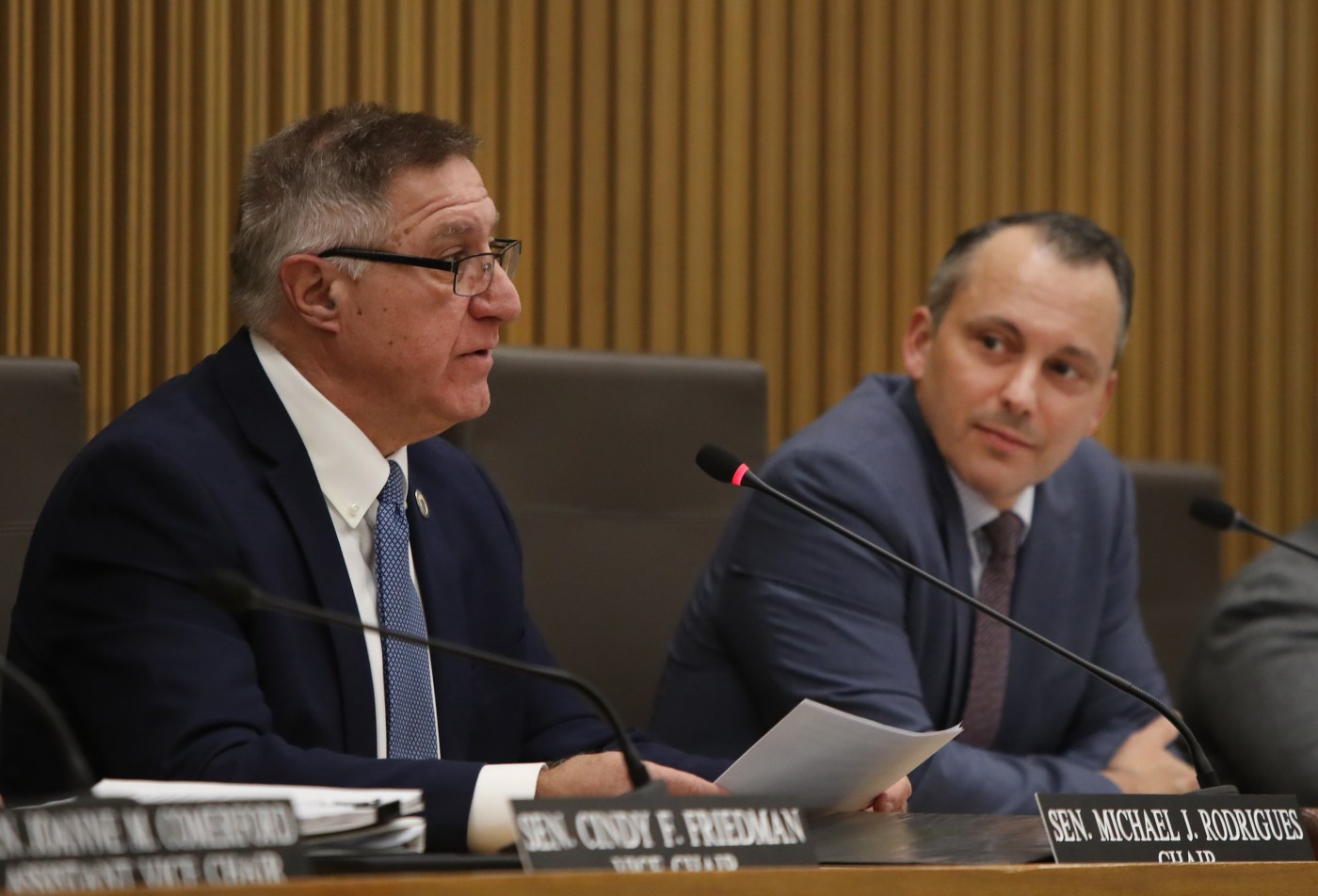
Beacon Hill Democrats say they have struck an agreement on the yearly state budget

Beacon Hill Democrats said they reached an agreement on the fiscal year 2026 budget Friday afternoon, a milestone that sets negotiators up to deliver Gov. Maura Healey a spending plan before the start of the new fiscal year for the first time in 15 years.
Rep. Aaron Michlewitz and Sen. Michael Rodrigues, the budget chiefs for the two chambers, did not release details about the compromise budget when they made their announcement, but said lawmakers planned to ship the proposal to Healey Monday.
“With this compromise agreement, the House and Senate are doubling down on our shared commitment to addressing the underlying budget challenges that we are collectively confronting in the face of ongoing uncertainty and federal funding impacts,” the two Democrats said in a statement.
The duo said legislative aides were “working hard” to complete the necessary paperwork to file a compromise budget over the weekend so that Healey and her team receive “a balanced and fiscally responsible” spending plan before the start of the new fiscal year on Tuesday.
Massachusetts is still on track to start fiscal year 2026 without a spending plan in place for the next 12 months because Healey gets 10 days to review the budget compromise.
But Michlewitz and Rodrigues’ ability to complete their budget work before the start of the fiscal year is notable because of the unknown impacts Massachusetts will feel from President Donald Trump’s efforts to reduce the size of the federal government and slash federal funding.
Lawmakers last handed a governor a budget before the July 1 start of the new fiscal year in 2010, when legislators sent then-Gov. Deval Patrick a $27 billion proposal on June 24 of that year. He signed the budget into law days later on June 30th.
The two budgets that the House and Senate are working to resolve this year are far larger.
The House and Senate each passed roughly $61 billion proposals that have been tied up in secretive discussions for the past month.
Michlewitz and Rodrigues previously said the two proposals were very similar, though there is still $1 billion in unique spending across each bill, according to an analysis from the Massachusetts Taxpayers Foundation.
The House spent $437 million that is not reflected in the Senate budget, while the Senate included $522 million that was not approved by the House. That means Rodrigues and Michlewitz need to reconcile the spending differences before releasing a final compromise.
Both bills also include a series of different policy proposals.
The House targets early education providers in several sections, creates a task force to make recommendations on vocational school admissions, and establishes a commission to study the future of Pappas Rehabilitation Hospital for Children.
The Senate looks to lower the cost of prescription drugs, allow cities and towns to take control of liquor licenses away from the Legislature, establish fare-free regional transit authorities, and direct the state’s housing department to publish more data.
The two chambers each backed eliminating renter-paid brokers’ fees, a proposal that has drawn support from Healey. But the House and Senate took different approaches to tackling the issue.
The Senate suggested language that would shift the burden of the fee to whoever enlists the services of a broker, mirroring a proposal Healey put forward in her own budget plan earlier in the year.
The House wants to prohibit renter-paid brokers’ fees in most instances unless a tenant initiates contact, receives a disclosure, and agrees to certain conditions.
Massachusetts Taxpayers Foundation President Doug Howgate said overall, the House and Senate budget proposals are not too different from each other.
“You can always find ways to disagree, sure, but when you look at this budget compared to other major bills and differences, you don’t see the same level of spending or policy differences that would seem to make a reasonable deal in a timely manner impossible,” he said.


More Stories
Al menos 203 muertos por protestan en Irán y se teme que cifra real sea mucho mayor, dicen activistas
DUBÁI, Emiratos Árabes Unidos (AP) — Al menos 203 muertos por protestan en Irán y se teme que cifra real...
Fallece a los 90 años Erich von Däniken, escritor suizo que impulsó la arqueología alienígena
BERLÍN (AP) — Erich von Däniken, el autor suizo cuyos libros más vendidos sobre los orígenes extraterrestres de las civilizaciones...
Continúa por 3er día la lenta liberación de prisioneros en Venezuela tras anuncio del gobierno
Por REGINA GARCIA CANO SAN FRANCISCO DE YARE, Venezuela (AP) — Cuando Diógenes Angulo fue liberado el sábado de una...
Combatientes kurdos evacuados de Alepo tras días de enfrentamientos
Por GHAITH ALSAYED ALEPO, Siria (AP) — Combatientes kurdos fueron evacuados de un barrio en disputa en la ciudad de...
Alemania rechaza afirmaciones de RFK Jr. sobre procesar a médicos por exenciones de vacunas
Por KIRSTEN GRIESHABER BERLÍN (AP) — Alemania rechazó enérgicamente las acusaciones del secretario de Salud estadounidense Robert F. Kennedy Jr...
Patriots-Chargers preview: How Drake Maye, Mike Vrabel can win their first playoff game together
It’s about time. The Patriots will host their first playoff game in seven years Sunday in a rematch with the...