
Traffic expert concludes Boston’s White Stadium transportation plan for soccer game days is a ‘disaster’

A traffic engineer commissioned by opponents of the public-private plan to rehab Franklin Park’s White Stadium for a pro soccer team concluded the city’s game-day transportation plan is a “disaster” that will worsen traffic and parking.
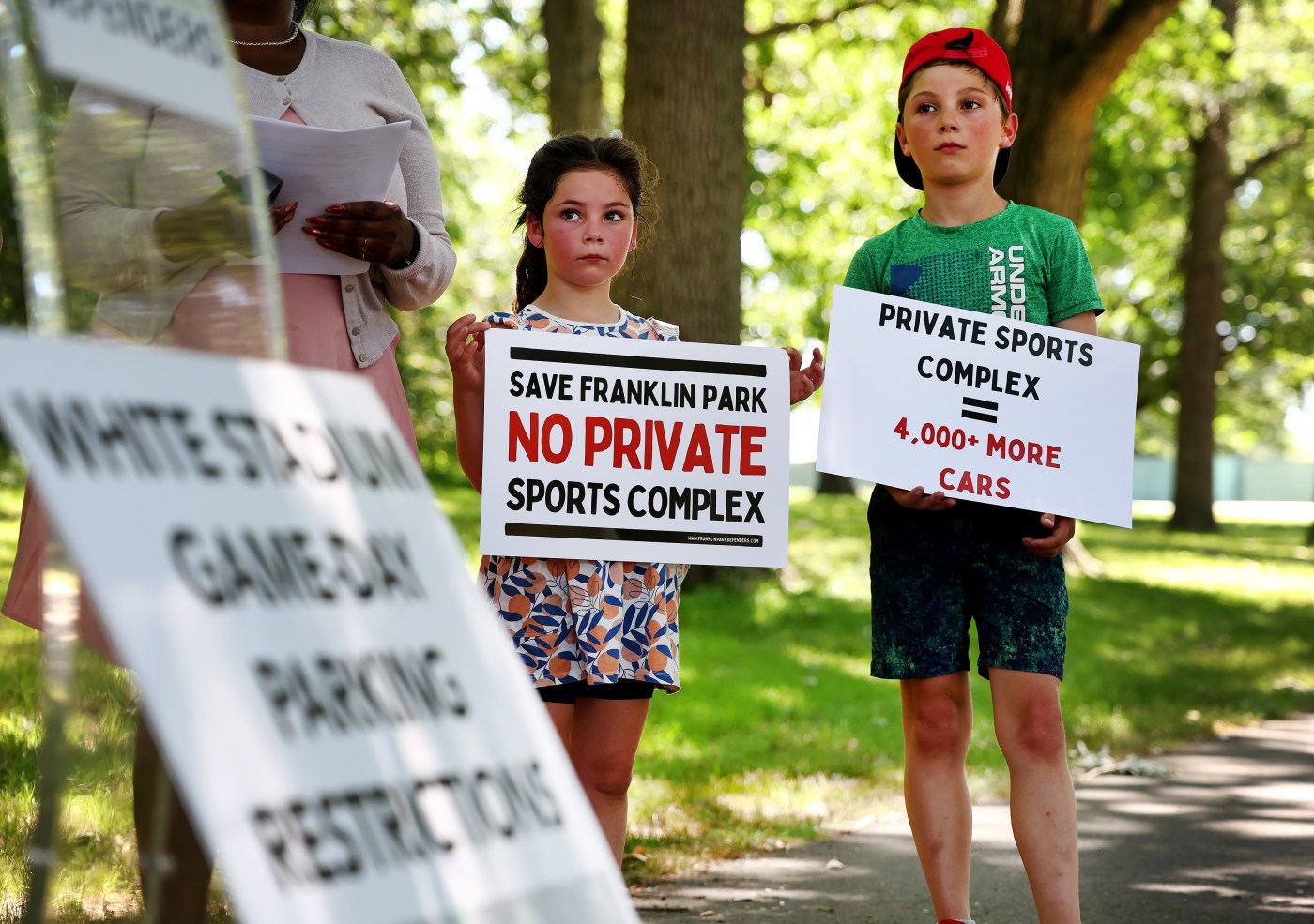
William Lyons Jr., president and CEO of Fort Hill Companies LLC, shared the findings of his 19-page analysis of Boston’s draft transportation plan for the 20 professional women’s soccer games set to be played annually at White Stadium, at a Tuesday press conference convened by park neighbors who oppose the project.
Lyons said he found that the 25-page city transportation plan released in April is “riddled with troubling opacity, internal contradictions, and unsupported assumptions and conclusions,” and that pertinent information like a detailed traffic study and satellite lot locations have not been publicly disclosed.
“To truly understand the traffic impacts of this project, the city and Boston Unity Soccer Partners must produce a traffic study, as required by the Boston Transportation Department, and must be transparent about the impacts and costs associated with the project’s proposed transportation plan,” Lyons said. “Without further analysis, many unforeseen circumstances could flow from this plan.
“In short, this is an incomplete proposal at best, and a poorly constructed plan at worst,” he said. “It leaves more questions than answers.”
Lyons found that the project’s transportation analysis as a whole is “flawed,” in that it relies on a comparison between the planned 11,000-seat professional women’s soccer stadium and Fenway Park, rather than facilities of “comparable attendance, scale and context.”
He was particularly puzzled by bus shuttle and rideshare plans. He projected that the number of buses shuttling people from MBTA stadiums and unidentified satellite lots will take up the “length of a football field” on Walnut Avenue. He said there’s not enough curb space there to accommodate buses that arrive at an estimated rate of one per minute.
According to the plan’s mode breakdown, the city anticipates that 4,400, or 40%, of soccer spectators will arrive at White Stadium by a satellite parking shuttle, while another 2,200, or 20%, will arrive by shuttles from MBTA stations.
Another 2,200 people are expected to walk from MBTA stations; 1,100 people are expected to walk or bike to the stadium, and remaining 10%, or 1,100 spectators are projected to arrive by rideshare, per the city’s draft transportation plan.
Lyons said the city has estimated that nearly 30 pedestrians will arrive per minute in the two hours before a game starts, with a higher volume of spectators that will “approach 50 pedestrians crossing Walnut Avenue down near Park Lane for the peak 15 minutes before a game.”
“That’s 50 pedestrians crossing the street at a time with all those shuttle buses trying to get into the site at the same time,” Lyons said. “The results could be catastrophic, mixing all those pedestrians with shuttle buses.”
He further stated that the significant number of shuttle buses traveling down the relevant roads between the stadium and MBTA stations to cross Walnut Avenue, coupled with pedestrians making their way to the pitch, will “gridlock” traffic on Walnut Avenue along the west side of Franklin Park.
Lyons shared similar concerns about a lack of curb space when speaking about the plan’s projected rideshare trips that he says are expected to arrive at 10 “Ubers” per minute, causing further on-site backup.
“This will cause more havoc on local streets as rideshare vehicles drop off passengers in unintended locations, causing additional foot traffic in the neighborhood in and around Franklin Park,” Lyons said. “The sheer number of pedestrian traffic on local streets will be highly disruptive to residents trying to enjoy their weekends at home.”
Lyons described the city’s plan as a “transportation disaster,” that should be reconsidered.
“What the city is introducing to us is just a figment of the city’s imagination,” Renee Stacey Welch, a park neighbor and plaintiff in a Emerald Necklace Conservancy-led lawsuit that seeks to stop the project, added. “It is not going to happen that way.
“They are creating something that is going to make life extremely difficult for the people who live here, for people who would not even want to live in this community or be part of this community or take care of this park.”
The city’s draft plan calls for a game-day parking ban in the neighborhoods surrounding Franklin Park, with $100 fines for violations. There will be no on-site parking for game days, with limited exceptions for emergency vehicles, broadcast trucks and a small number of essential personnel.
Spectators are required to select their transportation method when purchasing a ticket, the plan states.
Residents seeking to park in their neighborhoods will have to obtain a special event parking permit from the city. They will also be required to obtain a block party permit should they want to have guests over on soccer game days, the plan states.
“This plan is prioritizing the soccer team’s needs over our ability to enjoy our lives and have quality of life in this city, and that is just plain wrong,” Carla-Lisa Caliga, a park neighbor and lawsuit plaintiff, said.
The city’s $200 million public-private plan will see the National Women’s Soccer League expansion team, Boston Legacy FC, share use of White Stadium with Boston Public Schools student-athletes, beginning in March 2027. Project opponents prefer a high-school only rehab.
Related Articles
Disgraced Boston City Councilor Tania Fernandes Anderson plans to ‘celebrate’ at final meeting: ‘One last stand’
Josh Kraft rips Boston Mayor Michelle Wu on bike lanes: ‘Streets are a chaotic mess’
Critics fear tall towers turning downtown Boston into Manhattan
Michelle Wu bashes Josh Kraft for leaking ‘entirely false’ $172M tax hit for Boston’s White Stadium
Josh Kraft blasts Boston Mayor Wu again on ‘out of control’ White Stadium taxpayer spending
Mayor Michelle Wu’s office said the city is reviewing feedback to inform changes to the draft transportation plan.
“Franklin Park has always been home to large events, including some of the city’s most beloved annual concerts and cultural festivals that regularly draw tens of thousands of attendees,” Wu spokesperson Emma Pettit said in a statement. “But until now, there has never been an organized transportation plan to actively coordinate and manage traffic, parking, and enforcement.
“The renovated White Stadium transportation plan will set a new standard for crowd events in Boston: residents will benefit from new resident parking and visitor passes, visitors will travel on team-provided electric shuttles, and Franklin Park users will have their access to the park protected. We are grateful for the many community comments already received and look forward to reviewing them fully as we continue to revise the plan through the end of the year.”
Phil Lyons talks about traffic issues as the Franklin Park Defenders talk about parking and traffic problems at White Stadium. (Nancy Lane/Boston Herald)

More Stories
Senador republicano de Texas busca retener su escaño; demócratas se enfrentan
Por THOMAS BEAUMONT DALLAS (AP) — El senador republicano de Texas John Cornyn intenta aferrarse a un quinto mandato en...
Israel envía tropas al sur de Líbano mientras Hezbollah dice estar listo para una guerra abierta
Por ABBY SEWELL y BASSEM MROUE BEIRUT, Líbano (AP) — Israel envió tropas adicionales al sur del Líbano el martes...
Small plane makes emergency landing in frigid Hudson River and the 2 people aboard swim to safety
NEWBERGH, N.Y. (AP) — A small plane attempting an emergency landing crashed into the frigid Hudson River, but the pilot...
Small plane makes emergency landing in frigid Hudson River and the 2 people aboard swim to safety
NEWBERGH, N.Y. (AP) — A small plane attempting an emergency landing crashed into the frigid Hudson River, but the pilot...
Tens of thousands of people are stranded in the Middle East as Iran war complicates routes home
By STEFANIE DAZIO BERLIN (AP) — Tens of thousands of people, from Romanian religious pilgrims to tourists and diplomats’ family...
Tens of thousands of people are stranded in the Middle East as Iran war complicates routes home
By STEFANIE DAZIO BERLIN (AP) — Tens of thousands of people, from Romanian religious pilgrims to tourists and diplomats’ family...