
GOP’s Mike Kennealy has loaned his campaign double the amount allowed under state law

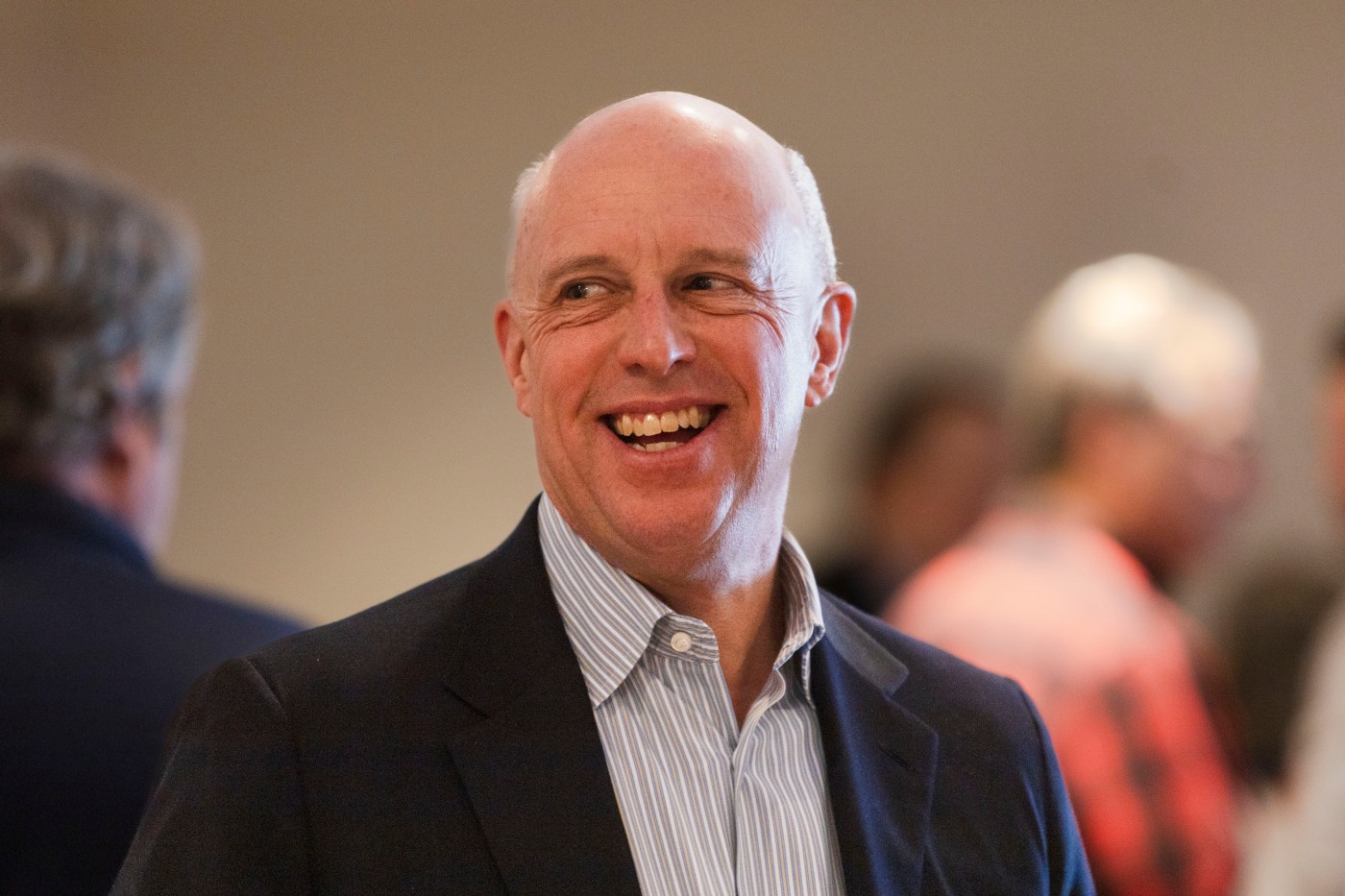
Mike Kennealy, a Republican running for governor, has loaned his campaign double the amount allowed under state law since launching his bid in April, a move that could set up future legal action if he or his family ever decides to recoup the cash he has loaned his bid for elected office.
Kennealy’s decision to loan his campaign $400,000 and plan to loan another $1.6 million ahead of the 2026 election comes after state campaign finance regulators in April dismissed his request to reconsider the limit on the amount candidates can loan themselves each election cycle.
In response to a petition from Kennealy’s campaign, the top lawyer at the Office of Campaign and Political Finance said the agency “will continue to enforce” the section of state law that caps the total cash a candidate for governor can loan their campaign at $200,000 per election.
But a spokesperson for the Office of Campaign and Political Finance on Tuesday did not say whether the agency planned to take legal action against Kennealy for already loaning himself double the amount allowed under state law.
“OCPF does not comment on specific candidates,” the spokesperson said in a statement to the Herald. “I can speak in general about the law: OCPF enforces section seven of the Massachusetts campaign finance law, as written.”
Kennealy, a 57-year-old from Lexington who previously worked for former Gov. Charlie Baker, loaned his campaign $200,000 in April and another $200,000 in May, state records show. The loans are part of a pledge to seed his campaign for governor with $2 million of his own cash.
Wealthy candidates for political office regularly contribute millions to their campaigns, but rarely loan themselves that amount of money because of the limit spelled out in state law. But the Kennealy campaign believes the statute is unconstitutional because of a 1976 court opinion.
Logan Trupiano, a spokesperson for Kennealy, said Kennealy is still “committed” to loaning his campaign $2 million. The campaign previously said the loan was part of a plan “to offer protection for Mike’s family in the unlikely event of an unforeseen tragedy.”
“Mike is clearly the only candidate that feels confident enough and has the commitment to devote his own funds to defeating Maura Healey and saving Massachusetts,” Trupiano said in a statement to the Herald Tuesday afternoon.
In a late April letter to regulators, an attorney enlisted by Kennealy’s campaign argued that a 1976 U.S. Supreme Court ruling rendered the Massachusetts loan limit law unconstitutional.
But the attorney, Chris Ashby of Washington, D.C., said the Office of Campaign and Political Finance “may never have had the opportunity to consider the matter.”
“Therefore, for the reasons set forth below, we request that your office consider the constitutionality of the candidate loan limitation in light of (Buckley v. Valeo), and issue appropriate written guidance or other response making clear that OCPF will not enforce the loan limitation,” Ashby wrote in the letter.
The 1976 decision came in the case of former U.S. Sen. James Buckley of New York versus Francis Valeo, the then-secretary of the U.S. Senate and the ex-officio member of the Federal Election Commission.
Buckley and others argued that the Federal Election Campaign Act of 1971 limitation on the use of money for political purposes violated First Amendment guarantees for free expression because no “political expression could be made without the expenditure of money,” according to the Federal Election Commission.
Kennealy’s lawyer said under the ruling, state law in Massachusetts limiting the amount a candidate can loan to themselves or their campaign committee “constitutes a limitation on the candidate’s personal expenditures in violation of the First Amendment to the United States Constitution.”
In an emailed response the same day Ashby asked regulators to reconsider the law, Office of Campaign and Political Finance General Counsel Sarah Harty said the agency “continues to enforce section seven of the Massachusetts finance campaign law, as written.”
That section of state law sets out various loan limits for candidates running for state offices.
People running for governor or lieutenant governor cannot loan themselves more than $200,000 each election.
Candidates for secretary of state, treasurer, auditor, and attorney general are capped at $150,000, while candidates for state senator and state representative are limited to $50,000 and $30,000 loans, respectively, each election cycle.
Candidates running for other offices do not face loan limitations, according to state campaign finance regulators.
For instance, Josh Kraft, a Democrat running for mayor of Boston, loaned himself $2 million last month as he looks to take on Mayor Michelle Wu.
“While my campaign just reached the $1 million mark in donations, a modern campaign that includes a strong and robust field organization requires more resources than I can raise in such a short time frame,” Kraft said in a statement.
More Stories
NFL free agency: Bryan Cook and 8 safeties Patriots could sign
The Patriots are fortunate to enter the 2026 offseason without many glaring needs at the top of their depth chart....
Netanyahu hace una apuesta sobre el apoyo de Estados Unidos a Israel con la guerra contra Irán
Por TIA GOLDENBERG A lo largo de su carrera política, el primer ministro israelí, Benjamin Netanyahu, ha guiado a su...
Battenfeld: Massachusetts Democrats blinded by Trump hatred in Iran “war”
An “historic blunder. A looming “catastrophe.” “Utter stupidity.” These are words used by our far left Massachusetts congressional delegation to...
Pakistán dice que mató a 67 miembros de fuerzas afganas en quinto día de combates
Por MUNIR AHMED y ABDUL QAHAR AFGHAN ISLAMABAD (AP) — Las fuerzas terrestres de Afganistán atacaron posiciones militares de Pakistán...
Massachusetts school build construction costs up, with state eyeballing over $700M projects on horizon
The price tag for a proposed rebuild of Madison Park High School in Boston may seem shocking with an estimate...
ICE hits back at Boston, says city police ignored 167 immigration detainer requests in 2025, not 57
Acting ICE Director Todd Lyons said the Boston Police Department ignored 167 federal immigration detainer requests last year, not 57...