
Pols & Politics: Gov. Healey touts WalletHub rankings. Reality is more complicated

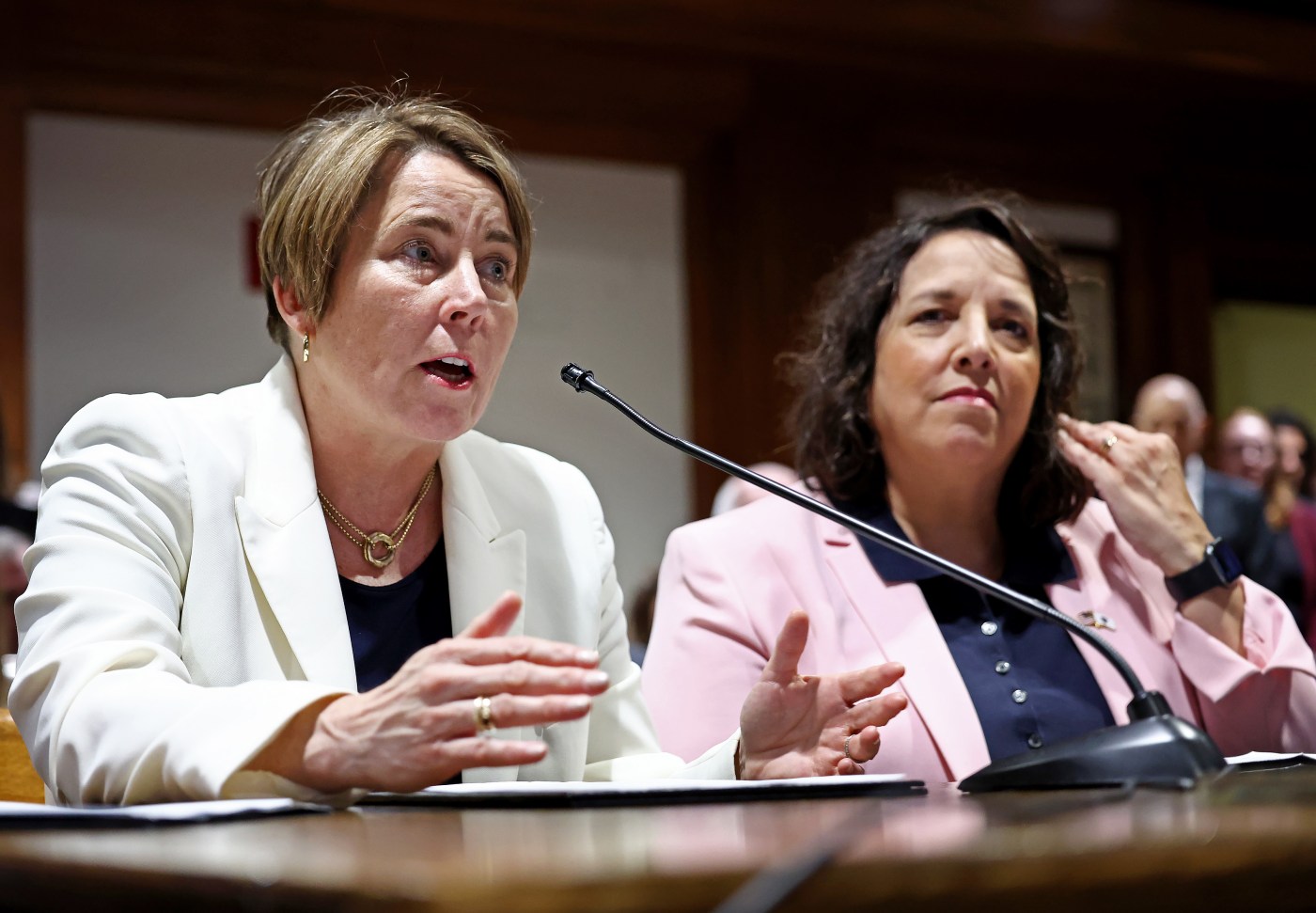
Gov. Maura Healey promoted a ranking last week that claimed Massachusetts had “the best state economy” in the United States.
The first-term Democrat, who is up for reelection next year, touted the ranking as a “testament to the incredible businesses, universities, and research institutions that drive our innovation economy and to the top-notch talent that continues to choose Massachusetts as the place to grow their careers and their futures.”
But the reality of residents’ lived experiences and the reliability of the ranking is more complicated, including the fact that WalletHub does not guarantee the accuracy of the information it publishes.
The ranking — which was the second from WalletHub that the governor promoted last month — said it compared the 50 states and the District of Columbia across 28 “key indicators of economic performance and strength.”
After taking into account those metrics, it gave each state a total score, which placed Massachusetts on top by a slim margin.
In fact, Massachusetts only topped the country in one sub-ranking, “innovation potential,” and came in sixth for “economic activity” and 17th for “economic health.”
Northeastern University Distinguished Professor of Marketing Koen Pauwels said rankings of any type — whether from WalletHub or elsewhere — are “never perfect,” but absent any better alternative, it could be one way to compare different states.
Pauwels did question how WalletHub weighed each metric.
“The only thing where we score high is innovation potential rank, and that, of course, has to do with how educated our workforce is,” he said. “You could say, ‘hey, innovation potential, that’s way more subjective. I think they should look more at economic activity and health.’ And of course, if you weigh these things more, then Massachusetts is not number one.”
Healey also promoted a ranking from WalletHub that scored Massachusetts as the best state for working moms. The ranking claimed the Bay State is the best for “child care” and “work-life balance,” but sixth for “professional opportunities.”
By its own admission, WalletHub does not “guarantee the accuracy of information.”
The company said it neither offers financial products and services nor is the front for a specific issuing institution or financial professional. Instead, WalletHub is an independent service that “strives to provide each and every customer with the information they need to make the best financial decisions and save money.”
“Another way to think of WalletHub is as a personal finance search engine/social network, and, in the same way that search engines do not guarantee the accuracy of search results, we do not guarantee the accuracy of the information presented through our website,” the company said on its website.
Still, WalletHub said it is “not in our interest to show information about products and services that is out-of-date or in error.”
A spokesperson for Healey declined to comment.
Local polls have consistently shown that the economy and affordability of Massachusetts are among the top issues on residents’ minds ahead of the 2026 statewide election. Healey has said she plans to run for reelection, and two Republicans have jumped into the race to challenge her.
Pauwels said he was “positively surprised” by the methodology of the WalletHub ranking on the best and worst state economies.
“They used specific metrics from other organizations that actually have pretty good, robust methodologies to kind of look at the economy and so forth,” he said. “I was actually positively surprised by how well they try to select the best other external agency to measure something, and basically … WalletHub is mostly an aggregation of what other more specialized firms do.”
– Chris Van Buskirk
Former Boston police commissioner wades into City Council race…
An at-large council challenger’s campaign is getting a boost from former Boston police commissioner William Gross.
Gross, head of BPD from August 2018 to January 2021, endorsed Will Onuoha for one of the four at-large seats on the Boston City Council last week.
“Boston needs elected leaders, with the extensive experience and right vision for its future, like Will Onuoha,” Gross said in a statement. “From running city departments to providing common-sense solutions to Boston’s greatest challenges, Will is the right person to represent every neighborhood as city councilor at-large.”
Onuoha worked for four previous mayoral administrations, Tom Menino, Marty Walsh, Kim Janey, and Michelle Wu, over a 15-year span at City Hall.
Today, he works as assistant general counsel and director of health and safety for the Boston Water and Sewer Commission.
Onuoha is part of a crowded field for this year’s at-large race, which includes all four incumbents — Ruthzee Louijeune, Julia Mejia, Erin Murphy, and Henry Santana — running for reelection.
The race also features a comeback bid from former Councilor Frank Baker, who chose not to seek reelection two years ago. Baker spent 12 years on the Council representing Dorchester-centric District 3, and is running citywide for the first time this year.
Former Mayor Marty Walsh has not endorsed in the race, but contributed $1,000 to Baker’s campaign last month, per the Office of Campaign and Political Finance.
Also running is Alexandra Valdez from the Wu administration. Valdez is the city’s director of cultural affairs.
Ten candidates have qualified thus far for the fall ballot, with the others being Yves Jean, Marvin Mathelier, and Rachel Miselman.
Barring withdrawals, the race will feature a preliminary election in September that would whittle the field down to eight candidates for the general election.
– Gayla Cawley

More Stories
Dear Abby: Work pressure is crushing my dreams
Dear Abby: I am in my early 30s and happy in certain aspects of my life: I recently moved to...
Latest Bears comeback bid falls short vs. 49ers
Brock Purdy threw a 38-yard touchdown pass to Jauan Jennings with 2:15 left, and the San Francisco 49ers forced an...
David Brom’s supervised release hearing set for Jan. 13
By all accounts, David Brom has made the transition from prison to work release without a hitch, setting the stage...
World Junior Hockey: Sweden, Finland prevail in Sunday’s games
World Junior Championship games went ahead on a snowy day in the metro as a pair of pool play games...
Pioneer Press delivery delayed Monday
Because of today’s severe weather conditions, your Monday Pioneer Press will be delayed. Please feel free to access the e-edition...
Longtime fine art destination Grand Hand Gallery moving down Grand Avenue
The Grand Hand Gallery, which has showcased fine art and craft on the corner of Grand Avenue and Dale Street...