
In downtown St. Paul, minus a cafe, Landmark Center is 100% leased

After more than 22 years overseeing Ramsey County’s historic Landmark Center in downtown St. Paul, Amy Mino braced for tough times filling the former federal courthouse and post office building on Fifth Street, which dates back to 1902.
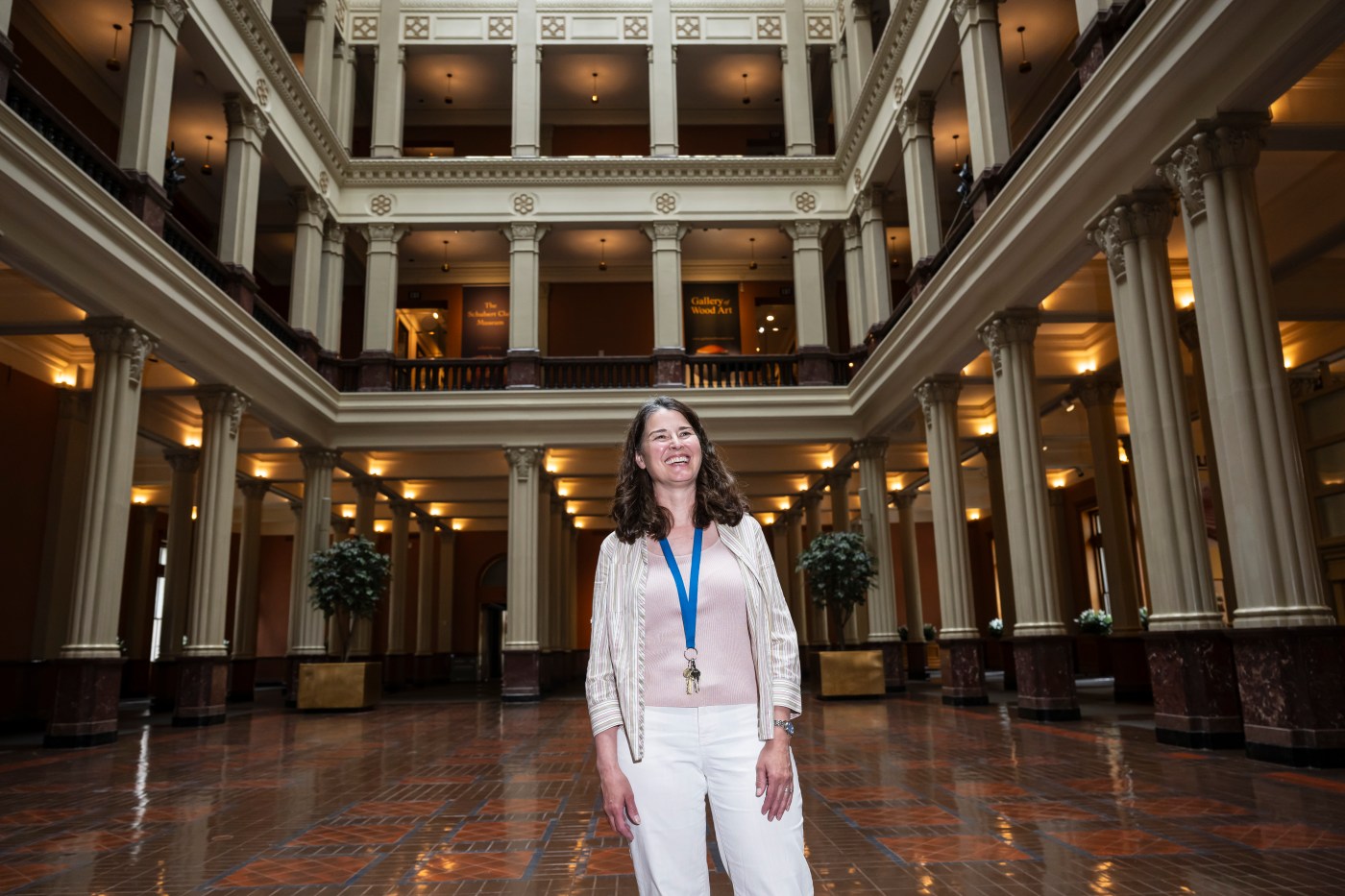
Its Richardsonian Romanesque architecture — punctuated by a five-story interior courtyard and skylight, two towers, peaked roofs, turrets and gables — lends itself to weddings and corporate events.
But new office tenants?
Even prior to the pandemic, Mino, the longtime executive director of nonprofit landlord Minnesota Landmarks, hired a real estate agent to scout for potential new lease-holders, without much success. Then came January 2024, when Red Bird Chapbooks — an independent printer of pamphlets and small books of postcards and poetry — moved into modest office space on the fourth floor.
Last spring, the downtown CapitolRiver Council, a neighborhood organization, found a home on the Landmark Center’s fourth floor. The League of Women Voters of Minnesota moved into the third floor around the same time, a level above the League of Women Voters of St. Paul. Then came Midion, a project management firm for major construction projects, as well as the Minnesota Alliance of Local History Museums, the administrative offices of the Ordway Center for the Performing Arts, and most recently the Polish American Cultural Institute of Minnesota.
With the key exception of a vacant lunch counter on the ground floor, the Landmark Center is now 100% fully leased and occupied by about 25 tenants, seven of them relatively new, following a whirlwind of lease signings.
“It’s pretty much been connections and word of mouth,” said Mino. “It’s really great to be 100% full. I have no space, and I’m still getting inquiries.”
One last vacancy: A cafe
The recent popularity of the Landmark Center stands in contrast to the struggles other properties have faced landing new commercial tenants elsewhere downtown.
The last office and retail tenants left the Alliance Bank Center at the end of March, a few weeks after property owner Madison Equities announced it had stopped paying utilities for the office building, which once hosted a popular food court within its ample skyway. Other Madison Equities properties downtown have fallen into foreclosure or court-ordered receivership even as the company attempts to sell the majority of its downtown portfolio.
Michell Witte, executive director of the League of Women Voters Minnesota, works in her office in the Landmark Center in St. Paul on Thursday, June 5, 2025. (John Autey / Pioneer Press)
After updating its figures with vacancies revealed by the company’s sales memorandum, the Greater St. Paul Building Owners and Managers Association found roughly a third of downtown St. Paul’s competitive office space to be vacant, up from previous estimates of 22%.
Mino said she’s received an inquiry about filling her final vacancy — the empty eatery space on the ground level — though she has yet to sign an agreement. A breakfast, lunch and coffee destination would serve the building’s tenants but also meets a need around Rice Park, she said, and capital improvements such as a new seating layout are planned later this year.
The Polish American Cultural Institute of Minnesota, or PACIM, moved its offices and library collection of 5,000 books into the Landmark Center’s fourth floor this March, and has since used the space to host Polish classes, two visiting actors from Poland, board meetings and other events. Its ample interior courtyard was a draw, as was below-market rent.
“For people from Europe, it reminds them of what we left in Europe,” said Edyta Dudek, a past president of PACIM. “We like to be in a space that will energize us. We can bring more crowds.”
Jon Fure, executive director of the CapitolRiver Council, said building staff have been helpful in arranging access to the center’s historic courtrooms, which now double as meeting rooms when his board meets in person. Art and live musical performances throughout the building add a sense of culture, he said.
Support from Ramsey County, Rice Park Association
Beyond its distinctive architecture, its proximity to Rice Park and its reputation as a magnet for nonprofits, small museums and cultural institutions have helped boost the building’s profile, Mino said. A clear sense of history and mission hasn’t hurt.
Sam Struekens, civic engagement director for the League of Women Voters of Minnesota, left, and Amy Mino, executive director of Minnesota Landmarks, talk while in the League’s offices in the Landmark Center in downtown St. Paul on Thursday, June 5, 2025. Minnesota Landmarks is the nonprofit that serves as landlord and program manager for the Landmark Center. (John Autey / Pioneer Press)
Commercial businesses pay for market-rate leases, but cultural institutions receive a discount for hosting performances, exhibits or other types of programming within the once-dormant building, which reopened in 1978 with the tagline “a work of art serving people.”
“What I’m hearing a lot is a lot of tenants are looking for community and experience in their building, and I think that’s something that Landmark Center has really done well,” said Kate Gillette, a commercial real estate broker who has sat on the Minnesota Landmarks board for six years.
Unlike some other downtown office buildings, the Landmark Center has a steadier property owner in Ramsey County, which put nearly $1.2 million into Minnesota Landmarks — the building’s nonprofit steward — last year alone, on top of $277,000 from outside grants and contributions. Rents and admissions totaled about $879,000, or about 34% of the nonprofit’s total annual revenue of $2.6 million. Building operations were about a $1.7 million expense.
The 39 members of the Landmark Center Volunteer Association donated the equivalent of almost $90,000 in man-hours last year toward tours, an information desk and other program support. While downtown foot traffic in the era of remote work has slackened, Rice Park remains a popular draw for downtown residents and visitors, and groups like the Rice Park Association and the St. Paul Garden Club provide advocacy, funding, park upkeep and eyeballs.
“Things have really gotten a lot better since COVID in terms of the undesirable activities, and there’s a lot of really good people working for downtown,” Mino said. “It’s always amazed me how the people in St. Paul gather together and work toward some good outcome, and I think we’ve seen that through a lot of different efforts. … Definitely eyes on the neighborhood makes a difference in Rice Park succeeding.”
The building is known for its free and low-cost exhibits, arts, education and cultural programming. On Wednesday, the Landmark Center hosted a neighborhood “Heart of the City” tour that extends throughout downtown, and opened its north tower to the public, which happens just a few times each year. On Thursday evening, the center hosted a sketching workshop featuring live models. Two wedding receptions were scheduled for Friday and Saturday, as well as a presentation featuring Romanian folk characters, led by the Heritage Organization of Romanian Americans.
Beginning June 19, the Landmark Center will kick off its Thursday night “Summer Nights in Rice” live music series, which it organizes pro bono on behalf of the Rice Park Association, and its “Music on the Cortile” lunchtime series, which take place from noon to 1 p.m. on select Wednesdays.
Related Articles
St. Paul Central students design a mascot to represent everyone
Despite slump for downtown St. Paul, some companies find new space to grow
St. Paul Corner Drug closing historic soda fountain
Officers in Minneapolis raid wore distinct patches. One was authorized, another wasn’t, feds say.
Longtime Grand Avenue fabric shop Treadle Yard Goods has closed amid owner’s cancer battle
More Stories
‘It’s hard, for sure’: Family honors fallen officer, husband, father with Christmas celebration
Every time a bird lands at the feeder in Kristin Tracey’s yard, she thinks of her husband. Paul Tracey never...
Callahan: Handing out Christmas presents to Drake Maye, Mike Vrabel and the 2025 Patriots
It doesn’t take a gratitude junkie to know this Patriots season has been a gift. The Pats punched their ticket...
Brockton Republican City Committee takes legal action against Geoff Diehl
The Brockton Republican City Committee is taking legal action against former GOP senate gubernatorial candidate Geoff Diehl over his push...
Today in History: December 24, Alan Turing granted posthumous pardon
Today is Wednesday, Dec. 24, the 358th day of 2025. There are seven days left in the year. This is...
Presidente de Ucrania: hay consenso en muchos puntos tras reuniones con EEUU, pero el territorio sigue sin resolverse
Associated Press KIEV, Ucrania (AP) — Presidente de Ucrania: hay consenso en muchos puntos tras reuniones con EEUU, pero el...
Zelenskyy: EEUU y Ucrania logran consenso en temas clave, pero no en las disputas territoriales
Por SAMYA KULLAB KIEV, Ucrania (AP) — Estados Unidos y Ucrania han alcanzado un consenso sobre varios temas críticos con...