
Boston shootings were up last summer, but city is sticking with similar safety plan

The City of Boston is largely sticking to the same summer safety plan, despite police statistics that show shootings were up during the hottest months last year.
Boston Police Commissioner Michael Cox said Tuesday that over the past 10 years, roughly 33% of the city’s annual gun violence has taken place during the first three months of the summer.
The number of shootings was up last year between June and August, when there were 64 victims shot in 46 incidents, Cox said. That represented a 12% increase in both shootings (+5) and victims (+7) in that summer stretch over 2023, he said.
The city’s police commissioner insisted that gun violence is still down in Boston. He said last year’s hot-weather victim total was 15% below the five-year average, and the third-lowest victim total in the summer since 2005, while adding that about 50% of that gunplay occurred overnight, between 10 p.m. and 3 a.m. on weekends.
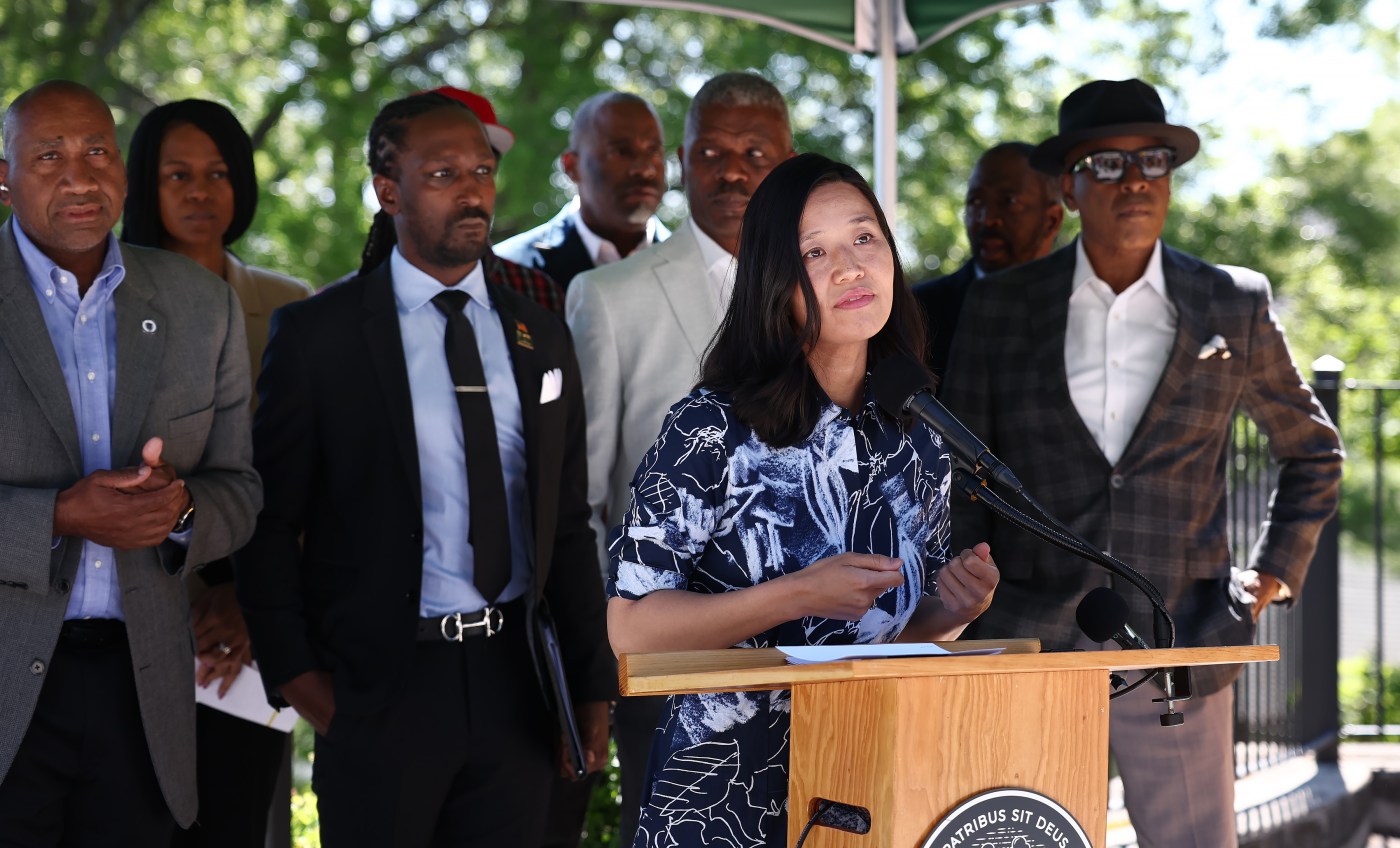
“That’s why we say it’s really important that if you see something, say something, and let us know about it, particularly as the summer months go,” Cox said at a press conference in Dorchester that was held shortly after a man with mental health issues grabbed a police officer’s gun and shot himself in the foot near Massachusetts General Hospital on Cambridge Street.
“To prevent violence” and “retaliation,” Cox said the police department will be focused on cutting down on so-called revelers, particularly out-of-towners who engage in late-night drag racing that creates quality of life issues for city residents, and honing in on the people who are driving the violent crime in Boston.
“That’s what we try to do all year long,” Cox said of the latter strategy, adding that officers have been deployed to hot spots since November to cut down on shootings.
Mayor Michelle Wu, who rolled out a similar summer safety plan that she said “builds” on what her administration has implemented in prior years, was asked by reporters whether last year’s uptick in summer shootings had her concerned.
Boston’s homicide rate has been a key metric that the first-term mayor, who is running for reelection this year, has been using to describe the Hub as the “safest major city,” in the country — which Wu touted again at the day’s press conference.
“Every incident of violence is too much in our communities, and we know that for families in our neighborhoods, the numbers don’t reset every year in their daily lives,” Wu said. “Overall, we still see that the numbers, if you just look at the statistics, are below the five-year average and that the progress is continuing — that these two years will likely be the lowest two years in some time.
“But we don’t judge ourselves by just one year or just any single month … It’s about lasting peace and safety.”
Wu’s summer safety plan focuses on addressing the “root causes of violence through a public health approach, while creating conditions for peace and community healing,” her office said.
Bisola Ojikutu, the city’s commissioner of public health, said this year’s plan includes more of a focus on domestic violence, which tends to increase during the summer months.
“We haven’t been paying enough attention to what’s actually happening to our residents,” Ojikutu said. “We want to build capacity in this area and really deal with some of the challenges that many of our residents are facing within their household and with intimate partners.”
Ojikutu mentioned that she’ll be working closely on that front with Isaac Yablo, who, the mayor announced Tuesday, will be joining the Boston Public Health Commission as director of the Office of Violence Prevention.
Yablo will continue to work as senior advisor for the mayor’s community safety team, which is transitioning into the violence prevention office, Wu said.
Boston’s violence prevention efforts this summer and beyond have also been boosted by a $1 million donation from the Cummings Foundation, the mayor said.
The mayor nor her office could provide a cost estimate on what the city spends annually on violence prevention, but many speakers, largely comprising Black community leaders, described Wu’s budgetary investment as a “value statement.”
Other aspects of the plan include helping prior violent offenders reenter back into society after incarceration, and expanding youth jobs and summer programming to keep teens off the streets and safely occupied.
Related Articles
Boston politicians honor Puerto Rican veteran community during Memorial Day event
Super PAC backing Josh Kraft spends $1.4M on advertising opposing Mayor Michelle Wu
Boston Water and Sewer Commission fired its HR director with a $45K payout amid civil fraud allegations
City looks to improve response times with new South Boston ambulance center in Seaport
Josh Kraft, son of billionaire Patriots owner, puts $2 million of his own cash toward his bid for Boston mayor
State Rep. Russell Holmes, a Mattapan Democrat, said there needs to be more state funding directed to cities for gun violence prevention, saying that such a line item in the budget should always spark a larger conversation.
“We’re not done,” Holmes said. “Every single time, there is something moving in that Legislature, the Black and Latino caucus demands that we look and address what the root cause is for us, of what’s still driving it, and that is a belief that you can kill someone and get away with it.
“There are too many unsolved murders in the commonwealth.”


More Stories
US court rules against Pentagon in killer AI dispute
The Department of War had ordered contractors to drop Anthropic after it refused to allow military use of its technology...
Which Interior Flooring is Best?
Where do you start when choosing new flooring? When shopping for new flooring a good place to start is to...
Petrol set to top £1.50 a litre as Iran war drives fuel price surge
UK drivers are bracing for a sharp rise in fuel costs, with petrol prices expected to exceed £1.50 per litre...
Dyson hit by £440m sales drop as Trump tariffs bite
Dyson has reported a £440 million drop in annual sales after being hit by US trade tariffs, although the group...
Octopus Investments to cut 20% of staff as AI reshapes asset management
Octopus Investments is set to cut around a fifth of its workforce as it accelerates the adoption of artificial intelligence,...
Next to invest £300m in UK logistics as new warehouse set to deliver £2.5bn boost
Next has unveiled a major expansion of its UK logistics network, committing more than £300 million to new warehouse infrastructure...