
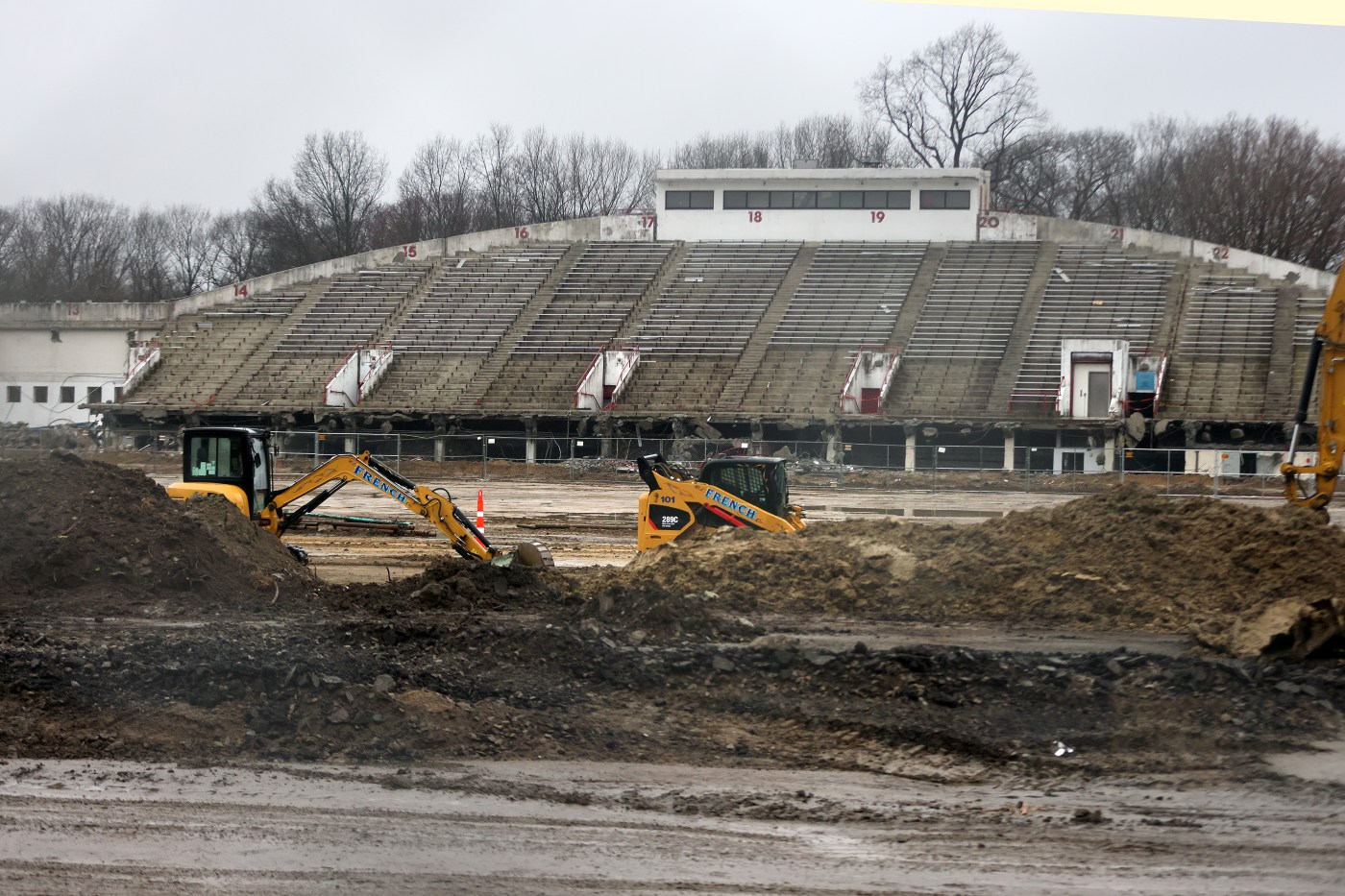
Boston’s White Stadium soccer plan opponents extend legal fight, appeal court’s ruling

Opponents of the city of Boston’s public-private plan to rehab White Stadium for a new pro soccer team are plowing on with their legal challenge, this time by appealing a Superior Court judge’s ruling that threw out their lawsuit last month.
The plaintiffs, Emerald Necklace Conservancy and a group of neighbors, filed a notice of appeal Friday, and released a statement to the media that contends the judge’s April 2 decision did not include a ruling on the lawsuit’s central argument, as it relates to parkland protections under state law.
While the judge ruled that the stadium parcel itself is not protected by Article 97 of the state constitution, the plaintiffs argue that the court’s decision did not address the “enormous impact” the $200 million project “will have on surrounding parkland in Franklin Park,” which, they contend, “is indisputably constitutionally protected parkland and recreation land.”
Such protections, the plaintiffs said, “trigger the requirement for substantial review under the public park and recreation land protections” of the state constitution.
“It’s our mission to protect and support our public parks for future generations, even when it’s hard,” Karen Mauney-Brodek, president of the Emerald Necklace Conservancy, said in a Friday statement. “This proposal for Franklin Park is the biggest change to public land in Boston and the Emerald Necklace in at least half a century, and it hasn’t received the thorough legal vetting the public deserves.
“We are optimistic that the courts will ultimately uphold the fundamental constitutional protections that all public recreation land in Massachusetts depends on, and protect Franklin Park and a public stadium for generations to come.”
A Suffolk Superior Court judge, Matthew Nestor, ruled in favor of the defendants, the City of Boston and Boston Unity Soccer Partners, which owns the professional women’s soccer team that is set to take the pitch at a redeveloped White Stadium in Franklin Park in March 2026.
“Notwithstanding the testimony from nearby residents, there is simply inadequate evidence that the everyday use of the property evinces an unequivocal intent to dedicate the property as public parkland,” Nestor wrote in his decision. “I conclude, therefore, that the stadium parcel is not protected by Article 97.”
The plaintiffs, the Emerald Necklace Conservancy and a group of 20 park neighbors, had alleged that the city and Boston Unity’s proposed use would privatize protected parkland in violation of Article 97 of the state constitution.
Article 97, approved by voters in 1972, requires two-thirds approval from the state Legislature for other uses for land and easements taken or acquired for conservation purposes.
Nestor disagreed that such protections applied in this instance after hearing evidence during a three-day trial this past March.
The plaintiffs said Friday that they disagree with the court’s ruling.
“The city and soccer investors assert that the Massachusetts constitution’s protections for public recreation land are only for ‘natural’ or untouched green spaces,” their statement said.
“That is not the case: Massachusetts’s public land protections apply to numerous school properties within the city of Boston and other cities and focus on public recreation amenities which include recreation buildings, restroom structures, and built facilities like baseball fields, playgrounds and stadiums,” the plaintiffs said.
The plaintiffs also contend that plans to serve alcohol in a school facility is a “clear violation of state law” and that the court “did not address claims of violations of the terms of the public trust that owns the White Stadium parcel.” Rather, they said, the court found that the plaintiffs lacked legal standing in throwing out those latter claims regarding the George Robert White Fund on the eve of trial.
The new professional women’s soccer team, Boston Legacy FC, will share use of a rehabbed White Stadium with Boston Public Schools student-athletes under a 10-year lease agreement with the city. The new team would have priority use for 20 game and practice days, displacing BPS football teams until November.
While her main opponent Josh Kraft opposes the stadium plan, Mayor Michelle Wu has touted the public-private project as “vital” for students and the community. She has described the private investment, amounting to roughly $100 million, as key to getting a long-awaited city goal to rehab a dilapidated 76-year-old stadium into a year-round facility off the ground.
“In a city of sports champions, this is a historic victory,” Wu said in a statement after last month’s ruling. “A renovated White Stadium will be open and used by BPS students, coaches, and community 15 hours per day, more than 345 days per year. We thank the Superior Court for twice affirming this vital project for our students and community as a year-round facility that will inspire the next generation of Boston students.
“Together, after so many years of broken promises, we will give our young people and all our residents the scale of investment and opportunity that Franklin Park and our city deserve.”
Related Articles
Receiver of troubled Boston nursing home defends hire of disgraced ex-senator Dianne Wilkerson
Boston City Hall staffers placed on unpaid leave after alleged domestic incident
Boston City Council passes ranked-choice voting system change for local elections
Boston City Council blocks resolution calling for removal of disgraced Tania Fernandes Anderson
Boston strikes deal opening union job opportunities for Madison Park grads
The plaintiffs maintain, however, that such a significant investment from the city — which is costing taxpayers roughly $100 million and counting — should result in exclusive use of the stadium by BPS student-athletes and the public.
Opponents continue to push their alternative proposal to rehab White Stadium as a public high school facility, for BPS student-athletes, which they say can be done at a “much lower cost to taxpayers.”
“We will continue to mobilize in defense of Franklin Park because the current plan is not right for Franklin Park, for the communities that surround it, or for Boston’s kids,” Jean McGuire, a former Boston School Committee member, civil rights leader and plaintiff, said in a statement. “Our tax dollars fund Boston’s services, and it’s not fair to use our money for this for-profit plan.”


More Stories
UK business confidence crashes to Covid-era lows as Iran conflict forces firms into survival mode
Britain’s finance chiefs have retreated into full defensive mode as the fallout from the war in Iran sends confidence tumbling...
OpenAI doubles down on London with first permanent office despite Stargate U-turn
The decision by OpenAI to plant its flag in King’s Cross with a permanent London headquarters, just days after walking...
Founders push for ‘repeat entrepreneur relief’ to keep exit capital flowing back into UK start-ups
Some of Britain’s most prominent entrepreneurial voices are pressing the Treasury to introduce a targeted tax incentive designed to keep...
Middle East war triggering global energy ‘shock’ – IMF
Disruptions to oil and gas supplies will leave lasting “scars” on the world economy, managing director Kristalina Georgieva has said...
What is fueling unrest across the EU?
The bloc is facing an energy crisis due to the Strait of Hormuz disruption, with soaring diesel prices triggering protests...
OECD urges reeves to overhaul ‘inefficient’ UK tax system
Rachel Reeves has been told by one of the world’s most influential economic bodies that Britain’s tax system is holding...