
St. Paul ordinance says city employees don’t ask about immigration status. How does it work?

As President Donald Trump says he’ll crack down on immigration laws, St. Paul has an ordinance of 20 years that says city employees do not ask people about their immigration status.
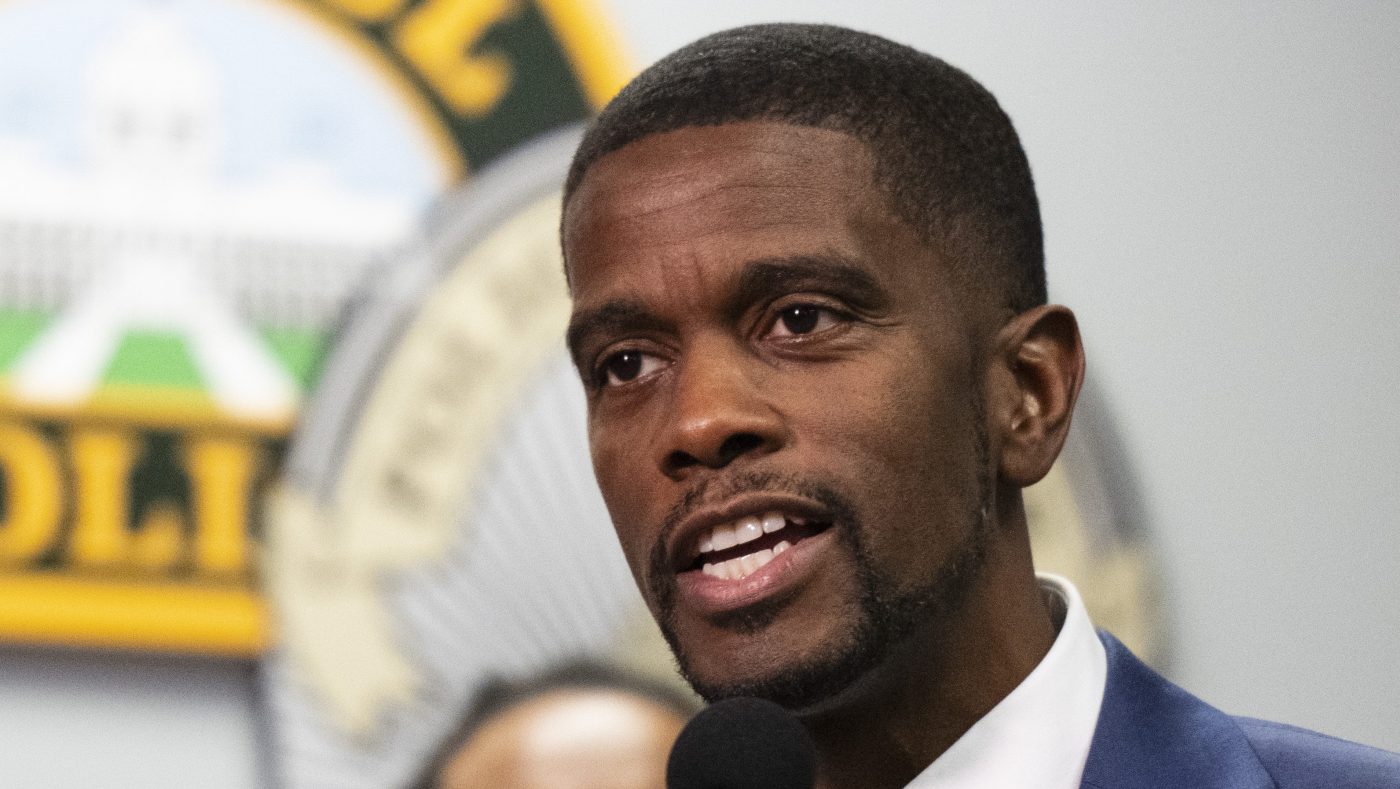
St. Paul Mayor Melvin Carter speaks at a Nov. 14 news conference at police headquarters. “If someone who is a citizen commits a crime in our city, we stop at nothing to hold them accountable,” Carter said this week. “That doesn’t change as a result of citizenship status either.” (John Autey / Pioneer Press)
The ordinance says all residents can access city services. It means people do not need to worry that a city employee “would ask someone to see their papers before letting them into a rec center or investigating a crime,” Mayor Melvin Carter said in a recent interview.
Trump, who was inaugurated for his second term Monday, has said he’ll deport “millions and millions” of people. Congress has passed one part of his plan, the Laken Riley Act, that expands requirements for immigration authorities to detain anyone in the country illegally who is accused of theft and violent crimes.
In St. Paul and Minneapolis, officials passed ordinances years ago with the intention of local employees not being in the business of enforcing federal immigration law. The Pioneer Press took a look at how the ordinance works in St. Paul, what local jails require to hold people for U.S. Immigration and Customs Enforcement (ICE) and local prosecutors’ decisions in cases involving immigrants.
How did the ordinance come about?
Pat Harris sponsored the city ordinance in 2004 when he was a St. Paul City Council member. He said they heard about people not contacting police when they were victims of domestic abuse and other crimes because they worried it could lead to them being deported.
“It was a pretty common-sense issue that people needed to be able to be free to report crimes, and our police department needed to be focused on crimes within our own community,” Harris said recently. “We didn’t think it was appropriate for St. Paul police to be doing the job of ICE agents.”
Harris said at the time that he received a flurry of emails and calls from people opposed to the ordinance, including some saying it would make St. Paul a haven for illegal immigration, though no one spoke against the measure during a public council hearing.
He also said in 2004 that the police department already had been operating under a policy similar to the one in the ordinance and the new measure codified that policy.
What does the St. Paul ordinance say?
Titled “Employee Authority in Immigration Matters,” St. Paul’s ordinance contains more than 2,000 words. Here are some highlights:
“The city works cooperatively with (the U.S. Department of Homeland Security) … but the city does not operate its programs for the purpose of enforcing federal immigration laws. Homeland security has the legal authority to enforce immigration laws in the United States, in Minnesota and in the city.”
“It is the policy of the city that all residents are equally entitled to protection and that all residents should be able to access city services to which they are entitled, without regard to their immigration status under federal law.”
“Public safety officials may not undertake any law enforcement action for the sole purpose of detecting the presence of undocumented persons, or to verify immigration status, including but not limited to questioning any person or persons about their immigration status.”
“If my neighbor is afraid to call 911, then my house is in jeopardy,” Carter said. “… If we’re putting out a fire or … filling a pothole or plowing a street or collecting garbage, citizenship status is not relevant to that service.”
Does the ordinance ice out ICE?
No, the ordinance says:
“Nothing in this chapter shall prohibit public safety personnel from assisting federal law enforcement officers in the investigation of criminal activity involving individuals present in the United States who may also be in violation of federal civil immigration laws.”
“Nothing in this chapter prohibits public safety personnel from adequately identifying criminal suspects or assessing the risk of flight of criminal suspects.”
“We don’t have the authority to prevent ICE from stepping foot in our city or prevent them from operating or prevent them from doing something,” Carter said.
When can a city employee can ask about immigration status?
The city’s ordinance says they can for “inquiries allowed by law or as necessary for law enforcement purposes.”
“All the rhetoric that we’re hearing about violent crime … is exactly that,” Carter said. “It’s rhetoric because if someone who is a citizen commits a crime in our city, we stop at nothing to hold them accountable. That doesn’t change as a result of citizenship status, either.”
Separately, the city ordinance says “city employees shall only solicit immigration information or inquire about immigration status when specifically required to do so by law or program guidelines as a condition of eligibility for the service sought. … The confidentiality of such information shall be maintained to the fullest extent permitted.”
The city attorney’s office can inform people about “possible immigration consequences of a guilty plea” and ask about immigration status for purposes of bail or conditional release, the ordinance says.
Do immigrant communities know about the St. Paul and Minneapolis ordinances?
“I don’t think it’s common knowledge in our communities,” said Wendy Zuñiga, communications director for COPAL, which works with Latino communities.
COPAL was impressed when Minneapolis Police Chief Brian O’Hara announced Jan. 16 that the department’s policy of not being involved in the enforcement of federal immigration law, in place for more than 20 years, had been updated.
“What our community really wants is local authorities to speak up about this and for more visibility about the separation policy because it would help people feel safer, but only if they knew,” Zuñiga said.
What are local jails’ policies about ICE?
The Ramsey County jail in 2018 discontinued housing people for U.S. Immigration and Customs Enforcement who were suspected of violating immigration rules. There are three county jails in Minnesota that serve as detention facilities for ICE: in Sherburne, Freeborn and Kandiyohi counties.
Related Articles
St. Paul man accused of helping son hide 4 bodies in Wisconsin cornfield sentenced to 16 years in prison
More than a dozen Minnesotans among Jan. 6 rioters who were spared by Trump
Burnsville ambulances will be the first in the state to carry blood for on-scene transfusions
Texas man gets 4 years in federal prison for carjacking at Inver Grove Heights strip club
Costumed St. Paul robber sentenced to 3½ years in federal prison for gun crime, violating probation
If someone is arrested and booked into a local jail for an alleged violation of state law and ICE has probable cause to believe they aren’t in the U.S. legally, they can issue a detainer to request the jail hold the person after the local charge has been handled. The Ramsey County Sheriff’s Office, which changed its policy about a decade ago, requires a judge’s order or warrant to hold a person for ICE.
Similarly, the Hennepin County jail only accepts signed judicial orders to hold someone for ICE.
“As of today, there appears to be no need to change the policy,” said Ramsey County Sheriff Bob Fletcher. “We will follow the law.”
Fletcher said they rarely get warrants from ICE to hold a person who’s jailed. To his knowledge, the people being arrested and booked into the Ramsey County jail are not often undocumented immigrants. “Most of our offenders have a long history with us in the past,” Fletcher said.
Will the Laken Riley Act change local prosecutors’ charging decisions?
The Laken Riley Act will mean that federal officials would be required to detain any migrant arrested or charged with crimes like shoplifting or assaulting a police officer or crimes that injure or kill someone. Some have raised concerns that the bill would strip due process rights for migrants, including minors or recipients of the Deferred Action for Childhood Arrivals program.
The act won’t change the Ramsey County Attorney’s Office charging policies, said spokesman Dennis Gerhardstein.
The office has had a policy on “collateral consequences” of prosecution since 2019, which considers the possibility of deportation for less serious crimes. It does not apply to people charged with more serious offenses or people who are in the country illegally, Gerhardstein said. The policy around considering deportation consequences is for immigrants who are lawfully in the U.S. when they’re charged with a crime.
The county attorney’s office policy says if they determine “justice requires altering a charge to arrive at an immigration-neutral result, (prosecutors) may choose an alternate plea similar in level of offense and length of sentence, but of a different nature.”
St. Paul City Attorney Lyndsey Olson, whose office prosecutes non-felony-level offenses, said they have “pre-charge alternatives to traditional prosecution that we will continue to consider for all qualifying cases.”
“While collateral immigration consequences may be a point of consideration in someone’s specific case, as to how we determine or recommend disposition, it is not the only piece of information considered, nor should it be,” she said in a statement.
Will St. Paul look at changing its ordinance?
Mayor Carter said he thinks it’s clear and isn’t proposing changes at this time.
But “this is a rapidly alarming situation, so I wouldn’t rule out the possibility that we get to a place that we want to add something” to the ordinance, Carter said.
What about the U.S. Department of Justice memo telling federal prosecutors to investigate local officials who stand in the way of cracking down on immigration laws?
Related Articles
Photos: St. Paul Winter Carnival Grande Day parade makes Grand Avenue debut
As Queen of the Snows, Tessa Westlund joins the Winter Carnival she grew up loving
Meet the canine king and queen of the 2025 St. Paul Winter Carnival and Doggie Depot
Ryan Cos. to appeal negative zoning decision at St. Paul’s Highland Bridge
Met Council Chair Charlie Zelle to deliver Met Council’s ‘State of the Region’ speech
Minnesota Attorney General Keith Ellison on Thursday joined attorneys generals from other states in a joint statement about the memo.
“It is well-established — through longstanding Supreme Court precedent — that the U.S. Constitution prevents the federal government from commandeering states to enforce federal laws,” the statement said. “While the federal government may use its own resources for federal immigration enforcement, the court ruled … that the federal government cannot ‘impress into its service — and at no cost to itself — the police officers of the 50 States.’”
Carter said in the recent interview that “separation of powers has been a core principle of American government.”
“We’ve never been the kind of country where the president of the United States would threaten to use the justice system against people who disagree with them politically,” he said. “The implications of that threat are absolutely terrifying.”


More Stories
AI boom fuels fears of an industry bubble (RT VIDEO)
A small group of tech giants has invested over $1 trillion in a technology that is failing to generate profits...
Grok blocked from undressing images in places where it’s illegal, X says
By ELAINE KURTENBACH, Associated Press Business Writer BANGKOK (AP) — Elon Musk’s AI chatbot Grok won’t be able to edit...
Grok blocked from undressing images in places where it’s illegal, X says
By ELAINE KURTENBACH, Associated Press Business Writer BANGKOK (AP) — Elon Musk’s AI chatbot Grok won’t be able to edit...
México quiere reforzar la resolución de controversias dentro del T-MEC ante medidas “intempestivas”
Associated Press CIUDAD DE MÉXICO (AP) — Reforzar y agilizar el sistema de resolución de controversias del tratado de libre...
15 former NCAA players among those charged in alleged scheme to rig basketball games
PHILADELPHIA (AP) — Federal prosecutors charged 20 people on Thursday, including 15 former college basketball players, in what they called...
15 former NCAA players among those charged in alleged scheme to rig basketball games
PHILADELPHIA (AP) — Federal prosecutors charged 20 people on Thursday, including 15 former college basketball players, in what they called...