
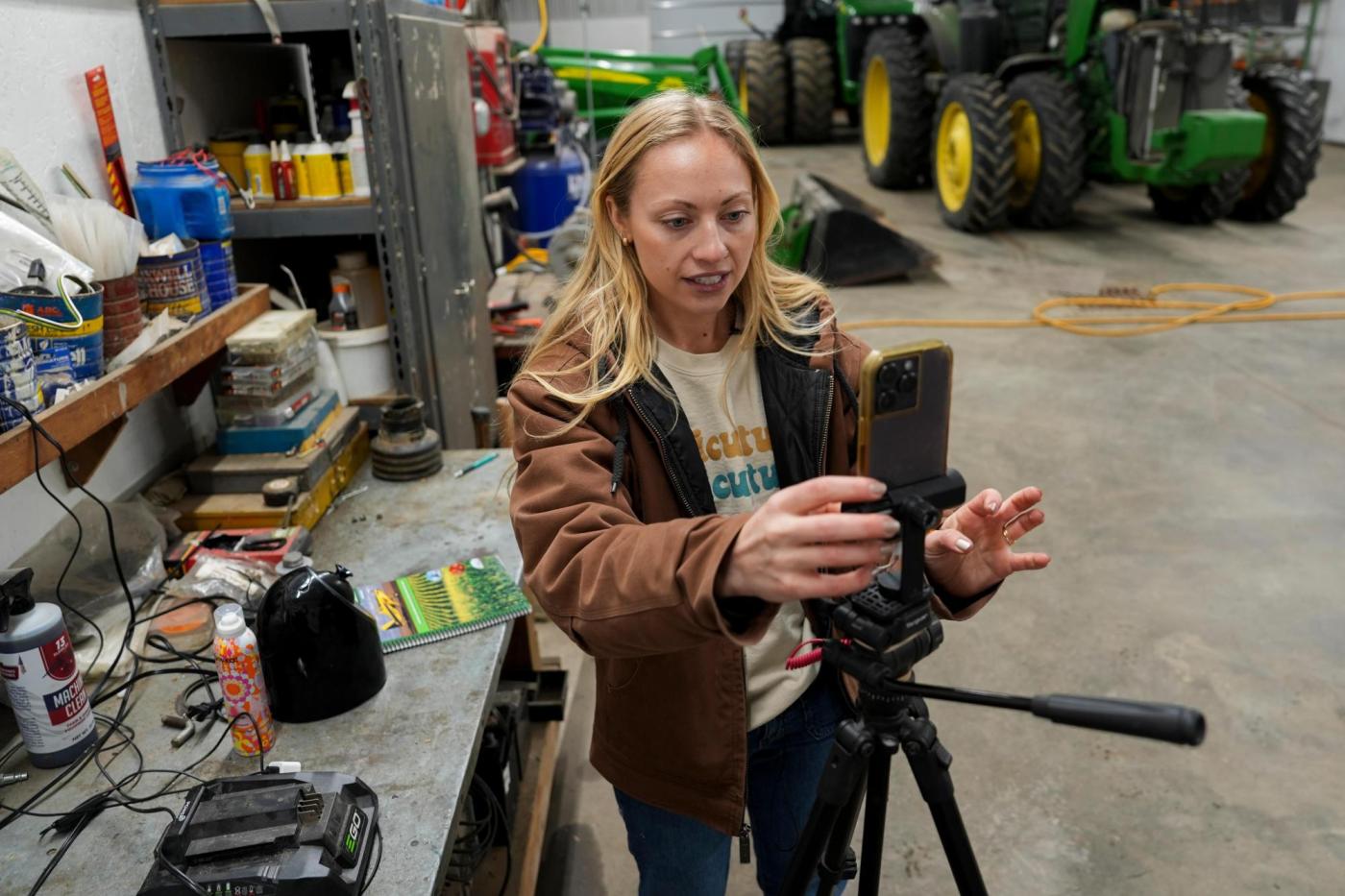
On ‘Farmtok,’ agriculture gets its moment in the spotlight. What would it mean if that disappeared?

By MELINA WALLING and JOSHUA A. BICKEL
BUCYRUS, Ohio (AP) — Zoe Kent hopes people get a little joy out of her talking about farming on the Internet. In one of her latest videos, she compares pesticide application to dry shampoo. “Farming is for the girls,” she quips.
On Instagram and TikTok, under the handle “farmwithzoe,” Kent films herself putting on boots to load corn into a massive truck bed, posts memes about the price of grain and documents just about everything else about farm life from getting rocks stuck in her equipment to eating lunch on long days out in a combine.
Zoe Kent walks into a machine shed, Monday, Jan. 20, 2025, at her farm in Bucyrus, Ohio. (AP Photo/Joshua A. Bickel)
Now, the future of TikTok — and “Farmtok,” as some creators call the ecosystem of farm-related influencers online — has become more uncertain, thanks to a ban the U.S. government briefly implemented on TikTok over the weekend. That was followed by the new Trump administration rescinding that ban, at least for now, but farmers are all too aware that things could change, and with them, the ways that they share farm life with the rest of the world. But most say they’ll keep adapting to whatever the platforms throw their way.
“It’s building your business on rented land, if you will,” Kent said. “It’s not guaranteed to be there.”
Even before the uncertain threat to TikTok’s future, farm creators had to contend with social media’s evolution. As algorithms changed, they faced greater challenges communicating with a public that many see as increasingly disconnected from agriculture.
Zoe Kent walks back to her truck after running an errand at a local grain elevator, Monday, Jan. 20, 2025, in Upper Sandusky, Ohio. (AP Photo/Joshua A. Bickel)
But most say they’ll keep adapting to whatever the platforms throw their way. Some producers make extra money by building a following on TikTok or Instagram. Others use social media to advertise to local customers like restaurants or farmers’ markets. Perhaps most importantly, they want to continue to build community with other farmers in the face of industry challenges like the toll of the profession on mental health, economic pressure and climate change.
Multiple farmers said that disconnection has grown over the years as social media algorithms have changed. “I know for a fact our social media reach is greatly diminished now,” said Beth Satterwhite, who has been posting about her small organic vegetable farm in McMinnville, Oregon on Instagram for over a decade now. “On the ground stories of people working in agriculture are a little less interesting to the consumer — I don’t know if it’s actually less interesting or just less visible,” she said.
Snow blankets fields at Zoe Kent’s farm, Monday, Jan. 20, 2025, in Bucyrus, Ohio. (AP Photo/Joshua A. Bickel)
Neil Denton, who farms corn, soybeans, wheat and rye in Barlow, Kentucky, shared a similar sentiment. He thinks that many of his over 80,000 followers on Instagram and 33,000 followers on TikTok are fellow producers, not members of the public. He calls that “disappointing” and worries about how little people know about the food that ends up on their plates.
But he does think there’s a silver lining: “Farming is a lonely occupation because you’re not with a lot of coworkers,” Denton said. “I think some farmers use social media as an outlet…to be able to express yourself and to be able to feel like you’re not lonely.”
Within the farming community, it can also be useful to learn from other farmers, many producers said. Megan Dwyer, who grows corn and soybeans and raises beef cattle in northwest Illinois, uses social media, especially X and Facebook, to gauge what matters to other farmers. “It’s a great source for information, especially rapid information,” she said.
However, all that rapid information does have a price. Satterwhite described a “language soup” around agriculture, saying it could be hard for an outsider to tell what farming practices are legitimately better for the climate or environment. “I see a lot of greenwashing,” said Satterwhite, referring to the practice of falsely portraying a product or practice as eco-friendly to market it to an environmentally-conscious audience.
Related Articles
The Grammys will proceed with wildfire relief changes and Trevor Noah as host. Here’s what to expect
Taylor Swift and Morgan Wallen lead the 2025 iHeartRadio Music Award nominations
Dear Abby: Sister hell-bent on marrying her brother
Everything you need to know about the 2025 Sundance Film Festival
Trevor Noah is tapped to once again host the Grammy Awards
“There’s definitely a lot of misinformation out there,” Kent said. “I try to sift out who has genuine questions versus who just already has a stance and they’re not willing to hear me out.”
That’s something many farming influencers agree on — that they still want a place to have the conversation.
As Dwyer put it: “You never know who you’re influencing there or or what may happen.”
Walling reported from Chicago.
Follow Melina Walling on X @MelinaWalling and Bluesky @melinawalling.bsky.social. Follow Joshua A. Bickel on Instagram, Bluesky and X @joshuabickel.
The Associated Press’ climate and environmental coverage receives financial support from multiple private foundations. AP is solely responsible for all content. Find AP’s standards for working with philanthropies, a list of supporters and funded coverage areas at AP.org.
More Stories
Kaiser affiliates will pay $556M to settle a lawsuit alleging Medicare fraud
SAN FRANCISCO (AP) — Kaiser Permanente affiliates will pay $556 million to settle a lawsuit that alleged the health care...
Kaiser affiliates will pay $556M to settle a lawsuit alleging Medicare fraud
SAN FRANCISCO (AP) — Kaiser Permanente affiliates will pay $556 million to settle a lawsuit that alleged the health care...
The new BTS album title and what to know about the K-pop band’s comeback
By MARIA SHERMAN, Associated Press Music Writer NEW YORK (AP) — After a nearly four-year musical hiatus, the K-pop giants...
Patriots D-lineman ‘optimistic’ he’ll return to play Sunday vs. Texans
FOXBORO — Patriots defensive lineman Khyiris Tonga said Thursday he’s optimistic he will be available to play in this weekend’s...
Mattel and Alex Aster team up for Barbie young adult novel, ‘Barbie: Dreamscape’
By HILLEL ITALIE NEW YORK (AP) — The publishing arm of Mattel Inc. is teaming with million-selling novelist Alex Aster...
Actor Michael Keaton is named Man of the Year by Harvard’s Hasty Pudding Theatricals
CAMBRIDGE, Mass. (AP) — Actor Michael Keaton has been named 2026 Man of the Year by Harvard University’s Hasty Pudding...