
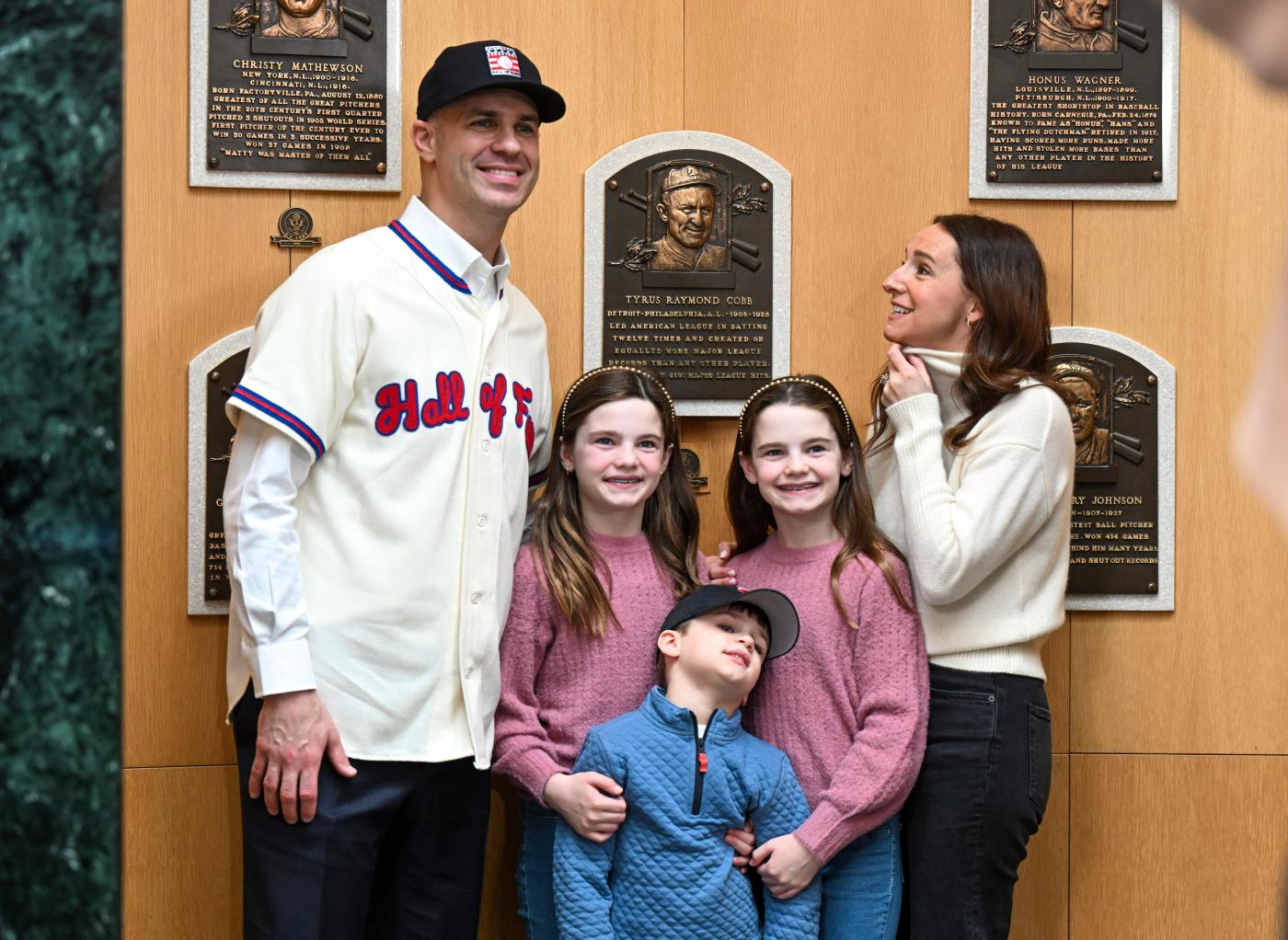
Check out the company Joe Mauer joins in the Hall of Fame

When Joe Mauer is inducted on Sunday, he will become just the 20th catcher in the Hall of Fame. There are 27 first basemen, 26 shortstops. Only 3B is less represented among the positions with 19 (let’s not get into designated hitters).
For whatever reason, Hall of Fame voters have paid less attention to catchers. Some of the greatest of all time had to wait several ballots to get the call to Cooperstown.
Here is the illustrious company Joe Mauer joins.
Johnny Bench
Johnny Bench (Louis Requena / MLB Photos via Getty Images)
Bench revolutionized the position (and allegedly ruined generations of young catchers) with his style of defense, catching everything, even the ones in the dirt, with that effortless one-handed style. He was one of the key players on the championship Big Red Machine in 1975 and 1976, and a first-ballot Hall of Famer.
What did he do that Joe Mauer didn’t: Embrace stardom. Bench was everywhere — TV specials, game shows, interviews. He appeared in “Mission: Impossible” and “The Partridge Family,” and not as himself. Mauer seems pretty happy just being a guy from St. Paul.
What did Mauer do that he didn’t: Hit for average. Bench hit .309 in a shortened 1981 season, but other than that he never hit higher than .293, and had a career average of .267 with a .342 on-base percentage. Mauer hit .306 with a .388 career on-base mark.
Yogi Berra
Yogi Berra tags Phillies shortstop Granny Hamner at the plate in the ninth inning of Game 3 of the 1950 World Series at Yankee Stadium. (Associated Press)
In competition with Willie Mays as one of the most beloved players in baseball history — and his colorful persona sometimes overshadows how great a player he really was. He won three MVP awards. In 1950, he hit 28 homers and struck out just 12 times. The next year, 27 homers vs. 20 strikeouts. In 1952, 30 homers and just 24 Ks.
What did he do that Mauer didn’t: Win it all, again and again. And again. He may be the biggest winner in baseball history, winning 10 World Series rings as a player.
What did Mauer do that he didn’t: Carefully choose his words. The world is full of “Yogi-isms” — “It ain’t over till it’s over,” “When you come to a fork in the road, take it,” “The future ain’t what it used to be,” and on and on. He probably didn’t say half of these things (“I didn’t really say everything I said”) but he did have a unique way of speaking. And the world was all the better for it.
Roger Bresnahan
Roger Bresnahan (Associated Press)
Bresnahan was the fiery catcher for the New York Giants in the first decade of the 20th century, known for his fiery demeanor. He designed the first batting helmet and was the first catcher to wear a padded facemask. It was a great career, but it’s hard to see what exactly got him into the Hall of Fame. Bresnahan also had a stint with the Minneapolis Millers in 1898.
What did he do that Mauer didn’t: Pitch. Bresnahan broke into the big leagues in 1897 as a pitcher and went 4-0 for the Senators. He moved to the field and was mainly a catcher by 1905 (though he did appear on the mound in 1910, too).
What did Mauer do that he didn’t: Roger Bresnahan played for John McGraw and caught Christy Mathewson in his prime. But Roger Bresnahan never did a single Head & Shoulders commercial.
Roy Campanella
St. Paul Saints manager Walt Alston congratulates Roy Campanella as he jogs toward home plate after socking a home run at Nicollet Park in Minneapolis on May 31, 1948. (Courtesy of the Minnesota Historical Society)
He was mentored by two of the greatest catchers of the Negro Leagues, Biz Mackey and Josh Gibson, and starred there for a few years before joining the Brooklyn Dodgers. After a brief stint in Brooklyn, they sent him to get some at-bats at their top minor league team, the St. Paul Saints. Campy made quite an impression in his brief stint here in St. Paul before he rejoined the Dodgers and continued his career as one of the greatest of all catchers. His baseball playing career came to a sad end when a car accident left him paralyzed.
What did he do that Mauer didn’t: Play professionally in St. Paul! Mauer’s our guy — born and raised on this side of the river, a star at Cretin-Derham Hall. But I’ve checked twice and the Metrodome and Target Field are both in Minneapolis. “Campy” had a memorable if brief run with the St. Paul Saints before he established himself with the Dodgers.
What did Mauer do that he didn’t: Fill baserunners with fear. Campanella might have had the best arm of any of the Hall catchers. Biz Mackey, Bench and Ivan Rodriguez are also contenders. But he regularly threw out more than 6 out of every 10 would-be thieves.
Gary Carter
Gary Carter gets a hug from the Phillies mascot, the Phanatic, left, in 1981. (Associated Press)
If, like me, you mostly remembered Gary Carter’s later years with the Mets (and then some other more forgettable years), you might remember as a pretty good catcher. But check out those years with the Expos once again. If you use the Baseball Reference wins-above replacement stat, no catcher had a better seven-year peak than Gary Carter. He hit for power and played even better defense than Johnny Bench had.
What did he do that Mauer didn’t: Mauer was a good defensive catcher, but Carter was out of this world — and the enthusiasm showed.
What did Mauer do that he didn’t: Get noticed. Maybe it’s because we knew how to dig deeper into the stats by 2009, but Mauer actually managed to win the MVP in his finest year, and he wasn’t exactly playing in the hottest media market. Carter didn’t get a single first-place MVP vote in one of the greatest years a catcher ever had. Then it took the world six ballots to put him in the Hall of Fame.
Mickey Cochrane
Tigers manager and catcher Mickey Cochrane in 1934, the year he won his second MVP award. (Associated Press)
Cochrane was the catcher for the Philadelphia Athletics of the late 1920s, a team so great that they kept the Babe Ruth-Lou Gehrig-Tony Lazzeri Yankees out of the World Series for three straight years before Connie Mack broke them up. Cochrane’s career on-base percentage was .419, and he won two MVP awards. He also led Detroit to its first World Series as a player-manager, before his career was ended by a fastball to his head that fractured his skull.
What did he do that Mauer didn’t: Curse up a streak. Cochrane was one of the most fiery players of his era, a time that was perhaps just a little rougher than today’s game.
What did Mauer do that he didn’t: Keep the fans and sportswriters on his side. Sure, there was some grousing about Mauer’s big contract after he had moved to 1B and wasn’t putting up MVP seasons anymore. But Mickey Cochrane got a lot of abuse in Philadelphia for a World Series loss in 1931 to the Cardinals, who stole eight bases in seven games (five of them by Pepper Martin). It probably expedited his ticket out of town, where he led the Tigers to their first World Series championship in 1935.
Bill Dickey
Bill Dickey at spring training in 1937. (Associated Press)
Dickey was a teammate of Ruth, Gehrig and DiMaggio, and he was the Yankees’ star catcher as they transformed from occasional World Series winners into trophy hogs. He won eight World Series championships, and was a regular .300 hitter with power.
What did he do that Mauer didn’t: Played himself in a movie. Dickey, one of Lou Gehrig’s closest friends, shows up as “Bill Dickey” in Gary Cooper’s “Pride of the Yankees.”
What did Mauer do that he didn’t: Hit over .362. Dickey’s 1936 season batting average was the record for an AL catcher until Mauer broke it in 2009.
Buck Ewing
The first catcher in the Hall of Fame, Ewing was a star of the 1880s and 1890s. Maybe THE star. Connie Mack called him the greatest catcher he’d ever seen, and that was in 1939 and after Connie had managed Mickey Cochrane. Ewing has been credited with things like being the first catcher to crouch behind the plate and to catch using a glove with padding. But he caught relatively few games (his teammates once accused him of being too afraid to catch hard-throwing Amos Rusie) and in many ways he just wasn’t playing the same game as they were even in the 1920s, much less today.
What did he do that Mauer didn’t: How much time do we have? Ewing had quite the colorful career, even by 19th-century standards. It seems likely that he tried to throw a game or two, not for money but to make sure rivals like John Montgomery Ward didn’t win the pennant. He once locked an umpire in a dressing room to get a more favorable ump sent in as a replacement. That’s wrong, of course, but I am shopping a screenplay set in an alternative universe in which Mauer does just that to Phil Cuzzi before Game 2 of the 2009 AL division series.
What did Mauer do that he didn’t: Be a good teammate. Just about every team Ewing was on was happy to be rid of him eventually. They accused him of cheating, playing favorites, faking injuries and all manner of general villainy. Star slugger Roger Connor even left the Giants because teammate Ewing decided to take his spot at first base when he was tired of catching. That’s slightly different from the Mauer-Morneau relationship.
Rick Ferrell
Washington Senators catcher Rick Ferrell in 1945 (Associated Press)
Ferrell was a respected but light-hitting catcher of the 1930s — he had some good but not great batting averages early in his career, but it was a time when everyone was hitting .300. He had a good defensive reputation but today’s stats don’t show anything out of this world. Still, he was highly thought of in his time and was frequently named an all-star.
What did he do that Mauer didn’t: Never strike out. Ferrell played 18 years and often had 400-500 plate appearances in a season, and he usually whiffed fewer than 20 times. His high was 26 in a season. But he had only doubles power, finishing his career with just 28 homers.
What did Mauer do that he didn’t: Outshine his own siblings. Joe Mauer’s brothers Jake and Billy both played in the Twins organization, of course, but neither made the big-league club. Rick Ferrell’s brother Wes was a star pitcher at the same time and sometimes on the same team — and he was the bigger star at the time and has a much better Hall of Fame case (60.1 wins above replacement vs. Rick’s 30.8). Somehow Rick is the one with the plaque.
Carlton Fisk
Carlton Fisk watches his 12th-inning home run against the Cincinnati Reds to give Boston a victory in Game 6 of the 1975 World Series at Fenway Park. (Harry Cabluck / Associated Press)
The original Pudge hit one of the most famous home runs in baseball history, the second-greatest World Series Game 6 homer of all time, in my book.
What did he do that Mauer didn’t: Keep going and going and going. Catchers don’t have long careers. The biggest knock on Mauer is his relatively short career and short peak. He’s not the only one. Cochrane and Josh Gibson both were cut down in their prime. Bench, Carter and Simmons faded in their 30s, earlier than other great players. Campanella was a shell of himself before the car accident. But Fisk appeared in 24 seasons. When he retired in 1993, he was four years older than Mauer is right now.
What did Mauer do that he didn’t: Be the best catcher in baseball. Fisk had a monster of a 1972 season and won the Rookie of the Year award in Boston, but he was never quite as good as that again, though he was very good for 20 years. But he never had a year like Mauer’s 2009.
Josh Gibson
Josh Gibson (Associated Press)
The greatest hitter in Negro Leagues history and the all-time big-league leader in batting average, at .372., and slugging percentage, at .718. He’s also the subject of some of the best baseball stories around. Gibson and Homestead Grays teammate Buck Leonard formed a 1-2 punch that was at least the equal of Ruth and Gehrig.
What did he do that Mauer didn’t: Hit like Josh Gibson. Hey, nobody did, unless they had names like Ruth, Williams or Bonds.
What did Mauer do that he didn’t: Get a happier ending. Gibson was diagnosed with a brain tumor in 1943, one of his great seasons, and he died of a stroke in 1947, when he was just 35. It’s not hard to imagine that if he had lived, he might have had the chance to play in the AL or NL to finish his career, as Satchel Paige did. Or to see his plaque in the Hall of Fame in 1972.
Gabby Hartnett
Gabby Hartnett blocks Hank Greenberg from the plate on Oct. 3, 1935 in Detroit. (Associated Press)
Hartnett starred for the Cubs in the 1920s and 1930s. It was quite a time for catchers — two of the greatest of all time were playing in the AL and NL with Mickey Cochrane and Hartnett, respectively, and Biz Mackey was starring in the Negro Leagues. Hartnett was a great hitter with a cannon of an arm who hit the famous “Homer in the Gloamin’ ” that propelled the Cubs to the 1938 pennant.
What did he do that Mauer didn’t: Sport a good nickname. Seriously, Mauer came up short in this department. Joe. I don’t think we ever even called him Joey or Joe-Joe or JMau or Chairman Mau. But Charles Leo Hartnett was occasionally called “Old Tomato Face.”
What did Mauer do that he didn’t: Not screw up the storybook ending by going off to another team. After 19 Hall of Fame years with the Chicago, Hartnett signed for the 1940 season with the New York Giants. He was still a good player, hitting .300 while playing part time. But can you imagine if Mauer’s last year had been in a White Sox jersey or something like that? Instead, we got one of the best moments in Twins history.
Ernie Lombardi
Ernie Lombardi at spring training in 1939. (Associated Press)
Big and slow, but he could hit — Lombardi won a batting title for the Reds in 1938 and another for the Boston Braves in 1942. The next catcher to win a batting title was … Joe Mauer. He also had a strong arm and threw out baserunners at a strong clip. He was beloved in Cincinnati but got some unfair blame for the Reds’ loss to the Yankees in the 1939 World Series. But “Schnozz” and the Reds won the title in 1940.
What did he do that Mauer didn’t: Stay behind the plate. Lombardi played 1,852 major-league games and never appeared anywhere on the diamond but catcher. He did some pinch hitting, but not one inning in the outfield or first base or anything but behind the dish.
What did Mauer do that he didn’t: Run. Was Lombardi the slowest player in big-league history? Certainly he was the slowest Hall of Famer. The stories are endless: Thrown out at 1B from left field, thrown out at 1B on a ball off the wall, teams using 4 outfielders whenever he came to the plate, and so on. But the man could hit.
Biz Mackey
Coaches Frank Duncan, left, and Biz Mackey decide who’s home before the Negro Leagues East-West All-Star Game at the Polo Grounds in New York on July 29, 1947. (Keystone / Hulton Archive / Getty Images)
Mackey was a star of the Negro Leagues in the 1920s and ’30s whose career connects a lot of the great names. It seems pretty certain that Mackey was one of the greatest defensive catchers of all time. He played practically forever, so his offense dropped off after stunning years in the 1920s.
What did he do that Mauer didn’t: Form a lineage of Hall of Fame catchers. Mackey supplanted the Hall of Famer Louis Santop with the Hilldale club, and he mentored the young Roy Campanella — especially on defense — at the other end of his career. Mauer took over from A.J. Pierzynski, and he was succeeded by Kurt Suzuki.
What did Mauer do that he didn’t: Hit for some power — unlike the other great Negro Leagues catcher of his time, Mackey didn’t hit a lot of homers — though in the ’20s he regularly turned in batting averages that would have made even Mauer envious.
Joe Mauer
Joe Mauer connects for a double against the Detroit Tigers in a single-game tiebreaker at the Metrodome on Oct. 6, 2009. (Ben Garvin / Pioneer Press)
Josh Gibson, Ernie Lombardi and Mauer are the only Hall of Fame catchers to win AL or NL batting titles, with Mauer winning three of them. (Outside of the Hall of Famers, the only other catchers to win batting titles are Buster Posey in 2012 and Bubbles Hargrave in 1926.) Mauer joins Johnny Bench and Ivan Rodriguez as the only first-ballot Hall of Fame catchers, as well. Like Bench, Dickey and Berra, he never played in another big-league uniform, either.
What did he do that Mauer didn’t: Nothing. Nothing at all.
What did Mauer do that he didn’t: I don’t understand the question.
Mike Piazza
Yogi Berra shakes Mike Piazza”s hand after throwing the first pitch to start an interleague game between the New York Mets and the New York Yankees at Shea Stadium. (Associated Press)
Piazza, through sheer doggedness, turned himself into the best-hitting catcher not named Gibson that the big leagues ever saw. His 1997 season is one of the greatest by a catcher of all time.
What did he do that Mauer didn’t: Hit dingers. Mauer cracked 143 homers in his career, with a high of 28 in his 2009 season. Piazza hit 427, with 399 of them as a catcher, the record.
What did Mauer do that he didn’t: All the other stuff. Mauer was the better defender and far better baserunner.
Ivan Rodriguez
Texas Rangers catcher Ivan Rodriguez tags out the Yankees’ Gerald Williams. (Henry Ray Abrams / AFP via Getty Images)
Rodriguez is linked with Mauer and Bench as the only catchers elected to the Hall of Fame on the first ballot. He wasn’t the offensive equal of some of the other all-time greats, but his mere presence seemed to shut down the running game.
What did he do that Mauer didn’t: Gun out runners. Rodriguez was usually at or near the top of the league in throwing out basestealers. He regularly threw out more than half of the runners foolish enough to take a shot at it.
What did Mauer do that he didn’t: Show some patience at the plate. Pudge was up there to swing — he somehow walked 55 times in 2003, but that was an anomaly. For his career he took 513 walks in 10,270 plate appearances, while Mauer walked 939 times in just 7,960 plate appearances.
Louis Santop
We probably know less about Santop, a Negro Leagues star of the 1910s and ’20s, than any of the other great catchers. There are stories of him calling home run shots and throwing the ball over the center field fence from the catcher position. He also outhit Babe Ruth in a 1920 exhibition series.
What did he do that Mauer didn’t: Remember that time Mauer stepped out of the box and called his own home run shot, jabbing a cocky finger toward the fence, egging on the masses and infuriating the pitcher? Yeah, neither do I.
What did Mauer do that he didn’t: End his career on a high note. Santop’s time as a star in the Negro Leagues effectively ended after he dropped a popup in the last inning of what was in 1924 called the “Colored World Series.” The Kansas City Monarchs batter, with new life, got the game- and series-winning hit to beat Santop’s Hilldale club, and the next year Biz Mackey took over as the team’s primary catcher.
Ted Simmons
Lee Mazzilli of the Mets flips in the home plate dirt at New York’s Shea Stadium after being tagged out by St. Louis Cardinals catcher Ted Simmons on May 29, 1978. (Ray Stubblebine / Associated Press)
Simmons had to wait for the call to Hall, too, but he supplanted Johnny Bench in the ’70s as the best-hitting catcher in the NL.
What did he do that Mauer didn’t: They both had pretty sweet left-handed swings, but Simmons could swing it from the right side, too. Among the Hall of Fame catchers, he’s the only switch-hitter.
What did Mauer do that he didn’t: Keep his hands to himself. Simmons was instrumental in one of the great brawls of the 1970s, when he (almost) inexplicably punched batter Bill Madlock, who up until that point had really only been arguing with the umpire.
Ray Schalk
Hall of Famers Harry Hooper, Eddie Collins and Ray Schalk of the Chicago White Sox in 1925. (Associated Press)
Ray Schalk hit 11 home runs in his 18 seasons — and four of those were in his best year, 1922. The first half of his career was in the dead-ball era, but still. Schalk was known as the best defensive catcher of his time, but it does seem like his Hall of Fame selection was helped simply because he was one of the most famous of the “Clean Sox” absolved of any involvement in the 1919 Black Sox scandal.
What did he do that Mauer didn’t: Record a putout at second base while playing catcher. In a game in 1918, Shoeless Joe Jackson made a surprising catch in deep left field, and Schalk was sharp enough to be standing at second base to take the relay and double off the baserunner who’d strayed too far from the bag.
What did Mauer do that he didn’t: Keep his teammates away from gamblers. We can’t really blame Schalk for the Black Sox scandal that might have cost his team the 1919 World Series, but let’s just point out that none of Mauer’s teammates has been banned for life over consorting with gamblers. So when the children of the Saintly City warble “Say it ain’t so, Joe?” to our Joe, he can send them on their way with a clear conscience every time.
“From St. Paul to the Hall”: the Pioneer Press chronicled the careers of Dave Winfield, Paul Molitor, Jack Morris and Joe Mauer, and we’ve compiled the best of our coverage into a new hardcover book that celebrates the legendary baseball legacy of Minnesota’s capital city. Order your copy of “From St. Paul to the Hall.”
Related Articles
Three current Twins learned valuable lessons from sharing clubhouse with Joe Mauer
‘From St. Paul to the Hall’: Paul Molitor steals home
Justin Morneau excited to see longtime friend, Twins teammate Joe Mauer honored in Cooperstown
St. Paul vs. Mobile, Alabama — which is the capital for Hall of Famers?
Joe Mauer’s 2009 season was legendary. Where does it rank among the best ever?

More Stories
Vinted breaks the billion-euro barrier as thrifty shoppers embrace second-hand fashion
The relentless squeeze on household budgets is reshaping how consumers buy clothes, and few businesses are reaping the rewards quite...
Oil price surges towards $100 as Middle East ceasefire begins to unravel
The brief sigh of relief across global markets lasted barely a day. Brent crude climbed sharply back towards $100 a...
Harrods Estates shuts up shop after 130 years as tax raids on wealthy overseas buyers take their toll
The iconic property arm of the Knightsbridge department store has closed its last remaining office after a perfect storm of...
John Lewis chairman’s pay climbs 21% to £1.2m as 3,300 roles disappear across the partnership
There is never an easy way to announce a hefty pay rise at the top while headcount is falling on...
Britain smashes solar records as ministers greenlight country’s largest solar farm
Britain’s solar sector delivered a statement of intent this week, smashing generation records on back-to-back days as ministers gave the...
The spectre of stagflation returns as Britain’s private sector grinds to a near-halt
The uncomfortable echoes of 2022 are growing louder. Britain’s private sector expanded at its weakest pace in six months during...