
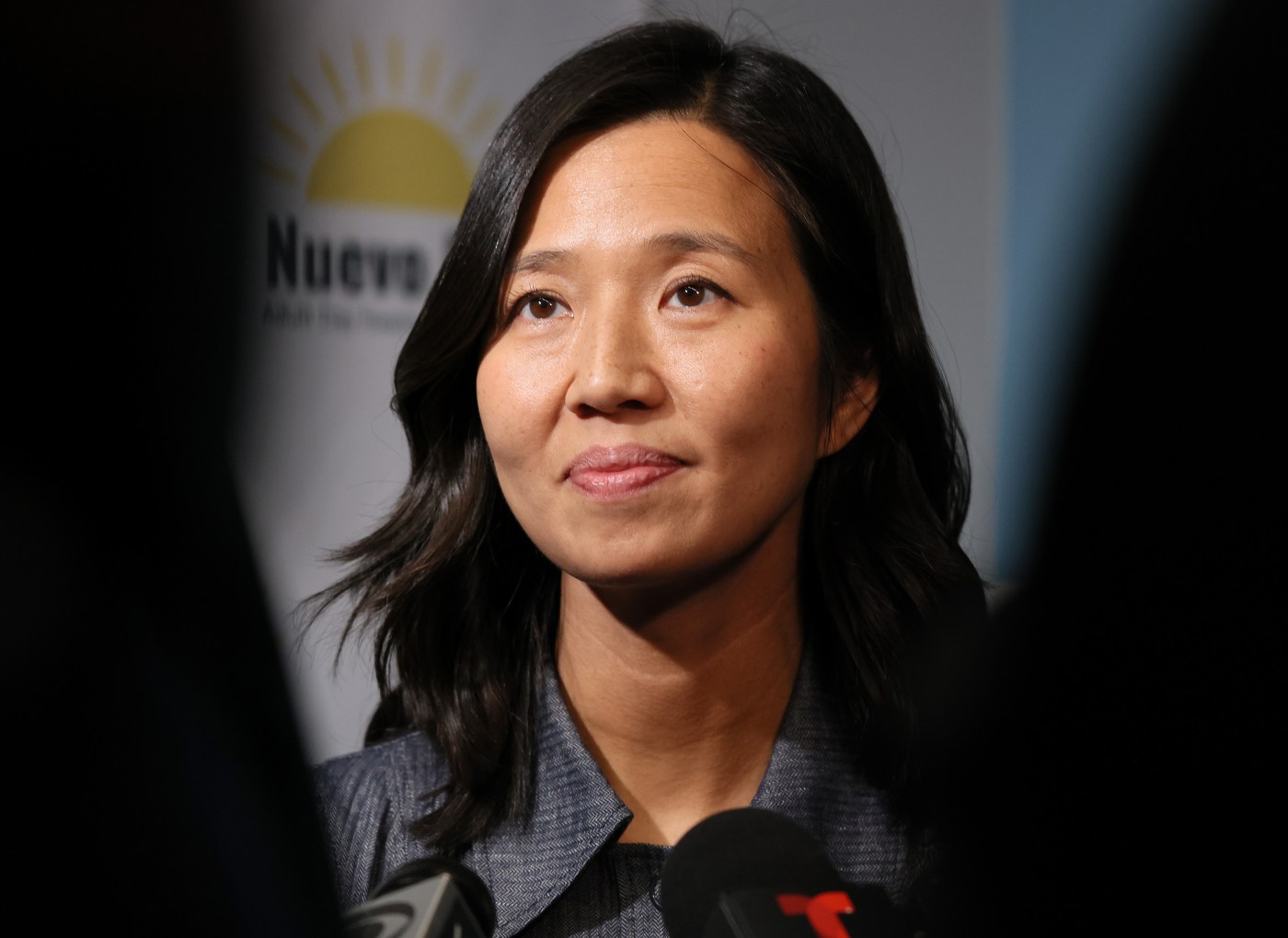
Boston Mayor Wu’s tax battle intensifies ahead of City Council vote to set residential tax hike at 13%

The battle over Boston Mayor Michelle Wu’s renewed tax shift legislation push intensified Monday as the Boston City Council prepared to set tax rates this week that would bring a projected 13% tax increase for the average single-family homeowner next year.
The Council is expected to vote Wednesday to set the residential tax rate at $12.40 per thousand dollars of assessed value and commercial tax rate at $26.96 per thousand dollars of assessed value. Those rates are based on setting the maximum shift of 175% of the city’s tax burden from the residential to commercial sector.
Wu said last week that such action would result in a 13%, or $780 increase, in property taxes for the average single-family homeowner next year. The Council is also expected to set the maximum residential exemption of 35%, which city financial officials projected would save qualified homeowners up to $4,353 on their tax bills next year.
“Without passage of these dockets, we would revert to a system where we have one flat tax rate for everybody,” Boston Commissioner of Assessing Nicholas Ariniello said at a Monday City Council hearing. “It’s a really important action that the Council and mayor … have always voted to maximize to provide the most relief possible to our residents.”
Rates need to be set before bills go out Jan. 1.
While Ariniello and Chief Financial Officer Ashley Groffenberger described the Council’s annual rate-setting vote as “routine” in nature, it will be done, for a second straight year, in the backdrop of a nearly two-year political battle the mayor has been waging with state lawmakers to pass her stalled tax shift legislation.
Wu’s top financial officers — and the councilors, labor unions and senior groups she’s aligned with — framed the mayor’s stalled legislation to shift more of the city’s tax burden from the residential to commercial sector, beyond the 175% state limit, as the best option to provide residential tax relief.
“I think the mayor’s proposal … is the only available lever to prevent extreme residential tax hikes,” Councilor Sharon Durkan said. “I’ve heard from commercial real estate owners that they do not care what happens here, that … this is a media fight. I heard from commercial owners that this is the cost of doing business, this change and this temporary shift. They would be able to absorb this.
“The seniors and the young families I’m talking to in my district cannot absorb this.”
Amir Shahsavari, vice president of the Small Property Owners Association, said in a statement, however, that the mayor’s plan “would devastate small businesses and property owners who will continue fleeing Boston because of its high taxes and hostile attitude toward business.”
The mayor’s legislation is designed to counter a post-pandemic market tied to remote work and vacant office space that has commercial values projected to drop by 6% alongside a 2% rise in residential property values in fiscal year 2026.
That trend is projected to continue for at least the next two years, Ariniello said, and per city officials, is pushing more of the city’s tax burden from the commercial to residential sector, due to a city budgetary structure that derives three-quarters of its revenue from property taxes — thus necessitating the need for legislation to stabilize the shift.
Should the legislation pass, the average single-family homeowner would see a $480, rather than $780, increase in their property tax bills next year, Wu’s office has said. Commercial owners would still see a decrease in their tax bills, though not by as much as they are projected to see without the bill’s approval, per Wu.
Durkan also used her remarks to echo Wu in blaming the state Senate, which killed the mayor’s tax shift legislation late last year and has not taken action on it this year, for the double-digit tax hike that homeowners are bracing for — for a second straight year. Last year’s increase was 10.4%.
“Anyone who tries to downplay the moment that we’re in right now is not representing our constituents,” Durkan said.
Several labor unions and a senior advocacy group who support the bill and held a press conference ahead of the Council hearing similarly cast blame at the Senate.
Wu has singled out state Sen. Nick Collins for repeatedly using a procedural move to block a vote on her legislation late last year. The bill was ultimately killed by Senate President Karen Spilka, due to a lack of support, after Department of Revenue-certified numbers of city assessing data showed residential tax increases were lower than projected by the city last year.
Collins said Monday that the timing of the mayor’s renewed push for the tax shift bill “does not show a serious effort to advance legislation,” given that it began last week, “well after the period when the Legislature conducts its formal business.”
“It looks like setting up a fight and preparing to point the finger when tax bills go out in January,” Collins said in a statement. “On the other hand, the Senate is advancing legislation that would give the mayor the authority to issue rebates and drive down taxes for homeowners. These bills would provide real relief for residential taxpayers while protecting small business owners and not putting our economy at risk.
“I stand ready to work with the mayor to deliver relief to taxpayers,” the South Boston Democrat said. “It is time to focus on viable solutions, not manufactured conflict.”
The mayor has directed all city departments to propose budgets for the next fiscal year that are 2% below this fiscal year, but that won’t result in a cut to next year’s city budget, which grew by 8% last year, 4.4% this year to $4.8 billion, and is expected to grow again next year, Groffenberger said.
Several other senators have made comments since the mayor’s urging last week for immediate approval of her bill that their stances have not changed.
Senate President Karen Spilka’s office issued a statement Monday defending Senators Collins and William Brownsberger, who led last year’s opposition to the mayor’s bill.
“The Senate is deeply committed to making Massachusetts more affordable and there are many ways to provide meaningful relief, including proposals from Senators Brownsberger and Collins that would support the most vulnerable residents without placing burdens on small businesses that will ripple throughout the state,” a Spilka spokesperson said, “and the city should have engaged with the Senate on these options well before now.”
Durkan asked city officials where talks stood with the Senate.
“We remain open to have conversations with anyone who wants to talk to us about this,” Groffenberger said. “but we’re here today because we are sort of under a time clock and need to proceed with adopting a docket that gets us the maximum under the law that exists today.”
Flynn, meanwhile, urged the city to practice fiscal discipline with the budget, in light of the impending tax increase, and said the Senate was not to blame for the city’s current predicament.
Related Articles
‘Unacceptable’: Boston homeowners to see 13% tax hike next year, state certification confirms
Editorial: City Hall can’t afford to miss another security lesson
Consultant worked for Boston City Council candidate and union backing her, violating campaign finance law
Boston skyline’s iconic CITGO sign will soon be moved and rebuilt
Battenfeld: Michelle Wu can cut a Christmas tree, but not her own budget
“In my opinion, it is not the time for finger-pointing between the city of Boston and the State House,” Flynn said. “What is needed is to lower the political temperature in the room. Have coffee, work together, find common ground, move forward in a respectful manner and listen to each other.
“To call out the state Senate as if they’re not concerned about the residents of Boston is false,” he added.
In response to councilors’ questions, Groffenberger said the city would have to cut nearly $1 billion from the city budget to offset residential tax increases. Lesser cuts of $232 million would keep this year’s residential tax rate, which is set to increase, and $116 million would mirror the 180% shift in the mayor’s legislation, she said.
Given the vast amount of baked-in non-discretionary spending like health care, pensions and debt service in the budget, such cuts would result in a reduction of “hundreds of millions of dollars to city services,” Groffenberger said, which would be “devastating” to Boston residents and businesses.

More Stories
Zelenskyy rechaza ceder territorio a Rusia mientras busca apoyo en Europa
Por PAOLO SANTALUCIA y ILLIA NOVIKOV ROMA (AP) — El presidente ucraniano, Volodymyr Zelenskyy, se reunió el martes con el...
Massachusetts Convention center board takes no vote on CEO, source says
No vote was taken Sunday night by the Massachusetts Convention Center Authority board after an abrupt meeting was called as...
Boston Saks fashionista Suhail Kwatra busted after allegedly stealing $429,000, making fraudulent returns
A Saks Fifth Avenue wardrobe stylist, who has been known around the region for outfitting socialites, was recently busted after...
Battenfeld: Unhinged Seth Moulton takes aim at President Trump
An unhinged Seth Moulton, trying to reignite his questionable Senate campaign, is now making incendiary charges suggesting President Trump will...
Today in History: December 9, ‘A Charlie Brown Christmas’ premieres
Today is Tuesday, Dec. 9, the 343rd day of 2025. There are 22 days left in the year. Today in...
La policía reporta al menos 17 muertos en un incendio en un edificio de oficinas en la capital de Indonesia
Associated Press YAKARTA, Indonesia (AP) — La policía reporta al menos 17 muertos en un incendio en un edificio de...